Is laundered illegal drug money driving the demand for higher density and SkyTrain expansion in Metro Vancouver?
Back in the 1990’s, the provincial Crown Corporations Secretariat stated:
SkyTrain is so expensive that it is only be built for land use purposes.
Thus planning in Metro Vancouver has been based on “hub to hub” SkyTrain lines, where properties adjacent to the light-metro line are densified to justify the construction of the extremely expensive proprietary SkyTrain light-metro.
Gerald Fox, noted American transit expert said:
But, eventually, Vancouver will need to adopt lower-cost LRT in its lesser corridors, or else limit the extent of its rail system. And that seems to make some TransLink people very nervous.
The Canada Line, which is not a proprietary light metro, was solely designed to promote high density construction on Cambie St. but light-metro was so expensive to build, especially in a subway, the scope of the project was greatly reduced. As built, the Canada Line has much less capacity than the ALRT/ART Lines and even less capacity than a simple streetcar. The Canada Line has less than half the capacity of a modern LRT line costing one third to one quarter to build, on routes that do not have the ridership to sustain them!
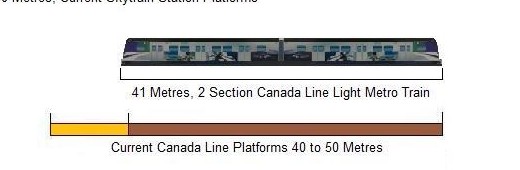
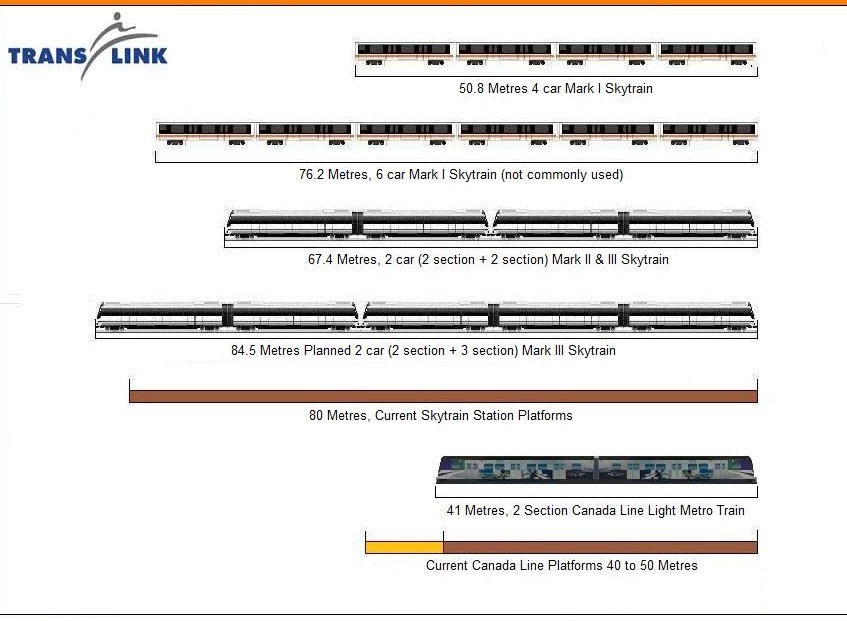
The Canada Line has station platforms only 40m long and can only accomodate 2car trains.
Why did then Premier Gordon Campbell, then Minister of Transportation Kevin Falcon; and the cabal running TransLink, insist on building the Canada Line, the only heavy rail metro in the world, built as a light metro and with less capacity than a simple streetcar line costing a fraction to build?
Sadly, the regional universities jumped on board this greatly flawed transit model, most notably Simon Fraser University, where unaffordable transit lines are built solely to promote higher densities along transit routes. This has paupered TransLink by building light metro lines costing up to ten times more than they should.
This is the crux of TransLink’s financial woes!
Has regional transit planning centered on creating a massive increase of density in the Metro Vancouver region, is nothing more than a vehicle to camouflageAi?? illegal drug money laundering in real-estate?
Even though Surrey is planning for LRT, it is being designed as a poor man’s SkyTrain, with costs to match. Surrey’s LRT is LRT in name only costing three to four times more than it should.
This begs many question about regional transit planning and the continued use of the obsolete light metro, especially Bombardier’s and SNC Lavalin’s ARTAi?? system (Expo, Millennium and Evergreen Lines).
Why do regional planners still plan for SkyTrain style light-metro, both the proprietary ALRT/ART lines and the dumbed down Canada Line heavy rail metro, when by 1986 the proprietary ALRT light metro was deemed obsolete by the TTC?
Why do regional politicians, planners and engineers continue to misinform taxpayers of both the real costs of SkyTrain (and light-metro) and that only seven such systems have been built (only three seriously used for rapid transit) since the late 1970’s?
Why are regional planners and politicians so determined to tear down affordable housing, for unaffordable high rise condos along SkyTrain lines?Why have the NDP and Liberal governments deliberately not allowed, much cheaper and more efficient LRT to be built?
Why is the Mayor’s Council on Transit demanding the now almost $4 billion Broadway subway on a route which doe not have the ridership to support a subway?
Why the deceit and deception by TransLink and the City of Vancouver about ridership along Broadway? Is TransLink deliberately creating crowded buses and pass ups in a blatant attempt to convince people that a subway is needed?
Why wereAi?? “goons” engaged to threaten and intimidate citizens from asking about light rail during the Broadway subway horse and pony shows?
How much laundered drug money is finding its way back into political parties bank accounts, in the form of donations?
It seems Metro Vancouver’s transportation planning is being driven by laundered drug money, so a question for Premier Horgan:
Why is it, when someone is elected to office, they become instant transit experts?
Why is it, when it comes to transit, common sense is tossed from the window?
It seems Liberal MLA, Jane Thornthwaite, wants a SkyTrain subway to the North Shore.
First question that she should be asking is: Would it be the Canada line or the Expo Line ALRT/ART mini-metro as they are incompatible in operation. MLA Thornthwaite must remember that it was her political party,Ai?? lead by then former Premier Gordon Campbell, abetted by then former Transportation Minister, Kevin Falcon, who oversaw the building of a non conforming mini metro Canada Line.
A 10 km. SkyTrain subway from Waterfront Station, via the First Narrows route (Stanley Park) and ending around Lonsdale would cost over $4 billion.
On a positive note, a subway to the North Shore would make lots more sense than a $2.5 billion SkyTrain extension to Langley.
Then there is the question of ridership. Is there the ridership to support a subway?
No, not even close and it is absurd in the extreme to even think about building SkyTrain to Squamish and Whistler.
SFU types have a bad habit calling themselves transit experts, but the university does not offer degrees in Urban Transport. Most academics who call themselves “transit experts” have little or no expertise in transit at all, but are very savvy with media relations.
Rail for the Valley has another, far cheaper solution., a light diesel multiple unit service (and later TramTrain, when Transport Canada approves the mode) connecting the North Shore with downtown Vancouver. Two trains an hour each way could probably offer adequate capacity for transit customers.
Such a service could be installed quite cheaply, for around $200 million, not breaking the TransLink budget.
Now we come to the big problem, our so called experts planning for transit are not experts at all, rather career bureaucrats, academics and politicians, planning for expensive gadgetbahanns like SkyTrain or the SFU gondola to further their careers.
The only transit expertise in Metro Vancouver is the art of manipulating facts to merit more and more hugely expensive and obsolete SkyTrain light metro construction.
North Vancouver MLA calls for North Shore SkyTrain
Brent Richter / North Shore NewsOctober 17, 2017 04:10 PM
A hypothetical SkyTrain map produced by MLA Jane Thornthwaite shows the North Shore with a commuter rail link across the Second Narrows and transit stops from Cates Park to Dundarave. image supplied
If youai??i??re patiently waiting for the SkyTrain to arrive on the North Shore, you could be in for a long wait.
But TransLink CEO Kevin Desmond has responded saying the transit authority is too focused on expanding the existing system to be getting serious about new megaprojects.
ai???I think the recent conversations, particularly about SkyTrain coming to the North Shore are just indicative of the thirst people have to improve the transportation infrastructure and the transit system,ai??? he said during a recent visit to North Vancouver. ai???We need to start advancing the current 10-year plan, moving forward with that with the support of the new provincial government to help make that happen. Then we have to move on and think about what the next plan is and the next plan after that,ai??? he said.
If a fixed rail bridge or tunnel to Vancouver is a high priority for residents, they should make that known in the upcoming review TransLink is doing of its 30-year regional transportation strategy, Desmond said.
But Thornthwaite isnai??i??t waiting 30 years. Sheai??i??s already drawn up a proposal including hypothetical transit map featuring a SkyTrain connection over the Second Narrows with stops across the North Shore, from Cates Park to Dundarave. And sheai??i??s started consulting with local MPs and the North Vancouver Chamber of Commerce.
ai???I desperately want to have the idea of a SkyTrain to the North Shore on the map of the mayorsai??i?? council,ai??? she said. ai???Iai??i??m talking about a bold vision here. I think we all have to start having these conversations.ai???
Thornthwaite said she was inspired to lobby for a North Shore rail link because constituents in North Vancouver-Seymour have very little coming to them in terms of transit improvements.
ai???If we want to have any hope of encouraging and incentivizing our people to get out of their cars and take transit, weai??i??ve got to start improving the system,ai??? she said. ai???I would certainly like TransLink to consider the option of SkyTrain to the North Shore within their 10-year (transportation) plan. Right now, thereai??i??s nothing in my riding from the (mayorsai??i??) 10-year plan and thereai??i??s hardly anything for the North Shore.ai???
Funding is in place currently for a new SeaBus, which will allow 10-minute service during rush hour, a 30 per cent increase in regular bus service and new B-Line buses for the North Shore.
Thornthwaite said she hasnai??i??t done any back-of-the-envelope calculations on what such a plan would cost although she conceded it would be in the billions.
ai???But the only way we can get an assessment going and the interest from the decision-makers like TransLink and the mayorsai??i?? council is to start talking about it. Thatai??i??s what Iai??i??m trying to do. Everybody Iai??i??ve talked to thinks itai??i??s a good idea.ai???
Such a rail line could even be connected to Squamish and Whistler over the longer term, Thornthwaite added.
Gordon Price, fellow with SFUai??i??s Centre for Dialogue and former head of the universityai??i??s city program, said itai??i??s refreshing to see the discussion of a fabled ai???third crossingai??? return but centred around mass transit for a change.
ai???Itai??i??s certainly doable and it could certainly be doable faster than what dreamers might think at this point. Thatai??i??s a political and financial commitment,ai??? he said.
But before North Vancouver and West Vancouver can pursue a rail link with any seriousness, they have to be able to answer some existential questions about the kind of communities they aspire to be. To justify a SkyTrain, our urban planning would have to become much more centred around transit over the long term than it currently is.
ai???If youai??i??re going to be looking at something like SkyTrain rapid transit, and you should, itai??i??s a long-term solution. Weai??i??re talking over 100 years. And it means a fundamental change in the scale, and for some parts of your community, a fundamental change in character. Youai??i??re building transit-oriented, concentrated communities with both work and play and all the rest of it,ai??? he said. ai???Because otherwise, why build rapid transit?ai???
Park Royal would have to look more like Burnabyai??i??s Brentwood neighbourhood, Price used as an example.
ai???North Van and West Vancouver would have to commit themselves to having a different kind of long-term vision for themselves, and Iai??i??m not sure that the population is yet ready for that,ai??? he said.
But, Price noted, if the hope is that a North Shore SkyTrain would be the silver bullet to solving the bridge congestion problem, there are much cheaper and faster options within reach, namely mobility pricing. The technology to track usage of the roads and transit system in real time exists in most anyoneai??i??s smartphone, meaning it would not be difficult to charge tolls based on usage. That would be the most effective incentive for getting people and cars off the road, and speeding up the daily commutes, Price said.
ai???Thatai??i??s going to be so much easier to do in the world weai??i??re moving into. Weai??i??re not quite there yet but itai??i??s happening,ai??? he said.Ai?? ai???The politics of that? Brutal. But it could be done.ai???
TransLink’s American CEO, Kevin Desmond, was always TransLink’s man. A consummate bureaucrat, he knows what buttons to push and what whistles to blow, but when it comes to transit, Desmond does what he is told to do.
TransLink has never acknowledged the fact that the public, especially the taxpayer after the 2015 plebiscite do not like nor trust the ponderous bureacracy. Blaming everyone else for TransLink’s woes, bureaucrats offered some “window dressing” changes but nothing more and one of those window dressing changes was Kevin Desmond, the new CEO.
Today, TransLink is mired in a fiscal fiasco, where it’s gross spending habits have greatly outpaced its income. Unwilling to live within its means and continuing to plan for two mega transportation projects that smack of “FastFerry Fiasco”, the over $2 billion Surrey LRT and the now estimated almost $4 billion Broadway subway, TransLink has doubled down by offering gimmicks, which were previously offered before, to take the attention away from their continued blundering.
The SFU Gondola, which the last cost estimate was $120 million in 2011, is supposes to placate the SFU types with “gimmickbahnn” transit, instead of investing about $10 thousand for chains for buses.
Sadly, unlike buses, a gondola operation does not have intermediate stops and the bus route to SFU would still continue. Contrary to what the TransLink CEO said, a SFU gondola will add to the cost of providing students; a gold plated transit solution on an economy class transit route. Economy class, you say? Yes, indeed as the vast majority of users would be those using the $1 a day U-Pass!
Then to add icing to the cake as to how unsuitable and out of touch Desmond is, he offers this little nugget:
Desmond also said there is a blueprint for extending the Arbutus Line to theAi??University of British Columbia, but said completing the mayorsai??i?? ten-year plan is TransLinkai??i??s top priority.
Desmond says if Arbutus line went to @UBC, it would double price of project. It says next set of plans should go out to the university
There are no plans to use the Arbutus Line for Rail, nor any plans to extend the line to UBC.
If LRT were to be used a 15 km Marpole to UBC Line would cost no more than $500 million, but if a subway is proposed for the Arbutus the same 15km route would cost over $4.5 billion.
Obviously Desmond is talking out of his hat and incredulous statements that are emanating from TransLink’s CEO, should signal that it is time to say adios and farewell to Kevin Desmond.
TransLinkAi??is trying to find a cleaner way to get people to Simon Fraser University according to CEO Kevin Desmond.
Desmond said the transport company is in talks with the academic institution to get an electric-powered gondola on Burnaby Mountain.
ai???The idea is if there is a gondola, it would replace the major bus route that goes from Production Way Station to the University. It would be a more reliable service, possibly as much, if not more capacity than the buses allow.ai???
He said the operating costs of the bus route would be incorporated into the costs of running the gondola.
ai???If we can figure out a way to pay for the capital; I believe SFU needs to be part of that solution as well. We think there might be some federal grants that could be available for that also, we might be able to put together a really nice project and replace basically at this point, diesel-powered buses.ai???
Desmond also said there is a blueprint for extending the Arbutus Line to theAi??University of British Columbia, but said completing the mayorsai??i?? ten-year plan is TransLinkai??i??s top priority.
Vancouver wants subways and nothing else. Vancouver wants the region to pay for those subways.
Vancouver’s pet SkyTrain subway, just to Arbutus Street, may cost upwards of $4 billion.
Vancouver’s pet SkyTrain subway will use the now obsolete ALRT/ART proprietary railway, jointly owned by Bombardier Inc. and SNC Lavalin.
Vancouver’s pet SkyTrain subway will have cars supplied by only Bombardier Inc. as no one else makes ALRT/ART compatible cars.
SNC Lavalin will automatically engineer the the almost $4 billion subway under Broadway because they own the ART Engineering patents.
Present traffic flows on Broadway are well under 5,000 pphpd or well under a third that would justify a subway for North American standards.
The operating costs for the Broadway subway have not been calculated.
The operating certificate for the ALRT/ART SkyTrain lines allows a maximum capacity of 15,000 pphpd.
The cost to upgrade the ALRT/ART SkyTrain lines could be as high as $3 billion.
The city of Vancouver lead TransLink is trying to force “Road Pricing” in Metro Vancouver, not for regional transit improvement, rather SkyTrain subway and associated upgrades.
Cost of FastFerry scandal, an estimated $450 million- cost of the future Broadway subway scandal, full build – almost $7 billion!
Cost of cancelling site C dam – estimated $7.3 billion.
Developers, city negotiated deals to set aside space for entrances at four key sites.
ByChristopher CheungToday|TheTyee.caChristopher Cheung is a reporter and page editor at the Tyee. You can find his stories here and follow him on Twitter at @bychrischeung.
The funding for the planned Broadway subway line is not confirmed, but the City of Vancouver has been steadily securing spaces under the busy corridor for transit stations, The Tyee has learned.
Space has been set aside for four potential stations ai??i?? at Great Northern Way, Cambie, Oak and Arbutus.
If there is a development,said Steve Brown, the manager of Vancouver’s rapid transit office, we can make a request to see if they are able to shape the development to allow for a void space that can connect from the street level down to the underground.ai???
These large underground rooms are not the stations themselves; they are entrances/exits, hence their official name Statutory Rights of Way.
The intention is to maximize the connectivity to future transit stations, and developers are usually more than happy to do that,said Jeff Doble, the global leader in transportation design with architecture firm Perkins+Will.
Perkins+Will designed the Crossroads project at the corner of Cambie and Broadway.
The cityai??i??s engineering department is in the mixed-use Crossroads project, along with a London Drugs, a Whole Foods and, formerly, a Lululemon lab at the street level where one entrance that descends to the void space is located. This void space is large enough to fit a staircase, an escalator and an elevator.
Doble said the developerai??i??s decision to prepare a potential transit entrance for the city is a ai???no brainer.ai???
ai???They would stand to benefit from having transit in their development and having retail in the station, which benefits the station as well,ai??? he said.
Six stations are planned for the Broadway subway; four already have void spaces. Two potential station locations, at Main and at Granville, do not have void spaces beneath them yet.
Crossroads, completed in 2008, was not the first project to have a void space.
The city negotiated in the late 1990s for the creation of a space beneath the Great Northern Way Campus Trust lands, home to the new Emily Carr University of Art and Design.
This should not be news but it is, congestion has returned to the Port Mann Bridge
With tolls, traffic and gridlock was just moved to the Patullo and Alex Fraser Bridges and the Massey Tunnel, but with the tolls eliminated, traffic pasterns are getting back to usual.
Welcome to the commuting world brought to you by your regional mayors and provincial politicians, by their grossly inept and self serving transit and transportation planning.
Don’t worry though, it will only get worse.
The cure?
Well not a cure but good medicine for regional traffic woes is the Leewood/Rail for the Valley plan to reinstate the old BC Electric interurban with modern diesel multiple units now and TramTrain in a few years hence.
With costs starting at a $750 million for a Vancouver to Chilliwack rail service, it seems a bargain compared to a now puny $4 billion SkyTrain Broadway subways, or TransLink’s dreadful offspring, the over $2 billion Surrey LRT and road project.
Both transit projects won’t take a car off the road, but the Rail for the Valley plan will.
Real transportation solutions work and work very well, but not so nice to cut ribbons in front of at election time.
An extra 30,000 vehicles use the Port Mann daily since tolls were eliminated
SURREY (NEWS 1130) ai??i?? The Port Mann Bridge has seen its fair share of delays since tolls were lifted on September 1st, and itai??i??s not just the extra traffic volume.
The crossing is handling an extra 30-thousand trips per day, leading to more significant accidents and frustrations for drivers.
Commuters like Charity Long ai??i?? who drives between Maple Ridge and Vancouver ai??i?? have seen the difference.
ai???My commute into work is an extra 25 minutes a day and my commute home has been at least an extra half hour,ai??? she tells NEWS 1130, blaming more traffic and more accidents since the tolls were eliminated on the Port Mann and Golden Ears bridges.
Long almost wishes the province would start charging drivers for crossing them again.
ai???Absolutely, itai??i??s terrible,ai??? she laughs. ai???Itai??i??s selfish but I want those tolls back on.ai???
Jen Coles in the NEWS 1130 Traffic Centre reports on the Port Mann Bridge during the busy weekday commute and says the delays have noticeably increased along Highway One over the past six weeks.
ai???There are definitely more collisions, more problems and more volume. Every day we are seeing an issue in that stretch between the Port Mann and the Iron Workers Memorial Crossing,ai??? she says.
ai???Now that we are into the fall we can see it is an increase in volume and, in turn, an increase in problems. People are not paying attention, theyai??i??re driving too fast and not leaving enough time and room, causing problems.ai???
Coles says callers to *1130 have been frustrated.
ai???We went from a bridge that was not seeing a lot of volume, with a quick commute through the Burnaby Lake stretch. When there was a problem it didnai??i??t cause much of a back up ai??i?? we hadnai??i??t seen a back up into Surrey since the tolls were put in,ai??? she explains.
ai???When you remove the tolls you get more volume and more collisions and now people are late for work and theyai??i??re trying to race, which is only adding to the problems on the highway.ai???
Those additional problems are not surprising to transportation expert Gordon Price at Simon Fraser University.
ai???This is physics. Whether itai??i??s atoms or automobiles, if you increase the number of units going the same speed in the same space, I think a physicist can probably work out exactly what youai??i??re likely to see in the way of more collisions,ai??? he says.
Price suggests the return to longer delays on the Port Mann Bridge likely wonai??i??t change if the region moves ahead with some form of road-pricing as a replacement for individual bridge tolls.
ai???It really isnai??i??t reasonable or fair to think that tolling should only be on bridges, and certainly not for only parts of the region,ai??? he adds.
ai???But how you do it fairly across a whole region in a way that all transit users and drivers feel is fair ai??i?? thatai??i??s the political challenge.ai???
Price expects Metro Vancouver and the province to move forward with some form of mobility pricing ai??i?? paying for distance travelled ai??i?? as a replacement for bridge tolls.
ai???One way or the other, new technologies are going to allow us to properly price the use of the road or any form of transportation in a way that better reflects what the real value is,ai??? Price says.
ai???Making the right choices is what the mobility pricing commission is looking at and ultimately what our political leaders are going to have to decide on.ai???
It is not an either/or situation. As built, the Canada line has small stations with 40 metre long station platforms, while the ALRT/ART Expo and Millennium/Evergreen lines have 80 metre long station platforms.
The Transport Canada operating certificate for the ALRT/ART lines allows capacity no more than 15,000 pphpd.
It is reasonable to suspect that the Canada line has about one half the legal capacity of the Expo and Millennium/Evergreen Lines.
The Canada line costs TransLink about $110 million to operate, while the operating costs for comparable light rail lines is around $25 million annually.
The reason why the Canada Line has 40 metre long station platforms is that former premier Gordon Campbell and Transportation Minister insisted the Canada line be a light metro, with subway construction in Vancouver. As the costs started inching towards $3 billion, the scope of the project was reduced by allowing cheaper cut-and cover construction; half size stations; single track stub terminus at YVR and Richmond and more.
The cost to enlarge the Canada line to increase capacity is now put at $1.5 billion, meaning the real cost of the Canada line will be almost $4 billion, which also happens now to be the projected cost of the proposed Broadway SkyTrain subway.
The real story is of course is that the Canada Line is a classic “White Elephant”, under built, under capacity, and extremely expensive to operate, needing a least $1.5 billion in additional investment just to match the the capacity of the rest of the light-metro system.
This begs the question: “Why are we building more expensive light metro in the region!
By Sean Boynton Online News Producer Ai??Global News
As Metro Vancouverai??i??s population grows, its transit authority is facing more SkyTrain struggles.
TransLinkai??i??s CEO is admitting they were short-sighted when building the Canada LineAi??ai??i?? and now faces a tough choice about how to combat the problem.
The service has taken a step towards addressing demand by ordering at least 22 new train cars specifically for the Canada Line, which are set to be in place by next year at the earliest.
But the stations along the line, which connects downtown Vancouver to Richmond and the airport, were only built to handle two-car trains, meaning TransLink has two expensive options: dig out and expand the platforms, or add more frequent service.
TransLink CEO Kevin Desmond says that in the short term, adding more cars is just about all they can do.
ai???Itai??i??s a little bit of a challenge, ultimately, how much throughput we can get on the Canada Line,ai??? Desmond said at a recent Surrey Board of Trade luncheon.
ai???At least in the near term, in the next 10, 15 years, we think just adding carsai??? will curb demand to an extent, he added.
But the problem is expected to only get worse in the years ahead, as massive condo development along the Cambie Street corridorAi??ai??i?? which the Canada Line runs underneathAi??ai??i?? will soon lead to a spike in ridership, due to people moving to the area partly for easy access to transit.
Vancouver mayor Gregor Robertson said poor planning and limited foresight are largely to blame for what TransLink is facing now.
ai???My sense of the Canada Line was that it was kind of scrimping and saving and not thinking long-term,ai??? he said.
ai???There were a number of decisions at the time made like that. The planning in the corridor wasnai??i??t done in advance. Weai??i??re doing that [kind of planning] differently now.ai???
Dresmond is promising TransLink will avoid making the same mistake when construction begins on the upcoming Broadway extension of the Millennium Line, which could begin as early as 2019.
Robertson said the city needs to do a better job of planning for the long-term future when undertaking massive projects.
ai???When we do these larger projectsai??i?? we have to think 100 years out,ai??? the mayor said.Ai??ai???We have to think big picture.
ai???We have a million people coming [to Metro Vancouver] in the next 20, 25 years. We have to be thinking longer-term and building infrastructure that makes sense for the future.ai???
Most people championing expensive transit, fail to see three minutes into the future.
The failure of a switch motor on the Expo Line last week caused transit chaos. Switch motors fail and on automatic railways, the regimen is to replace motors on a preventative basis before they fail in revenue service to maintain the integrity of the transit system. ART SkyTrain has expensive maintenance costs and to curb costs, essential maintenance takes precedent over preventive maintenance.
No skin off TransLink’s nose if the transit system fails, as the expensive spin doctors will smooth troubled waters, with one invention after another and with an extremely gullible mainstream media, the spin becomes fact. Metro Vancouver media do not fact check news releases from TransLink.
In other cities, the media tend to be better informed and understand transit issues, sadly Metro Vancouver lack an informed media.
In other jurisdictions, penalties are assessed against senior management if the transit system fails, in the form of reduced bonuses, wage penalties and in extreme cases firings.
Not so with TransLink, where planning continues for a $3 billion plus SkyTrain Broadway subway, with absolutely no thought for the expensive maintenance regimen needed to operate it at peak efficiency.
Unlike non automatic railways, driverless trains need much expensive preventative maintenance to guarantee operation.
Transit is a vital Toronto service with an insatiable hunger for money. TTCai??i??s budget committee met yesterday to consider a first cut at their next 10-year capital plan and how this might fit with the City of Torontoai??i??s limited funding.
To hear TTC management, all is well, at least in the short term. Spending plans for 2018 match available funding and, most importantly, the City-imposed limit on borrowing for transit projects.
But over 10 years, available fundingai??i??monies that various governments have committed to provideai??i??are about $2.8 billion short of the $9.24-billion plan. This gap between what the City will pay and what the TTC needs has been growing for years. It is only minimally offset by accounting prestidigitation that assumes the TTC will not actually spend all the money they are asking for. That shaves $420 million off of the total, but much remains.
How Deep is the Hole?
The first big problem with the TTCai??i??s budget is that it understates the long-term shortfall by omitting many projects from the formal ai???base budget.ai??? There are four different types of ai???unfundedai??? transit projects:
Base budget items for which there is no funding because the City and its ai???funding partnersai??? cannot or will not ante up the money: $2.273 billion (e.g., automatic train control for Line 2 (BD), new subway cars for Line 2, new subway cars for ridership growth on Lines 1 (YUS) and 2, purchase of new buses starting in 2021, purchase of additional new streetcars for ridership growth and system expansion)
Deferred new budget requests for items that are ai???should haves,ai??? but not yet important enough to formally be in the base: $1.05 billion (e.g., purchase of more than 500 new buses separate from those above, new bus technologies, future Wheel-Trans buses,Ai??Warden Station redevelopment)
Scope changes on existing projects: $128 million (e.g.,Ai??fire ventilation upgrades, escalator replacements)
Projects for future consideration: $2.216 billion (e.g.,Ai??Bloor-Yonge Station capacity improvements, platform edge doors on Line 1, new subway maintenance facility at Davisville, station modernization, new transit control centre,Ai??Islington Station improvements)
Groups 2 to 4 all contain a variety of facility upgrade projects to deal with aging infrastructure. Many of these have a relatively low cost, but collectively they are worth hundreds of millions.Ai??These areAi??only a sampleAi??showing the largest or more important projects.
These lists are growing because City Council has instructed the TTC that new projects cannot be added to the ai???base budgetai??? without Council approval. This does not make the projects disappear. It only hides their cost by leaving them out of the official version of the capital plan. The only exceptions are projects that are deemed critical, or that do not start until the 10th year of the plan, far enough in the future that they have little effect on spending projections.
One important change at the City is the imposition of a ai???stage gateai??? process where a project cannot even reach commitment to proceed until its design is sufficiently advanced to keep the risk of cost overruns low. This is a big change for those who prefer to sketch plans on napkins and worry about the cost later, but it also affects management who low-ball cost estimates simply to get political approval. A more rigourous process has its effects on both groups.
Noble as this change may be, it is a recent addition to the process, and few projects have actually gone through it. The benefits will take a few years to materialize, and it is unlikely that pet projects will completely disappear from TTC plans even with dubious cost estimates.
Which Projects Go First?
The second problem is that every project is presented as if it had equal importance in the overall scheme. The TTC Board previously asked that staff propose a prioritization scheme for projects, but this has yet to appear. A big issue is the meaning of ai???priorityai???ai??i??is a priority project one where ai???if we donai??i??t do this, something will break,ai??? or one where ai???if we donai??i??t do this, I wonai??i??t be re-electedai???? Even ai???breakai??? can mean anything from annoying unreliability to complete collapse.
Not only is a priority list missing, major project clusters (such as the planned renewal of the Bloor-Danforth subway) are scattered across multiple budget lines with no indication that they are related.
Budgets can be deadly dull reading, and the documents can be daunting to a novice, including most members of the TTC board and Council. During the meeting it was obvious that members, and not a few management, were struggling with the details of this core TTC planning document. The budget committee itself cancels more meetings than it holds, and tends to review the budget in the heat of the moment when the whole document must be approved. Little surprise that few understand how it works.
This is not just an exercise in good management theory, but an important part of planning for the Cityai??i??s transit future. Without digging, it is almost impossible to learn how the budget relates to various initiatives councillors might like to see. Is there actually a provision for some change, or has a request simply been relegated to the ai???somedayai??? pile? Are all components of a change present, or are there ai???oops,ai??? missing pieces lurking in the budget that will delay policy changes?
A good example lies in service quality and improvement. Within the 10-year plan, there is provision for only 99 new buses, to be acquired over the coming five years, dedicated for service improvements. Hundreds more may be purchased, but these will simply replace what is on the street today. Pressed to explain what these would be used for, management explained that they would mainly be spare service buses, ai???run as directedai??? as the TTC calls them, to fill in where necessary.
Planning and Budgeting
The TTC board will receive three important reports in coming months that could have significant effects on the capital budget:
Ridership Growth Strategy: a plan for building ridership with a more attractive transit system. This will require more vehicles, but the lead time to provision buses (not to mention build a garage to house them) can be several years. All the will to improve service can founder through a lack of capital resources.
Bus Fleet Plan: related to the RGS or even to a ai???do nothingai??? approach to service. The TTC needs an updated view of its bus and streetcar needs, based on anticipated changes in demand, changing vehicle technologies and the shift of riders between modes as new LRT and subway services replace bus routes.
Renewal Plan for the Bloor-Danforth Subway (Line 2): Separately from the Scarborough extension, the BD line is 50 years old and in need of major overhaul for track, signals, fleet and maintenance shops.
As jobs and population return not just in the core area, but to other parts of the ai???oldai??? city like Liberty Village, there is a growing demand for travel. What are the options for moving more people by transit in areas where streets are clogged with motorists? There is little provision for this in the capital budget.
Other non-TTC projects (such as SmartTrack) compete for funding and these can elbow aside the more mundane, but badly needed, work on the existing transit system.
A structural problem with the TTC budget comes from the age of the subway system. For decades, many components have used up their design lives and some parts of the systemai??i??track, trains, escalatorsai??i??have been replaced once or more. Now with large segments of the subway over 40 years old, the bill is coming due on replacing major subsystems and structures. This effect is only dimly appreciated by members of the TTC board because only the highest priority subsystemai??i??signallingai??i??has attracted their attention through its cost and ongoing service interruptions.
As written, the 10-year plan gives no indication of the magnitude and timing of effects from these issues and policy decisions that they could trigger.
Paying for Transit
Money for transit projects comes from many sources including direct charges against taxes at all three government levels, from project-specific subsidies and from other levies such as development charges.
In recent years, City finance staff have become more creative in their approach to financing capital needs, and this includes measures that could have unexpected consequences. One example is a scheme, advanced in the budget presentation, that the savings from ai???efficienciesai??? could be used to finance debt for capital projects.
Suppose a new bus fleet is alleged to be more energy efficient and require less maintenance. These savings could help pay for the buses, even to the point of subsidizing a premium price.
However, the savings must actually materialize and be sustained over the life of the debt. If they are not, then there is an unfunded cost. If the energy or maintenance savings donai??i??t pan out, what pays down the debt? Problems with new bus technologies that failed to deliver on expectations (Compressed Natural Gas and Hybrids) are perfect examples.
Recently, purveyors of electric buses have suggested that their extra cost could be financed through savings compared to diesel buses. If that approach is taken, the savings could be completely eaten up to offset the extra vehicle cost.
More importantly, savings like these would normally offset rising operating costs. A new bus might use less fuel, or run forever without a tune-up. However, those savings will not translate to more service or lower fares because they will be scooped to pay down the debt. This is a subtle way to transfer capital costs to the operating budget and poach money that should be providing service or limiting fare increases.
One large potential funding source is the second phase of the federal Public Transit Infrastructure Fund, but this is not yet a done deal. Details of the next phase of PTIF remain uncertain, and the current phase extends only to March 2019.
For the City, there is a tricky balancing act. If PTIF money goes to a project that is now City-funded, then the City can recoup part of its contribution for use on other projects. However, if an unfunded project such as new trains for the BD line moves into the funded part of the plan, this requires net new City spending unless there are offsets elsewhere.
The TTCai??i??s plan gives no indication of which projects might be on their ai???wish listai??? for PTIF grants or how the timing of this funding would affect the staging of projects in the pipeline.
The capital budget and plan passed by TTCai??i??s budget committee is, at best, an outline of what capital spending could look like over the next decade, but it raises difficult questions about the number and scale of unfunded projects. This must be explored and explained in better detail to the full TTC board and to Council as it works through the 2018 budget.
Much vital work does not lend itself to photo ops nor to election campaign slogans, but Toronto ignores the growing backlog of transit repairs and renewal at its peril.
As TransLink wheezes along, planning two very expensive rapid transit projects, the Broadway SkyTrain subway under Broadway and the Surrey LRT, both projects are being built to suit a political timetable and not to provide good public transit. Both projects are being planned to be built to both subsidize developers and land speculators in their efforts in building massive multi story condominiums and to appease car users, by not taking away road space and or building new roads.
The question must be asked; “Why spend over $6.2 billion (that’s right, read on!) on two transit projects that will not reduce road congestion and may force more transit users into cars!
Subways, by there very nature are expensive to build, maintain and operate. So expensive that they are only built on transit routes with large traffic flows which demand both long trains and long station platforms to accommodate them.
*
Despite claims of high ridership on Broadway, it doesn’t equate to the present traffic flows that are present today. B-Line bus service, only has a mere 20 articulated buses per hour in the peak giving a capacity of under 2,500 pphpd; with the trolley bus service added, traffic flows on Broadway are less than 4,000 pphpd.
*
The minimum traffic flow recommended for a subway is 15,000 pphpd, which means the subway will be heavily subsidized, with money cannibalized from the rest of the transit system.
Subways also do not attract ridership and by their nature being user unfriendly, do not reduce congestion, in fact subways may increase congestion!
*
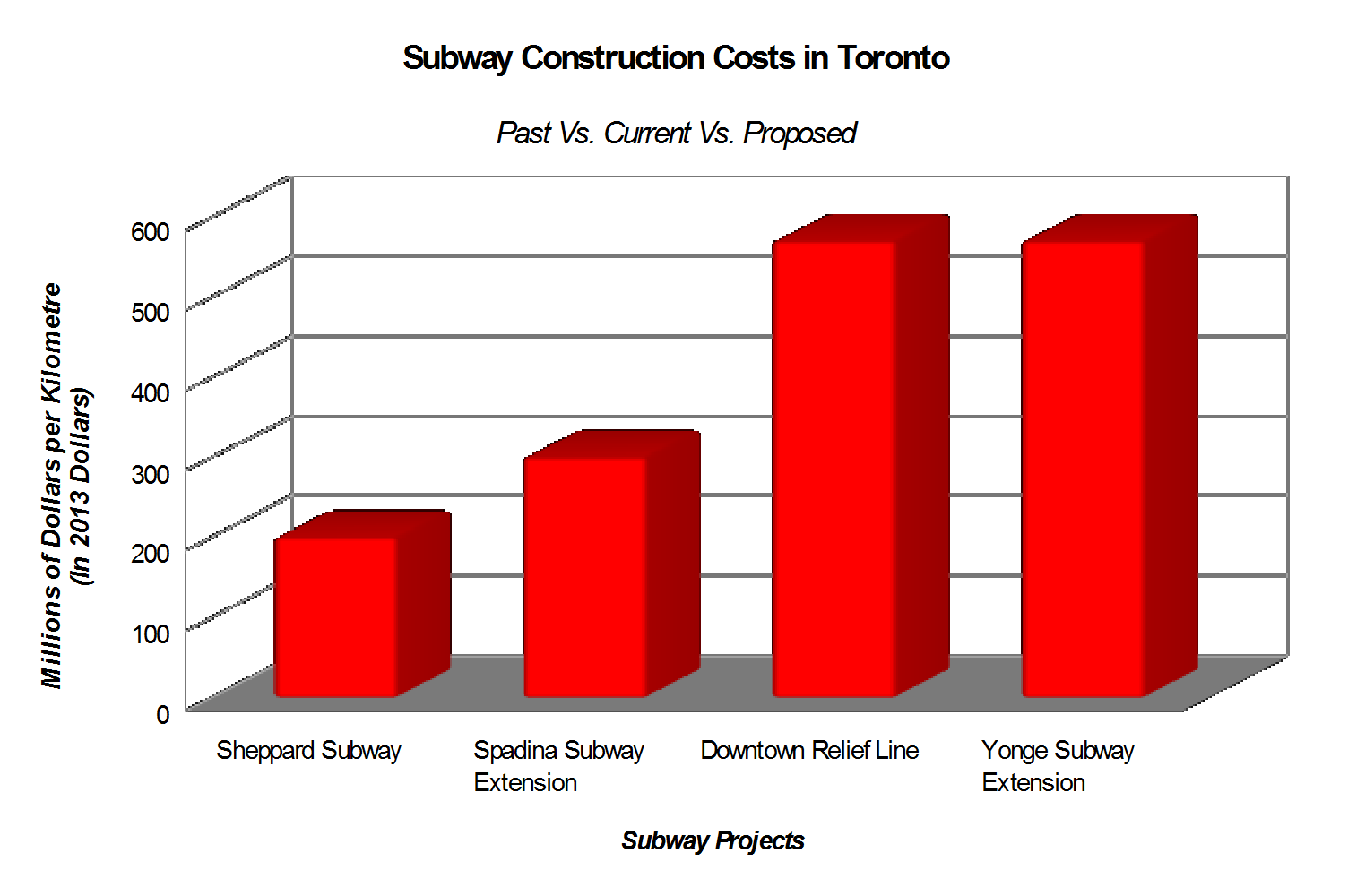
The cost of the proposed Broadway subway has now passed $3 billion (based on Toronto’s recent subway construction costs) and may approach $4 billion.
*
For $4 billion, we could build the Vancouver/Richmond to Chilliwack TramTrain; a road/rail bridge replacing the Patullo Bridge; and a Surrey Centre to Whiterock LRT, which would attract new ridership and help ease congestion.
*
The Regional Connector Transit Project is a long time missing link in LA’s LRT network. It will join the Blue, Gold and Expo LRT Lines together,Ai??all running throughAi??to LA’s Union Station,Ai??as well asAi??giving a direct connectionAi??to the Red/Purple Subway LineAi??and theAi??area’s Commuter Rail Network called Metrolink.
*
The cost of this 1.9 mile (3.04 KM) LRTAi??tunnel I imagine, is what has always kept it from being built. The total cost of this project is $1.756Ai??Billion (US).Ai??The tunnelAi??will haveAi??2 new obviously underground intermediate stations and has a direct connection to existingAi??underground 7th ST/Metro Center LRT stationAi??on the Blue Line and a relocated underground, Little Tokyo/ArtsAi??District Station on the Gold Line. The existing Little Tokyo/ArtsAi??District Station isAi??a surface LRT station.Ai??The project is being paid for by the 1 cent area sales tax and matching funding from the State of California and the FTA (Federal transit Administration) of the federal US government. This tunnel will see 88,000 riders a day passing through it 20,000 will be new to transit. The tunnel is already under construction and is set to open in early 2021.
*
The subway will prove to be very expensive to operate and maintain and in my humble opinion, not worth the money for 20,000 new transit riders, if they materialize at all, but in the United States, grossly overbuilt transit lines are the flavour of the past two decades.
*
That’s $924.2 Million/Mile (USD) or $577.6 Million/KM (US) or $780.5 Million/KM (CAN). Ottawa’s LRT Tunnel isAi??cheap in comparisonAi??at $286 Million/KM (CAN).
*
I have a link to LA’s Rapid Transit Map andAi??a link to theAi??Project’s Information Sheet.
The Surrey LRT is just being planned as a not so cheap “poor man’s” SkyTrain, taking all the ills that comes with the light-metro but forgetting all the positives of modern LRT. As a long time supporter of LRT, I am appalled at what TransLink has done with Surrey’s LRT!
*
A reminder that the Canada line was built on the cheap by the former Liberal government, due to spiraling subway construction costs. The Canada line has puny 40m long station platforms and can only operate 41 metre long trains, thus as built, the Canada Line has slightly more than one half the Capacity of the Expo and Millennium/Evergreen lines, which stations have 80m long platforms or longer. The cost today to increase the Capacity of the Canada line to match that of the E&M/E Lines is now about $1.5 billion!
The aging SkyTrain system is having many troubles today.
One of the big problems with expensive light-metro lines is the lack of redundancy in the system.
With the huge costs to build just one line, only one line is built, unlike mature light rail systems, where multiple lines offers redundancy in the system if problems develop with one line.
As most North American light rail lines are built like hugely expensive light-metro lines, the lack of redundancy also becomes an issue.
What is interesting, is that the GVRD in the 1970’s had planned for three east/west lines and two North South lines coming and going out of Vancouver, by the 21st century.
Such planning offered operational redundancy for the LRT network, thus further making the light rail lines user-friendly and of course, user friendliness is the top reason for attracting ridership to transit, especially the motorist from the car.
SkyTrain track issue causing delays for afternoon commuters
Commuters are seen waiting to take a bus after a SkyTrain track issue caused delays on Sep. 27.
Commuters planning on taking the SkyTrain out of downtown after work are being warned of some potential delays.
TransLink says thereai??i??s a switch problem affecting the Main Street station so no trains are running between Stadium and Commercial stations.
Stadium-Chinatown Station has been closed due to overcrowding as well as the HBC entrance to Granville Station.
Canada Line is also experiencing delays due to a train that had to be removed from the tracks at Marine Drive Station.
Spokesperson Chris Bryan said the delays are minor but as could disrupt the rush hour commute.
ai???I think about 15-20 minutes is pretty safe but if crowds get in as the afternoon rush continues, itai??i??s going to get pretty crowded.ai???
TransLink has put shuttle trains in place at both Stadium and Commercial Drive.
Commuter Melissa Jackson said sheai??i??s been waiting for more than an hour and has not moved so far, ai???Thereai??i??s no ETA so it might be an hour, it might be four.ai???
She said thereai??i??s a lot of miscommunication and things are getting tense.
ai???Shoulder to shoulder traffic. Thereai??i??s been a couple of outbursts and outbreaks, arguments, there are a couple of transit people but most of them have vacated because itai??i??s sort of turning into a semi-disgruntled mob mentality.ai???
So far thereai??i??s no timeline for when the issue will be fixed.
More to comeai??i??
Ai??Ai??2017Ai??Global News, a division of Corus Entertainment Inc.
As reported earlier, it has been announced that Siemens and Alstom will merge their rail units.
Time will tell how this will effect Bombardier Inc., but one thing is for certain, the merger will streamline their product line and with no sales in the past decade and a greatly diminishing demand for niche light-metros, how soon until ART or what we call SkyTrain will go the way of the Edsel?
Siemens and Alstom signed a Memorandum of Understanding to combine Siemensai??i?? mobility business, including its rail traction drives business, with Alstom. The transaction brings together two players of the railway market with unique customer value and operational potential.
Siemens will receive newly issued shares in the combined company representing 50% of Alstomai??i??s share capital on a fully diluted basis.
ai???This Franco-German merger of equals sends a strong signal in many ways. We put the European idea to work and together with our friends at Alstom, we are creating a new European champion in the rail industry for the long term. This will give our customers around the world a more innovative and more competitive portfolio,ai??? said Joe Kaeser, president/CEO of Siemens AG. ai???The global marketplace has changed significantly over the last few years. A dominant player in Asia has changed global market dynamics and digitalization will impact the future of mobility. Together, we can offer more choices and will be driving this transformation for our customers, employees, and shareholders in a responsible and sustainable way.ai???
ai???Today is a key moment in Alstomai??i??s history, confirming its position as the platform for the rail sector consolidation. Mobility is at the heart of todayai??i??s world challenges. Future modes of transportation are bound to be clean and competitive,ai??? said Henri Poupart-Lafarge, chairman/CEO of Alstom SA. ai???Thanks to its global reach across all continents, its scale, its technological know-how, and its unique positioning on digital transportation, the combination of Alstom and Siemens Mobility will bring to its customers, and ultimately to all citizens, smarter and more efficient systems to meet mobility challenges of cities and countries. By combining Siemens Mobilityai??i??s experienced teams, complementary geographies, and innovative expertise with ours, the new entity will create value for customers, employees, and shareholders.ai???
Closing is expected at the end of calendar year 2018.
The new entity will benefit from an order backlog of approximately $72.1 billion, revenue of approximately $17.6 billion, an adjusted EBIT of approximately $1.4 billion, and an adjusted EBIT-margin of 8%, based on information extracted from the last annual financial statements of Alstom and Siemens.



 A hypothetical SkyTrain map produced by MLA Jane Thornthwaite shows the North Shore with a commuter rail link across the Second Narrows and transit stops from Cates Park to Dundarave. image supplied

By Kyle Benning Reporter Ai??CKNW


By Sean Boynton Online News Producer Ai??Global News


Siemens and Alstom signed a Memorandum of Understanding to combine Siemensai??i?? mobility business, including its rail traction drives business, with Alstom. The transaction brings together two players of the railway market with unique customer value and operational potential.





Recent Comments