A candid conversation with a former TransLink planner all most a year ago (I gather from an email he is happily motoring along in his motor home in New Mexico), may shed some light on TransLink’s current planning and fiscal ills. The problem seems to be TransLink’s planners and bureaucrats are afraid of success.
Why?
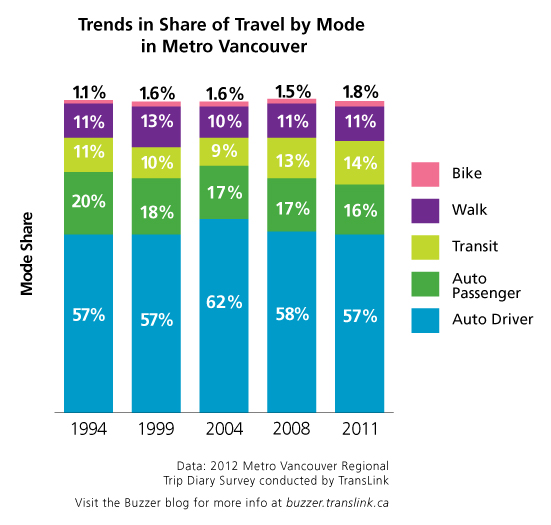
The fear is that LRT, if built (and especially the Valley TramTrain) would attract more new customers (people new to transit) than their current multi billion dollar transit projects. Despite the hype and hoopla from TransLink, ridership increases roughly matches population growth.
This is why Surrey’s planned for LRT is designed to be an expensive failure and why TransLink shuns TramTrain.
As the retired planner told me; “There is great fear by senior TransLink staff that a Vancouver to Chilliwack TramTrain would attract more non U-Pass new customers to transit than their new transit lines.”
The important phrase is non U-Pass holding customers because every new U-Pass customer is a post secondary students forced to purchase U-Pass plus nowAi?? massive black market in the Metro Vancouver region selling unused U-Passes, more and more people are riding on cheap, but probably not take transit if it were not for the deep discounted U-Pass. With over 130,000 U-Passes issued for 2015/16, permitting multiple boardings a day has greatly skewed TransLink ridership numbers and revenue.
So great was this fear in the past, that senior bureaucrats “sent to Coventry” then TransLink CEO Tom Prendergast because he was warming up to the idea of a Valley TramTrain service.
This, in part, caused him to leave TransLink.
This bodes ill for future transit planning in the region and gives credence for the call to dismantle TransLink and start anew.
Here is the link to an article in the Raise The Hammer (“The Hammer” is Hamilton, Ontario) website about their tour of the ION LRT Construction Site.
The pictures are telling. The development has already started and the line isn’t even finished yet. The start date is Fall 2017, I don’t have a more precise date yet.Ai??TheAi??work on the ION LRT started in spring of 2014! 19.4 km of LRT and 17.6 km of lite BRT (which opened in April of 2015) built in less time than your Evergreen Line for only $818 Million.
From the “You just got to be kidding department”. Evidently too much of the wrong kind of sun can delay trains!
This reminds me of the monotone recording at Victoria Station, in London in 1980; “The 4:15 Victoria to Bournemouth will be delayed by permanently persistent points problems in Purley.”
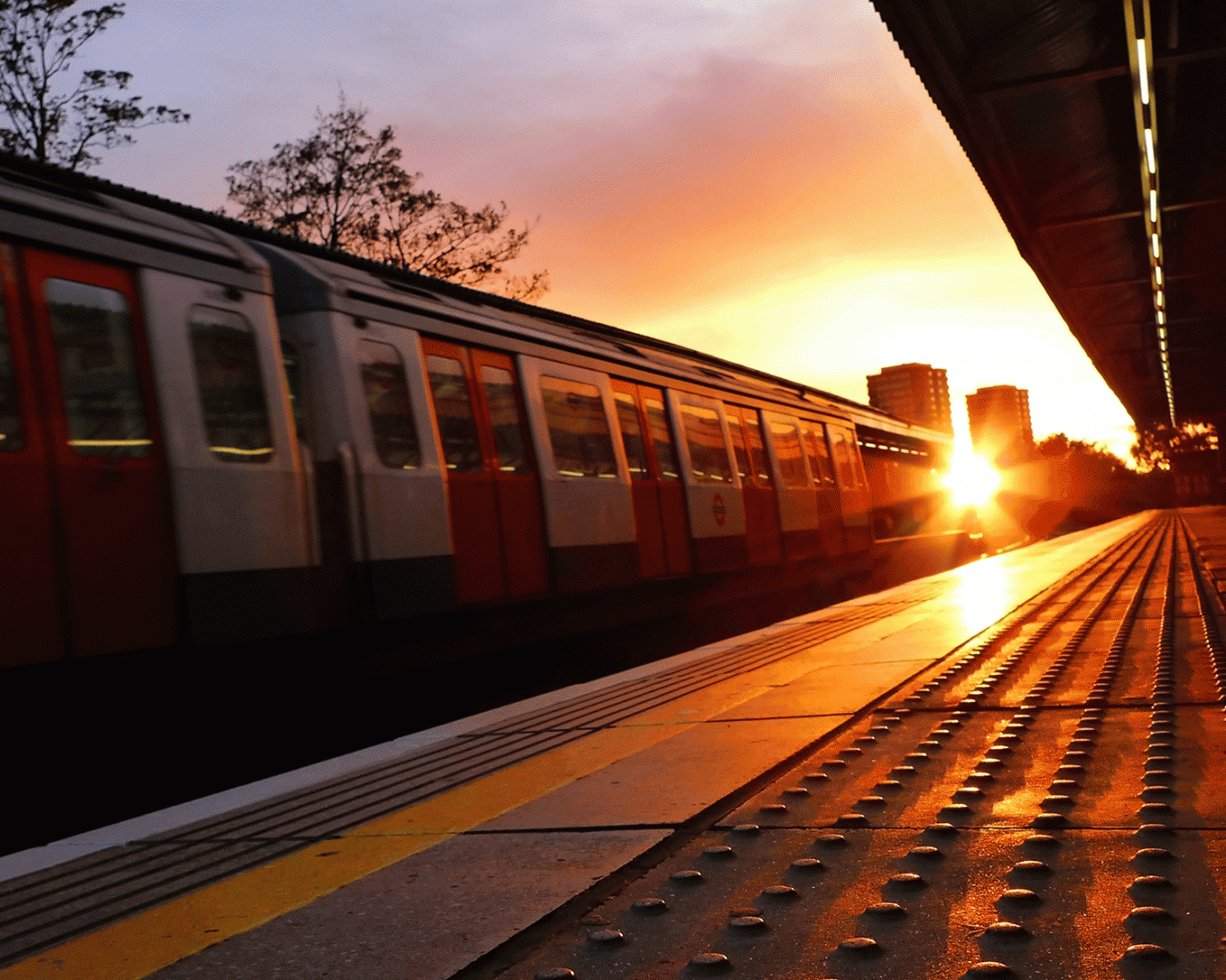
London Underground has said “excess sunlight” is causing delays for the Tube network.
Bright sunshine beamingAi??ontoAi??CCTV monitors, which are used to give a clear view of the platform before pulling away, isAi??blocking drivers’ line of sight, according to staff.
Passengers at South Harrow station were surprised to hearAi??”the wrong type of sun” was causing their slow journey last Friday -Ai??an announcement which London Underground said was “not ideal”.
The issue of bright sunshine, although rare, is reportedly a problemAi??whenAi??the sun rises in the morning in early spring or winter.
“There’s lots of things we can control but unfortunately the sun isn’t one of them,” a spokesperson for London Underground said.
“The ‘wrong sort of sunlight’ isn’t how we’d usually say it as we want to keep passengers calm and reassure them.
“But basically it’s when the sun is in certain parts of the sky at certain stations, and it shines onto the CCTV monitoring screen in their cab so they can’t see the screen and who’s on the platform.”
Charlie Smith of the Georgia Straight is the one reporter who has studied the transit issue and knows the issues.
Despite the hype and hoopla, especially from provincial politicians (both Liberal, Socred & NDP) the SkyTrain Lobby, the many issues surrounding SkyTrain have been glossed over by the mainstream media. This is still evident today with the many “puff” stories appearing in the Vancouver Sun.
As SkyTrain, as well as most light-metros are user unfriendly and force customers to make unwanted transfers, taking the car is preferable.
Unable to serve ‘local’ areas with affordable transit, ICTS/ALRT/ART has morphed into a regional railway in Metro Vancouver, with TransLink’s planning, a role it is totally unsuited for. To expensive to build to lightly populated areas, means the density myth comes into play. The density myth is simply one needs to greatly increase density along a transit route to make it viable, yet modern LRT puts a lie to the density myth and the many myths surrounding SkyTrain.
Instead of reporting mainly invented events thirty years ago, the mainstream media should do well to deal with the many ills that surround public transit today.
If Charlie Smith can do it, so can the likes of Kelly Sinoski and the other scribes who work for the Sun and province.
Ai??The Expo Line, including its rolling stock, cost $1.23 billion, leaving the region saddled with debt for decades. Stephen Hui
Today, social media is full of fond memories of Expo 86, which opened on this day 30 years ago.
There’s no doubt that Vancouver’s only World’s Fair was a great success, drawing huge crowds to the north shore of False Creek from May to mid-October in 1986.
The theme was transportation and communication. This influenced the provincial government to launch the first SkyTrain passenger service four months before Expo 86 began.
SkyTrain was popular with riders, but it was also phenomenally expensive. And it gobbled up precious funds that could have gone into more efficient methods for moving people.
It might surprise today’s taxpayers to learn that the Bill Bennett government bought the system without going to tender.
The seller was an Ontario crown corporation,Ai??Urban Transportation Development Corporation.Ai??The display of this driverless system at the World’s Fair was designed to spur sales of this Canadian technology around the world.
That helped bring the federal government onboard to support the fair.
In the end, those sales of SkyTrain systems never really materializedai??i??at least not with the original Mark I cars. This left the Lower Mainland with a colossally expensive rapid-transit project covering a relatively small footprint.
Better transit service couldn’t be delivered to other areas for years to comeai??i??not by bus nor by street-level light railai??i??because there wasn’t enough money.
A Crown corporation secretariat 1992-93 annual report showed that over the previous nine-year period, B.C. Transit’s bus service hours only increased by 3.5 percent. (B.C. Transit was the precursor to TransLink in the Lower Mainland.)
In 1991, the Toronto Transit Commission was generating 69 percent of its operating expenses through the farebox, compared to just 49 percent for B.C. Transit. With a smaller portion of revenue coming through the farebox, it meant larger subsidies just to maintain status quo transit service.
It’s worth noting that the TTC rejected buying SkyTrain. That’s because it didn’t carry anywhere near enough passengers to justify the price.
The cost of the Expo Line from Waterfront Station to King George Station was $1.23 billion, including rolling stock, but not including debt-servicing costs.Ai??More than a decade after the line opened, the debt still stood at $1 billion, according to B.C. Transit figures supplied to the Straight at the time.
The annual debt-service costs for 1997-98 were $143.3 million for SkyTrain-related expenditures. It was Vancouver’s version of the Montreal Olympics.
Metro Vancouver became the guinea pig
The first UTDC line using the Mark I cars opened in Scarborough in March 1985. The following year, passenger service began in Greater Vancouver on what became known as SkyTrain.Ai??The Lower Mainland was the high-profile guinea pig.
Not long after, the Montreal-based engineering giant Lavalin bought UTDC, but Lavalin’s debt burden became so large that it went bankrupt.
Ownership reverted back to the Ontario government, which sold UTDC to Montreal-based transportation giant Bombardier. After Bombardier developed larger Mark II cars, it sold SkyTrain-style systems to JFK Airport, Kuala Lumpur, Beijing, and Seoul.
But that was a small amount of business compared to the number of other rapid-transit systems sold around the world by Bombardier, Germany’s Siemens, and France’s Alstom.
Had Bill Bennett’s Social Credit government opted for holding a tender before purchasing a rapid-transit system, the eventual winning bid might have been significantly less expensive and carried more passengers.
This could have enabled rapid-transit to be extended sooner to other parts of the Lower Mainland. And that would have reduced gridlock and enhanced overall livability. Consider it a missed opportunity.
Instead, the region was stuck with a brutally costly driverless intermediate-capacity system in which new cars had to be bought from a single vendor, pushing up the price. And subsequent extensions, such as the Millennium Line and the Evergreen Line, had to be compatible with the original purchase.
That’s the real legacy of Expo 86.
Of course, SkyTrain was never about moving people. The real purpose was to spur real-estate developmentai??i??and in this regard, it has succeeded magnificently.
New Transit projects in the UK go through a rather onerous process before approval and the Leeds trolleybus projects did not stand up to scrutiny.
It would be fair to say that not one of the SkyTrain or mini-metro projects could have stood up against a truly independent review, which is too bad because by not having a rigorous process to review hugely expensive transit projects means, that $10 billion in public expenditure on the mini-metro system may have been wasted on a series of never ending “vanity projects”.
Back to Leeds, this must be a blow to trolleybus fans everywhere, but certainly in Leeds, the trolleybus just did not provide the benefits as promised by its promoters and now it is back to the drawing board.
From the BBC.
Leeds’ A?250m trolley bus scheme rejected
12 May 2016
Plans to build a A?250m trolley bus network in Leeds have been rejected by the government.
The Department for Transport (DfT) accepted a report from a planning inspector who said the scheme was “not in the public interest”.
Councillor Judith Blake said the city had been “let down” by the decision.
The DfT said its A?173m contribution towards the project would be used on other public transport schemes in the city.
The proposed project, known as the Leeds New Generation Transport (NGT) scheme, would have seen a nine-mile (14.8km) route built from the centre to the north and south of the city.
‘Very frustrating’
In his report, the planning inspector accepted there “was a strong need to improve public transport in Leeds”.
However, he added “the applicants have not demonstrated that the scheme would meet key objectives of supporting significant economic growth, reducing congestion and greenhouse gas emissions, or enhancing the quality of life in the area it would serve”.
The report also said the public inquiry into the scheme had received more than 1,700 letters of objection – “the most ever in decade”.
Ms Blake, Labour leader of Leeds City Council, said the delay in making the decision had been “very frustrating”.
“Leeds has been let down by successive governments in Whitehall on transport – first Supertram and now with NGT,” she said.
However, Ms Blake was grateful the city was still getting some help with other infrastructure projects.
“I’m pleased Leeds will still be allocated the funding and look forward to working with our partners to bring forward the public transport improvements Leeds so desperately needs as quickly as possible.”
The Capital MetroRail system in Austin Texas uses Stadler GTW diesel electric light rail cars.
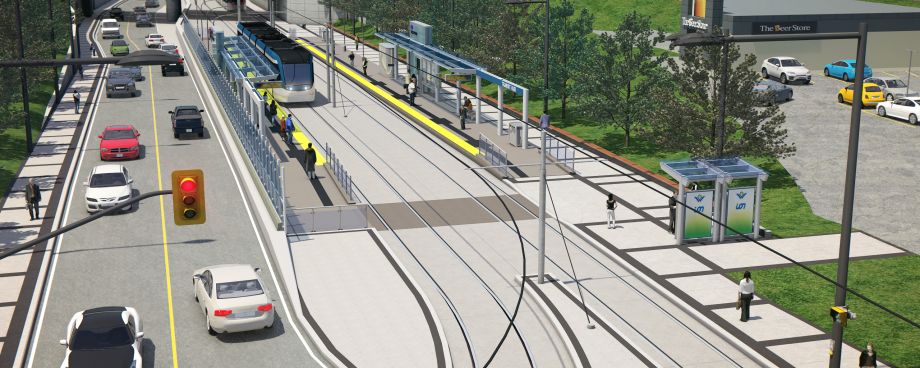
TransLink’s and the City of Surrey’s much ballyhooed LRT really doesn’t offer the transit customer very much, except a very inconvenient transfer to the Expo Line and a 39 minute ride (if their are no glitches) on a dinky and crowed SkyTrain car to Vancouver.
The 320 Langley Centre to Surrey Central bus takes 51 minutes to complete its journey; the 395 Langley Centre to Surrey Central Express (limited stop/limited service) takes 40 minutes; the 501 Langley Centre to Surrey Central Station takes 58 minutes; thus a the time for a full transit journey from Langley to Vancouver would take anywhere from almost hour and a half to almost 2 hours, including transfer but not including total commute time.
The Rail for the Valley TramTrain concept could do the trip from Langley (200th Street) to Vancouver Central Station in 50 minutes, including two stops at Braid St. and Willingdon on the West side of the Fraser River and the 10 mph speed restriction on the Fraser River rail bridge.
The Leewood/Rail for the Valley Study time matrix shows that a 23 km. journey from 200th Street in Langley to Scott Road Station, including four stops, would take 22.5 minutes and an estimation of the 22km. trip from Scott Road to Vancouver would take 27.5 minutes – 50 minutes; a full 40 minutes faster than a combined LRT/SkyTrain trip to Vancouver!
The cost, around $400 million for track improvements, signalling and vehicles.
$500 million, certainly looks more affordable than the $2.5 billion Surrey LRT, designed as a poor man’s SkyTrain, especially if one can get to Vancouver faster and in more comfort.
The Stadler GTW light rail car could use city streets and operate as LRT if need be.
Old Zwei has touched this subject many times; Subways age badly and they cost a lot to keep in good condition.
Renewal costs are not generally factored in with budget calculations and tend to be a nasty surprise for politicians who were not around when the subway first opened.
Yet, despite this, subways are the number one transit vanity project of politicians on both sides of the 49th, that is, until the maintenance costs become due, then it is the taxpayer’s problem.
For those who would like to dispel the notion that TramTrain is not viable in the Fraser Valley, this video should dispel the notion. Lots of single track operation on a sparsely populated route.
In one of the greatest non stories from the pages of the Vancouver Sun, the announcement that the Evergreen ART cars will be operated on the ALRT/ART system as they arrive.
Why wouldn’t they?
Let us not forget the Evergreen Line is the unfinished portion of the NDP’s boondoggle, the Millennium Line.
The entire story is nothing more than the continuing ‘puff’ stories by the Vancouver Sun, written by a reporter that is more of a PR flack than a reporter.
Just another Vancouver Sun embarrassment, trying to invent the news, instead or reporting it.
Evergreen Line cars slated to run on Expo, Millennium Lines this summer
The new Evergreen Line cars will be pressed into service on the Expo and Millennium lines as soon as they have been tested, to alleviate pressure on the transit system. Here Peter Fassbender, minister responsible for TransLink, takes a look at some of the new cars purchased for the Evergreen Line, though a construction fence at the Moody Centre Station on the Evergreen Line, as construction nears completion. Kelly Sinoski / PNG
AAi??fleet ofAi??SkyTrainAi??cars ordered for the new Evergreen Line will be pressed into service even before the $1.4-billion line opens next year, as TransLink looks to ease rush-hour crowdingAi??on the Expo and Millennium lines.
The change will increase the average capacity of each train on the system by 100 passengers.
VivienneAi??King, president of TransLink Subsidiary B.C. Rapid Transit Co., said seven of the new Mark III trains (Bombardier Innovia metro cars – Zwei)will be added to SkyTrainAi??as soon as they have been tested. That will likely be this summer.
Most of the increase is because adding the new trains willAi??free up some of the Mark II cars to be added to the old four-carAi??Mark I trains to make up more six-car trains (Mk.1 & Mk. 2 cars do not operate coupled together, as the different wheel diameters cause problems with the automatic train control – Zwei). That will boost the capacity of the older trains to 500 passengers fromAi??about 320 passengers.
ai???As soon as theyai??i??re available and released for service we will look at doing that,ai??? King told The Vancouver Sun editorial board Wednesday. ai???You need to put your resources where theyai??i??re going to get the best bang for the buck.ai???
The additional capacity isAi??expected to helpAi??address crowding on the Expo line, particularly between the Commercial-Broadway and Waterfront stations in downtown Vancouver during the morning rush hour, TransLink said, at least until the Evergreen Line starts operating in early 2017. The 11-kilometre rapid transit line will connect Coquitlam and Port Moody with the MillenniumAi??Line in Burnaby.
The new Evergreen Line trains have fewer seats ai??i??Ai??with 30 in each car ai??i??Ai??but areAi??more openAi??to allow a few additionalAi??standing passengers,Ai??TransLink spokesman Chris Bryan said (In North America, lack of seats deter customers – Zwei). This is consistent with changes during previous SkyTrain upgrades: The first batch of Mark II cars hadAi??41 seats and a capacity of 130 people, while the latest generation of Mark IIAi??SkyTrain cars seatAi??33 people with aAi??total capacity of 145 people. By comparison, the first Mark I cars, which went into service in 1985, had 36 seats aAi??car and could carry a total of 80 passengers aAi??car.
(General note, capacity is measured at approximately fiver persons per metre length of car. TransLink uses the figure of all seats occupied and 6 persons per metre/2, which gives theoretical capacity only – Zwei.)
TransLinkai??i??s 10-year funding plans calls for additionalAi??SkyTrain cars for the transit system, along with moreAi??buses and rapid transit line expansions for Surrey and Vancouver.
Meanwhile, TransLink CEO Kevin Desmond said he is in discussions with InTransitBC, which runs the Canada Line, about boosting capacity on that line between Vancouver and Richmond. He saidAi??extending the platforms on the Canada Line would be expensive but there may also be ways to expand capacity with additional rail cars.
(Canada line has a maximum capacity of only 7,500 persons per hour per direction – Zwei)
It has been puzzling me greatly, TransLink’s claim that; “SkyTrain revenue up 7% after closing of fare gates.”
Strange that because prior to the fare gate introduction, the majority of the fares for SkyTrain were paid on the bus.
As over 80% of SkyTrain’s customers first take the bus, the fare was paid on the bus, either by cash; fare saver; monthly/annual passes and or Daypass; with the only fares that could be directly linked to SkyTrain coming via the fare machines at stations.
The only difference now is that all the buses operate via flat fare, with SkyTrain having 3 zones, with the Compass Card apportioning fares between bus and metro.
Question:“Was bus revenue up by 7% as well?”
The 7% increase is probably nothing more than a change in accounting practices, with the Compass Card giving an almost exact apportioned fare due to the metro and not from chastened fare evaders.
The real winner is the provincial government who forced the faregates onto TransLink and is eager to show that it was the correct thing to do. The mainstream media as always, took the bait and printed this bit of nonsense with out any research or fact checking.
SkyTrain revenue up 7% after closing of fare gates: TransLink
VANCOUVER (NEWS 1130) ai??i?? Closing SkyTrain fare gates earlier this month is paying major dividends for TransLink.
TransLinkai??i??s chief executive says SkyTrain revenue is up seven per cent.
Itai??i??s a seemingly simple formula; now that the gates have closed, more people are paying up to use the system.
This seven per cent revenue increase, if sustained over the long term, would mean an extra $6 million to $7 million for TransLink per year.
ai???Itai??i??s looking at the stations ai??i?? thereai??i??s some estimating going on ai??i?? itai??i??s looking at just prior to the gate closures and just after the gate closures. Thatai??i??s the best way our statisticians can analyze this, at this point,ai??? says TransLink CEO Kevin Desmond.
Itai??i??s hard to say whether this new increased revenue level will sustain itself in the long run. After all, the gates were only fully closed this month.
ai???Itai??i??s going to take awhile to see how everything fully settles out. And of course, weai??i??ll look system-wide ai??i?? the buses and all the other modes ai??i?? but thatai??i??s a very good indication of the very high utilization of the Compass Cards,ai??? adds Desmond.


 Ai??The Expo Line, including its rolling stock, cost $1.23 billion, leaving the region saddled with debt for decades. Stephen Hui

 The Stadler GTW light rail car could use city streets and operate as LRT if need be.



 Kelly Sinoski
![The new Evergreen Line cars will be pressed into service on the Expo and Millennium lines as soon as they have been tested, to alleviate pressure on the transit system. Here Peter Fassbender, minister responsible for TransLink, takes a look at some of the new cars purchased for the Evergreen Line, though a construction fence at the Moody Centre Station on the Evergreen Line, as construction nears completion. May 4, 2016. Kelly Sinoski/Vancouver Sun [PNG Merlin Archive]](http://wpmedia.vancouversun.com/2016/05/the-new-evergreen-line-cars-will-be-pressed-into-service-on.jpeg?quality=55&strip=all&w=840&h=630&crop=1)

 (Denise Wong, NEWS 1130 Photo)



Recent Comments