Again, Switch Problems Stall SkyTrain! Come On TransLink, Enough Is Enough
Really, Translink can do much better.
The claim that the switch is used 500 times a day excuse doesn’t hold water as there are literally hundred of transit systems around the world that have switches that are used 500 times a day or more, yet do not have the problems that are plaguing our aging SkyTrain light-metro.
Isn’t time that Translink thoroughly investigate the matter, to prevent service disruption, instead relying on Mr. Zabel’s weak excuses.

Switch problems delay SkyTrain service once again
The Columbia Station switch is used more than any other in the SkyTrain system
CBC News
Posted: Jul 17, 2013 5:14
Thousands of SkyTrain commuters were delayed for the second time this month because of a broken switch at New Westminster’s Columbia Station.
TransLink says the station’s switch is used 500 times a day because Columbia Station serves as a hub between the Millennium and Expo lines.
“This one is the most active switches in the entire system,” said TransLink spokesman Derek Zabel.
“We do recognize that more wear and tear is going to occur on that switch. We try to keep regular maintainence, we try to stay on top of it, but anything mechanical, it can break down.”
So far this year, TransLink says there have been 13 switch-related service disruptions, three more than the same period last year.
http://www.cbc.ca/news/canada/british-columbia/story/2013/07/17/bc-skytrain-delays.html
Liz James Sings The TransLink Blues
Liz James is one of the few columnists in the region that has taken the times to research our local transit fiasco and she has well demonstrated that she understands the issue. Unlike the mainstream media, which collectively have not done much research on the issue (some even believe that no builds with LRT anymore!) and seem to take their ‘marching orders’ directly from TransLink, Ms. James confronts the TransLink and transitAi?? issues squarely on target.

Hand TransLink pain back to province
“The silos in which [the region’s] land planning, economic development and transit functions operate are symptomatic of the problems many cities in the world face. . . . We need to be working on the same page.”Richard Walton – June 20, 2013
In our recent exchange about his presentation to the Mayors’ Council on Regional Transportation, District of North Vancouver Mayor Richard Walton said he shares a concern expressed by several of his colleagues – “TransLink is (required) to plan for the future as part of its mandate, but the funding levers necessary to implement the plan lie with the province.”
Clarifying his reference to the three silos, he said that while land planning is the responsibility of Metro Vancouver, economic development is done by 23 separate communities in the absence of any central co-ordination.
As for the third silo – TransLink – Walton did not need to tell me that today’s dysfunctional agency is a direct result of that lack of co-ordination, coupled with under-funded interference from Victoria.
Instead, more diplomatic than I, Walton said “effectively, the province controls the levers but will not engage in the process.”
The problem with being diplomatic is that nice guys often finish last.
For 15 years, various costly incarnations of TransLink boards, committees and councils have tried to negotiate an appropriate funding model. They tried to no avail with both NDP and BC Liberal administrations.
So if those committees find it difficult to take the next step, let me stiffen their resolve: Your decade-long reluctance to stand up to Victoria, to say you “ain’t gonna take it anymore,” has brought TransLink to its financial knees.
People have had enough – to such an extent that many view the governance of TransLink as being part of the problem.
For validation of those opinions, we need go no further than the executive summary of a March 2013 report on the TransLink governance commissioned by the mayors.
The summary quickly came out of its corner with a right hook to the chin on transportation governance which it said is: “less than ideal in relationship to the six major criteria of accountability, transparency, responsiveness, clarity of purpose, advocacy and productive relationships.”
“The most critical of these,” the report stated, “is accountability to the population being served, which is almost completely missing .”
That point isn’t new. People have been saying that since the Glen Clark days.
The governance we have endured since 1998 is an international embarrassment. At least, that’s what I gathered from the next two paragraphs that say our “arrangements” are “unique in the world and not in a good way.”
Regardless, we cannot allow the victims of a failed and expensive governance model to be further penalized for driving their vehicles when no workable transit option is available.
TransLink has been on a wild ride, hampered by provincial decisions like the $2.4 billion Canada Line but left without dollars for its basic obligations.
For their part, most regional politicians have lacked access to the impartial technical expertise on transit required to challenge Victoria’s dictates and have had little option but to go along.
International experience with light rail, trams and shared-track systems demonstrates that popular, affordable transit technology is available. Open minds among our decision-makers would enable TransLink to do more – and do it superbly – with less. And that accounts for my specific interest in the merits or otherwise of using congestion pricing as a means of raising additional revenues to support vital TransLink initiatives.
Walton told his colleagues that, despite its detractors, the funding model is meeting its objectives in Stockholm.
So in an effort to determine whether it would work in Vancouver, I asked whether ‘Metro Stockholm’ had a robust transit system in place before congestion pricing was implemented.
“Yes, they did,” Walton replied.
“I rode their rapid transit system in 1968 and it had been around for at least a decade before that.”
That answers one question – when congestion pricing was imposed in Stockholm, drivers at least had a functioning transit alternative available within their 360 degree commuting perimeters.
But as Walton said in his presentation, “[Stockholm’s] centric model would not fit Vancouver’s traffic patterns . [our] traffic flows in different patterns.”
To my last question: “Do Stockholm residents pay transit-related taxes in addition to the congestion pricing?” Walton’s answer disappointed.
“My understanding is that property tax goes to the federal government,” he said.
“But income tax in Sweden is used for transit in cities, among other sources.”
Clearly, we need more definitive information before we even think of congestion pricing in this region. It may well be that, overall, the Swedes pay far less than the significant total of gasoline, carbon, and other transportation-related taxes people already pay in Metro Vancouver.
Be that as it may, every North Shore dollar sent to TransLink for little direct return on investment is a dollar councils cannot spend on other essential services we expect.
Walton is right when he says the reason many parts of Northern Europe have developed better integrated planning models than us, is because the political systems there produce a constant need for coalition groups to work together.
But if we can’t work together, for now, the only way we can force Victoria to “engage in the process” and to be accountable for its behind-the-scenes decisions, is for TransLink to be returned to the hands that control “the funding levers” – the provincial government – and, yes, I am suggesting we do just that.
rimco@shaw.ca
http://www.nsnews.com/business/Hand+TransLink+pain+back+province/8670456/story.html
Another Comment, Worthy of a Post.
Justin Bernard, who reads the RftV blog offered a link yesterday about the Scarborough ICTS/SRT which deserves a post of its own. What was considered cutting edge transit technology in the 70’s, is now considered somewhat obsolete today; somewhat like the Wuppertal Schwebebahn.
http://www.thegridto.com/city/local-news/scarborough-transit-debate-goes-back-to-the-future/

Mon Jul 15, 2013
Local NewsScarborough transit debate goes back to the future
The Scarborough RT was once hailed as a space-age system. Hereai??i??s how we wound up back at the drawing board.Torontonians love arguing about the same proposed transit lines ad nauseum. Tuesdayai??i??s City Council debateai??i??regarding which form the Scarborough RTai???s replacement will takeai??i??feels like a replay of past battles where a streetcar/LRT line was displaced in favour of a pricier, sexier option.
Among the priority studies recommended in January 1975ai??i??by a joint provincial/Metro Toronto task force on the regionai??i??s transportation needs for the next quarter-centuryai??i??was a high-speed transit line linking the recently approved Kennedy subway station to Scarborough Town Centre, Malvern, and Pickering. Scarborough officials saw this line as key to spurring development in a downtown area based around the new civic centre, which would employ 25,000 people.
Click on the above link to read more.
A Comment Worthy of a Post.
Zwei has never met, nor even talked in person to chap who uses the name Haveacow, but I do know he is a professional planning consultant working on the the Ottawa light rail project and I have a great respect for his opinion. Like Cardinal Fang, who is also a transit professional, and they choose to use other than their real names to prevent unwarranted repercussions from their opinions.
I have communicated and had meetings with a great number of transit professional in the past 25 years and they have guided my opinions on our current transit malaise. Contrary to what a certain high school students says about SkyTrain, it is indeed a proprietary transit system and proprietary transit systems do have a shelf life. SkyTrain’s shelf-life is rapidly coming to a close and is probably the reason for the haste of Translink and the City of Vancouver wanting a SkyTrain subway under Broadway.
Here is another disturbing fact told to me by a then sitting Richmond MLA a decade ago. The chap told me in person that on orders from Gordon Campbell. no Liberal MLA was aloud to even discuss using the Arbutus corridor for transit (LRT) with any constituent, if the Premier were to be found out, the MLA would be ignored for any government perk , etc. available to other Liberal MLA’s; in effect the MLA would be sent to Coventry. (As an aside, when this diktat was issued from the Premier’s office Alstolm walked from the Canada Line bidding process; the very same bidding process that judge Pittfield called a charade!)
This says a lot about our transit planning in Metro Vancouver.

Gentlemen, as an independent planning consultant let me put forward a few points about Bombardier’s (UTDC’s really) Advanced Rapid Transit system. A few years ago (2010) Ottawa had a 3 day technical briefing and conference about rail technology and it’s merit. It was only open to the public on the last day. The first two days were for the city’s transit panning group and people like me who got to chat and pitch ideas to industry people with none of the pesky public and rail transit fan-boys allowed. I say pesky because you have to stop and explain every sentence if it contains too much technical information to most members of the general public. The fan-boy comment is there because we are not trying to prove how much we know and sound important like most fan-boys do and that if another expert has a different opinion than I do, it is OK and I want to hear what they have to say. What is nice is you get fresh unguarded, unedited info about new ideas and not constantly rehashing tired technology arguments like, LRT vs. BRT, LRT vs. Light Metro/Subway et al. Also, in about 1 out of every 4 conversations you get information that shakes you to your core about the realities of this industry, professional horror stories and other important info. Then when the show is over for the day, the really smart guys go to a near by pub/bar and then, the real talking starts. Again the comments are not meant to be mean but, as someone who actually has to deal in this arena of hell as way of life, it’s nice to bitch to someone who understands.
However, to the point of this story. During one of these pub info sessions I was sharing a very tiny table with a rep from Alstom, another from Siemens one from Bombardier, another from Colorado Rail-car (now he is at United Transit USA new American streetcar builder part of Skoda) and two other independent people like me both based in Toronto (my hometown). There had been a strong management led push by several Bombardier and Siemens sub groups to push for Light Metro in Ottawa because most of the R.O.W. is totally segregated physically and by grade by design. The Light Metro people had the lead which really burned the LRT guys I was talking to. That their own company would send those groups to try and push for these useless crap, as the LRT guys put it “nearly dead pieces of old tech useless crap”. The LIM centered Bombardier system and the Val centered Siemens acquired system. Both technology had been acquired by the parent companies because the original companies both government
owned were sold off and or privatized. Both companies got stuck with these monsters. Both have had very few transit versions built and both have moved into the amusement park and airport people mover markets.
It was clear though that both companies knew by the end of the second day of this conference that, Ottawa was going the LRT route. The Bombardier guy was telling us that Bombardier was getting tired of the LIM driverless system because no one in North America or Europe wants it (other than Vancouver and maybe Honolulu) as a transit system. The worry was that, Bombardier could be in the same place that Siemens was in a few years ago. They (Siemens) made too many products, in too many different industries and too many of them were not making money. Siemens had to cut many divisions and either sell them or kill them off all together. Bombardier’s Transit Vehicle Division was making too many products and many of them were competing with each other in the same markets. The
(Sky Train) LIM tech is on that list. In as early as 2014-15 there will be a massive cut of non competitive transit vehicle designs to free up production in company facilities world wide. I made the comment that Vancouver had heavily invested in this tech and he (Bombardier Guy) nodded “Yup, my bosses don’t give a s*** about Vancouver. By 2014 we will have the Flexity LRV design in as few as 5 cities or as many as 14 and that is not counting N. America. Real orders, real money is what they want. Not chances to pitch to people about something they might buy, maybe in a five years. Cold hard cash!” He continued, “after the crap that Ottawa pulled (cancelling a signed LRT contract with Siemens) and all these tight fisted sanctimonious Conservative politicians who could care less if people ride a bus or subway as long as their driver gets them the right type of latte in the morning, my bosses will only offer products we can for sure get multiple cities and multiple future orders for. The days of designer systems for each city are over. If the political winds change and that visonary Conservative turns back to the fiscal f***ing a****** maybe a bus is better than a full rail system kind of guy, we will either sue them or never talk to this city again till gets it’s better leadership”. The Siemens guy smiled and said “make a choice and stay with it”. Someone else (I don’t remember who anymore) commented that, “the lefties are the worst for that! They will champion anything unless someone with more backbone says no, which is everyone”.
Now alcohol was very apparent here in this conversation but the point is clear. Vehicle producers want serious people and are not going to keep endless production lines open hoping someone will buy it. Bombardier for example has, totally abandoned the Guided Electric Trolley Bus BRT products (Buses that look lime LRV’s) they use to pitch. This is another example of a company’s technology that they got stuck with when they purchased it.
It is not enough anymore for a single city to buy a product and have the builder keep the production line ready just in case they get around to order a next generation of vehicles or more of the same class for an existing line extension. The development costs are just too large to keep going on products that no one buys. Keeping in mind they warn cities and their government agencies now directly up front about this, so there are no misunderstandings. If no one else buys this we may shut down the product line, make your choice wisely. They both the Siemens and Bombardier guys pointed out to me that, most of the features available with Sky Train, including, down to the second computerized scheduling and remote fleet vehicle activation (the ability to turn on an immediately needed train from the yard put it into service and remove one or several trains at the same time from service without the need for any human intervention or knowledge of), can already be put into LRT vehicles
as long as they have a private R.O.W.’s. Driverless system technology has been available commercially for rail transit vehicles since 1969 when PATCO started the sucessful Lindenwood N.J. to Downtown Philly subway line. Even now, San Francisco’s streetcars and LRV’s operate on a driverless system when they operate in the central subway tunnel portion of the Muni’s LRT system. The need for having Sky Train’s expensive LIM tech is dropping away fast and they (Bombardier) know it. Some are saying that, in as little as 10 years we will reach the point of a totally driverless system regardless if the vehicle (Bus or Train) is on a private R.O.W. and when that happens, say goodbye to the bus driver forever. The choice of vehicle technology in rapid transit is a political decision it always has been, even in privately run systems. The choice is expensive and needs people who are willing to take big chances even if the choice seems easy to lay people. Today’s newest gadgetbahn system becomes tomorrow’s Seatle Monorail. LRT has survived because it is adaptable where system like Sky Train are fixed into a pre existing design category that it can never get out of. That predesigned market category, Light Metro technology (which needs fully segregated R.O.W.’s) has been surpassed by cheap add on technology to existing LRV’s already operating.
Lastly, street running LRT’s maybe slightly slower because of the need to control traffic signals when they go through intersections (they will always have private R.O.W.’s that cars can not access) but, Zwei is correct when he says they almost totally eliminate the need for buses in their corridor because with stops between 500-800 metres you do not need most local buses. For example, Toronto’s LRT surface lines are important because they will be faster than a bus almost as fast as a the subway and will immediately remove the need for 150 buses as well as ultimately remove the need for up to 400 buses from the TTC’s surface fleet. They have roughly a fleet of 1650-1800 depending on the year and have admitted that they cannot afford a larger fleet of them due to their high operating costs (a minimum of 2.5 drivers per bus) LRT will massively reduce the need for buses on these streets and increase the operating speed of the service. There will be a total 182 LRV’s in the fleet for the 3 new lines. At peak all three lines will be in either two or three car trains at most 61 trains operating total for all 3 lines, instead of 150 buses. The trains will also have extra capacity that the buses don’t currently have so again the TTC comes out way ahead. It’s the operating costs that the transit agency is trying to reduce. The problem with Sky Train is the high maintenance costs as well the need to hire attendants to get people out for trains when stuff breakdown. The lack of need for drivers is lost when you have to hire almost as many attendants as if you had a vehicle technology that required drivers and so is cost savings. Plus, the latest LRV’s are significantly larger than the Sky Train vehicles and thus by design have a big advantage when thinking about available capacity. Sky Train has to make up for this by running more frequency but that comes at a greater maintenance cost (less time to do maintenance because a greater percentage of your fleet needs to be active).
Vancouver Comes in fourth, With the Decades Most Expensive Transit Projects
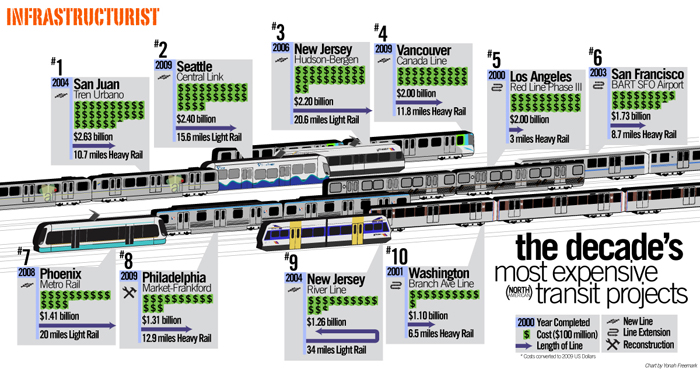
This graphic should sound alarm bells to transit planners and politicians about the ever escalating cost of transit projects. What ever happened to the 80’s light rail philosophy of “build it cheap and build lots”?
The the real cost of the Canada Line has now been pegged at $2.4 billion (depending on who one listens to in Translink or the Provincial government), which would mean that the Canada line would be tied in second place with Seattle’s hybrid light metro/rail. Yes indeed, Vancouver has a world class heavy rail metro that as designed, has less capacity than a streetcar.
“How would the RftV/Leewood interurban fair in comparison“, you say.
The cheapest interurban option would be $500 million for 98 km or 61 miles of route.
Not a bad investment for the taxpayer.
Really Mr. Zabel, You Can Do Better Than That
Really, Mr. Zabel, you can do better than this.
Switch motors do burn occasionally , but with the SkyTrain light metro system, when a switch motor burns out, the system goes down. When a switch motor burns out on a light rail line, the system does not go down and service is maintained. SkyTrain’s all too frequent switch motor problem points to lack of maintenance and not system age.
What TransLink’s spin doctor is trying to convey is that it is not the SkyTrain mini-metro that is at fault, rather it is age. Sorry sir, there are plenty of older rapid transit systems in operation that don not “pack it in” when a switch motor fails, especially when they are properly maintained.
Zwei is very cynical indeed and I think that the all too common service disruptions on SkyTrain due to system failures are contrived by Translink management to give the impression that huge sums of monies must be invested in SkyTrain to maintain service. Is TransLinkAi?? trying to convince the commuting public that new taxes are needed to keep the system functioning?

UPDATES: Problem fixed, Skytrain service back to normal
VANCOUVER/CKNW (AM980)7/9/2013
Another brutal morning for those riding the Skytrain Expo line.
A switch problem halted service between Edmonds and 29th Station.
Translink’s Derek Zabel says old age is a factor in the latest shutdown.
“The Expo Line is getting older….it was build in 1986, so we’re doing regular maintainenceAi??to make sure we keep these situations at minimum”UPDATE: Translink announced shortly before one pm the problem had been fixed and service restored.
Vancouver Once Had Streetcars & Interurbans
Vancouver once had streetcars and interurbans, a photo essay.
 A PCC on Hastings
 A PCC on Main St.
 Two PCC’s passing at a tram stop. Note passenger safety zone.
 On Commercial Drive, above the ‘cut’.
 A Central Park Line Interurban. Note the 10 second headways!!!!!
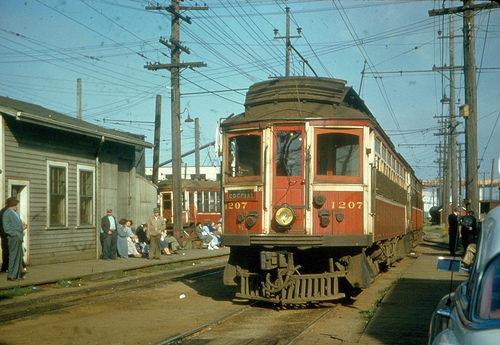 Marpole Station
Really, SkyTrain Craps Out Again!
For a transit system that is supposedly free of breakdowns and loss of service, the SkyTrain mini-metro seems to have all too many breakdowns.
I would ask the SkyTrain lobby to refrain from the claim that SkyTrain is more reliable than light rail, simply because it isn’t.
Millennium Line out of service in New Westminster
Some SkyTrain riders will experience delays this morning because the Millennium Line is out of service between Sapperton and Columbia stations.
Photograph by: Ward Perrin, Vancouver Sun
METRO VANCOUVER – Some SkyTrain riders will experience delays this morning because the Millennium Line is out of service between Sapperton and Columbia stations.
TransLink says a bus route will be set up between New Westminster and Braid station.
Service on the Expo Line is not affected and running as normal.
Spokeswoman Jiana Ling says riders using the Millennium Line should plan for extra traveling time.
Ai?? Copyright (c) The Vancouver Sun

A Letter In The Vancouver Sun
Ah “Road Pricing”, the next great tax grab by regional politicians and bureaucrats. When, oh when will they learn to make do with much cheaper and just as effective light rail?
The sad fact is, if regional politicians do get their wish and road pricing is approved, kiss goodbye to any sane and/or affordable transit planning for the peasants south of the Fraser and say hello to subways in Vancouver!

Wednesday, June 3: TransLinkai??i??s record canai??i??t justify road pricing
Re: TransLink mulls road pricing to generate $23 billion, June 20
For road pricing to succeed, one needs a comprehensive public transit network as an attractive alternative to the car. Metro Vancouver does not have this.
Stockholm, Sweden has a form of congestion charging or road pricing and a comparison with Metro Vancouver is revealing.
Metro Stockholm has an area of 6,488 square kilometres, with a population of just over two million (population density 320 per sq. km) By comparison, Metro Vancouver has an area of 2,877 sq. km, with a population of 2.5 million (pop. density 856.2 per sq.km.)
Stockholm has three heavy-rail metro lines, with a total length of 106 km; five suburban rail lines, with a total length of 300 km; and four LRT/tram lines with a total length of 30 km.
Vancouver, with a larger population and more than twice the density, has only 68 km of mini-metro; and a 69- km commuter rail line with service limited to five trains in and out each week day.
Vancouver has almost three times the population density Stockholm has but a fraction of rail transit options. We have not invested in affordable transit.
TransLink, as BC Transit before, has squandered tax monies on three (soon to be four) prestigious and ultra expensive mini-metro lines that have done little to alleviate congestion and gridlock. The well paid transit bureaucrats want even more money, through road pricing, and continue to do more of the same. I think not!
It is time for regional taxpayers to say adios to politicians who support this road pricing nonsense and maybe its time to say adios to TransLink as well.
MALCOLM JOHNSTON, Delta
Liz James asks important questions
Liz James, who writes opinion pieces for the North Shore News, asks some ‘striking’ questions of the Mayors’ Council on Regional Transportation, the question is; “are they willing to answer?“
The answer is no, as the regional mayors are afraid of a referendum and the reason is simple, they are afraid of a “none of the above” answer.
Why?
Again, the answer is simple, pie in the sky transit projects; grossly under performing transit lines; and questionable planning practices would halt as the transit authority would be forced (kicking and screaming) to cut its cloth to match its income. If a “none of the above” option wins, Translink would have to say goodbye to its reason d’etre to exist, as SkyTrain is the ‘bread and butter‘ of the transit authority and its employees.

Next, a few unequivocal words for the Mayors’ Council on Regional Transportation: Please, unless you are willing to include a “none of the above” option, no more surveys that ask taxpayers how they would like to remit the lint in their pockets to TransLink.
We’re on a sit-down strike – period.
On strike until you commission an ethical, unbiased cost-benefit comparison of SkyTrain versus light-rail transit – and not by Bombardier or SNC-Lavalin.
On strike, until an audit reveals the latest use-and-abuse costs of the U-Pass program.
And on strike until the province shoulders its responsibility for decision-making by filling its voting seats on the TransLink Board.
Until those conditions are met, taxpayers are no longer willing to be prey to TransLink’s version of the Stockholm syndrome – prey under its spendthrift thumb despite the comforting clichAi??s about sustainability and the greater good.
.Read more: http://www.nsnews.com/technology/Take+risk+difficult+questions/8579905/story.html#ixzz2XLiUA0wU



Recent Comments