13.9% Grade in Lisbon – Impossible Claims the City of Vancouver!
Ever see a tram climbing a 13.9% grade?
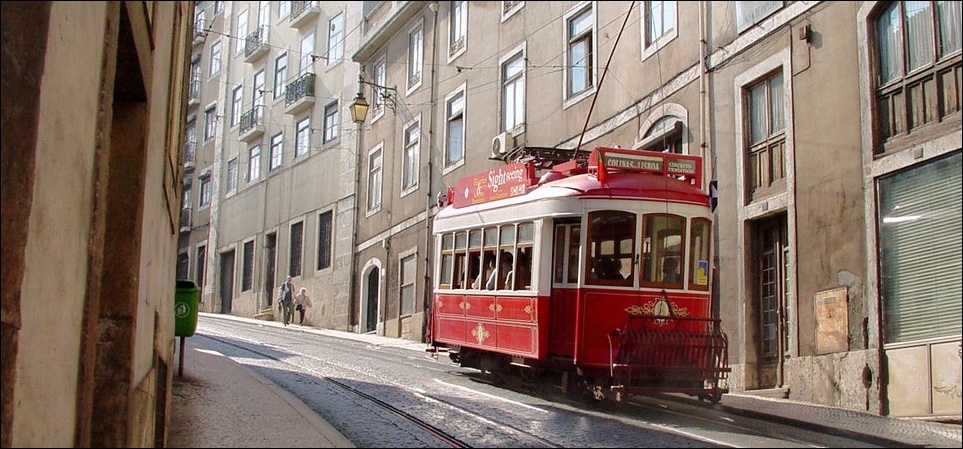
Well now you have! A Lisbon tram climbing the famous 13.9% grade in the city.
Please don’t tell the City of Vancouver or its Engineering Department, because they will just just believe you.
TransLink’s Subway Fiscal Time Bomb

The SkyTrain/metro Lobby remain mute on the long term fiscal effects of operating subways, especially on routes that have low ridership, say less than 15,000 pphpd.
Building a subway is a very expensive proposition and many factors should be considered before embarking on such a costly investment. The first questionAi??any knowledgeable transit planner must ask is; “Is the traffic flow along the subway line enough to sustain it?”
Generally speaking, if average traffic flows are less than 15,000 pphpd, a subway is not needed , as a surface transit route would be more economic. If a subway is built on a route with low ridership, then the subway must be subsidized, with the lower the ridership, the higher the subsidy.
There are many other expensive problems associated with subways, but one that is seldom admitted to is the extremely high maintenance costs that come with a subway. Subways must be cleaned as the accumulated debris and dirt because the piston like action of every passing train acts like a sandblaster on signalling and power equipment. As a subway ages, the maintenance costs escalate. German cities that joined the subway mania in the 60’s and 70’s are now ruing the decision as onerous maintenance costs for the subways have all but bankrupted many transit companies.
It is sad that Vancouver City hall and TransLink are infected with the subway mania and our transit planning shows this as it is 40 to 50 years out of date!
The Broadway SkyTrain subway is a throwback to earlier days, where “mass transit” schemes were built to win votes, built at a time when money was thought ‘cheap’ to borrow and ; “hell anyways, it is just built for show as we must keep the road clear for cars.“
In 2013, politicians lose elections due to bad transit decisions; money is not cheap; there are way too many cars on the road, so much so that gridlock is a daily occurrence, and the European light rail Renaissance has not yet reached Vancouver.
The following is from a transit specialist from Germany.
When some light rail subway systems over here (Koeln, Bochum) converted some lines built for high-floor cars in the 60/70s to low-floor cars, they simply filled the trackbed in the stations with enough ballast to lift the rails up.
The operating and maintenance cost for all those escalators, lighting and ventilation of the tunnel stations (not to mention cleaning) etc. might kill such a project, however. Over here, the electricity bill just for all that tunnel-specific equipment is already typically higher than that for traction energy of the rolling stock.
Decades ago, they wanted to put the streetcars on grade-free tracks in order to reduce cost by running them driver-less.
Today, all transit operators that have buried their streetcars face serious financial problems due to the operating and maintenance cost of the grade-free
infrastructure. It’s those operators that did not follow the “tunnel-mania” that have the lowest operating cost today. Burying streetcars turned out as a huge mistake.
The Greer Report & Rapid Transitai??i?? A repost from 2009.
Posted by zweisystem on Thursday, September 17, 2009 – With minor editing for 2013.

OverAi??13 years ago the Greer Report, done by Greer Consulting Services, issued a scathing report on the Broadway/Lougheed Rapid Transit Projects, later to be know as the SkyTrain Millennium Line. The report found:
- cost comparisons appear to have been contrived to favour SkyTrain over LRT
- no ridership (demand) analysis was reported to justify the high capacity system
- air quality and transportation benefits are unsubstantiated
- accelerated construction advantages of SkyTrain were clearly unrealistic
- risks associated with the SkyTrain car manufacture have not been assessed.
Fast forward to 2013, has anything changed?
The same argumentsAi??have beenAi??used by TransLink for the Evergreen line.
Nada, nope, not a chance!
How can TransLink be trusted with any honest rapid transit planning, especially when they want hundreds of millions more in taxpayers money to pay for ai???pie-in-the-skyai??i?? light-metro planning based on contrived planning and phony studies? The RAV/Canada line is just a symptom of a major problem: TransLink refuses to plan for affordable light-rail and instead invents statistics to suit their in-house light-metro planning. The 100,000 passengers a day, quoted by RAV officials and Liberal politicians, needed so the RAV/Canada line will operate subsidy free is ai???stuff-and-nonsenseai??i?? as TransLink has absolutely no mechanism in place to apportion fares between SkyTrain, RAV/Canada line, Seabus, and the regular buses. TransLink doesnai??i??t know what percentage of fares are full fares, concession fares, and the deeply discounted U-Pass, nor do they have a formula for allocating fares between bus, seabus and metro.
Fast forward to 2013: the Canada Line is carrying in excess of 100,000 passengers a day (or so TransLink claims), yet TransLink is still paying about $90 million annually to the operating consortium!
Example: A South Surrey student (3 zone fare) going to UBC via transit pays just $25 a month for a U-Pass; he/she takes a bus to Casino/Bridgeport Junction, transfers to the RAV/Canada Line and then transfers again to a bus going to UBC. The apportioned fare should be $8.33 for the RAV/Canada line and $16.67 for the bus system. The RAV/Canada Lineai??i??s share of an U-Pass (1,2,or 3 zones) would be $8.33 a month or about $0.41 cents a day (based on 20 days use)! There is absolutely no way with the current fare structure that RAV will pay for itself with 100,000 passengers a day; especially when other metros need 400,000 to 500,000 passengers a day to justify construction.
Clearly TransLink hasnai??i??t a clue about apportioned fares or even how the RAV/Canada line will determine what percentage will be paid to the metro and buses. What may happen is that TransLink will count all ridership on RAV as full adult cash fares and ai???fiddle awayai??i?? monies that rightfully should go to the bus systemai??i??s coffers.
Certainly nothing has changed much at TransLink as American transit expert, Gerald Fox, stated in a Feb.2008 letter regarding the Evergreen line:
ai???I found several instances where the analysis had made assumptions that were inaccurate, or had been manipulated to make the case for SkyTrain. If the underlying assumptions are inaccurate, the conclusions may be so too.ai??? And adding: ai??? It is interesting how TransLink has used this cunning method of manipulating analysis to justify SkyTrain in corridor after corridor, and has thus succeeded in keeping its proprietary rail system expanding. In the US, all new transit projects that seek federal support are now subjected to scrutiny by a panel of transit peers, selected and monitored by the federal government, to ensure that projects are analyzed honestly, and the taxpayersai??i?? interests are protected. No SkyTrain project has ever passed this scrutiny in the US.ai???
Metro politicians take note, TransLink is about to take you and your taxpayers on a wild ride, ai???around, around, TransLink goes; whereAi??the money trainAi??will stop nobody knows!ai???
For the full Greer Report
http://www.bcgreen.com/~samuel/green/GREER_Rep-SkyTrain_April_12_1999.pdf
Gerald Foxai??i??s letter
http://railforthevalley.wordpress.com/2008/12/26/can-translinks-business-cases-be-trusted/
The London Underground: 150 Years in Culture
Ai??Ai??Ai??Ai??Ai??Ai??Ai??Ai??Ai??Ai??Ai??Ai??Ai??Ai??Ai??Ai??Ai??Ai??Ai??Ai??Ai??Ai??Ai??Ai??Ai??Ai??Ai??Ai??Ai??Ai??Ai??Ai??Ai??Ai??Ai??Ai??Ai??Ai??Ai??Ai??Ai??Ai??Ai??Ai??Ai??Ai??Ai?? 

The first journey on the London Underground was made 150 years ago, on this day, 9 January 1863 from Praed Street (Paddington) to Farringdon; the line opening for public service on the 10th of January . Since then, the iconic transport system and culture have crossed paths. We look at the artists, writers and zombies in culture who have taken over the Tube.
http://www.telegraph.co.uk/culture/culturenews/9789903/The-London-Underground-150-Years-In-Culture.html
Ai??150 years, 11 Lines totaling 402 km, 270 stations and a daily ridership of 3.6 million on, the Tube as London Underground is known is loved as much as it is reviled
http://blogs.independent.co.uk/2013/01/09/150-years-of-london-underground-loved-as-much-as-it-is-reviled/
Ai??The London underground at 150 – a birthday journey
http://www.guardian.co.uk/uk/2013/jan/09/london-underground-150-years-birthday
Ai??There have been as number of attempts to show tube stations where they really are but this map by Andy Hudson-Smith of the Digital Urban blog goes one step further by rendering landmarks too!
Ai??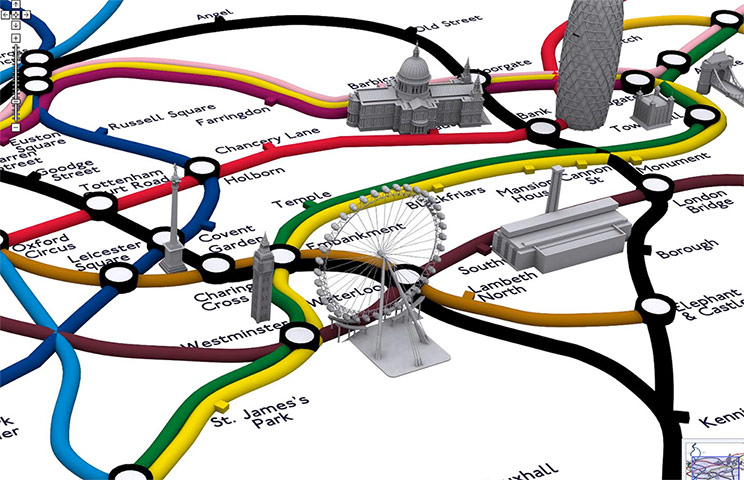
Ai??London Underground: 150 fascinating Tube facts
The Tube turns 150 today. Here is a nugget of knowledge for every year of its existence.
http://www.telegraph.co.uk/travel/destinations/europe/uk/london/9789966/London-Underground-150-fascinating-Tube-facts.html

Ai??Finally, after 150 years London Underground has its own disused station web site
http://www.abandonedstations.org.uk/
Ai??& its own slightly irreverent Blog ai??i?? Going Underground
http://london-underground.blogspot.co.uk/
Ai?? Ai??Imagine life without the London Undergroundai??i?? The iconic Tube has been transporting Londoners around Britainai??i??s capital for 150 years, and today 150,000 passengers use the Underground every hour.
This fascinating miscellany takes us on a round-trip through every aspect of the London Underground, from the history of its construction to its many appearances in books, films and popular music, giving a glimpse into the technical marvels beneath our feet and the many human stories that play out in its trains and tunnels every day.
1845: A pamphlet is published in which Charles Pearson, a London lawyer, pushes the idea of an underground railway to transport both passengers and goods to the city centre.
1863: On 10 January the Metropolitan Railway goes down in the history books when it opens the first subterranean railway in the world.
1998: A previously undiscovered breed of mosquito, adapted to life underground, is discovered living in the Tube network.
2012: Close to one million people use the Northern line alone, every day.
ai??i??ai??i??ai??i??ai??i??ai??i??ai??i??ai??i??ai??i??ai??i??ai??i??ai??i??ai??i??ai??i??ai??i??ai??i??ai??i??.. & Translink children, London Underground is aAi??150 year old heavy rail underground, surface & subsurface metro system and with that, it has little in common with SkyTrain; though no doubt one of you wretched individuals will try to argue white is black!
and there areAi??Ai??steam locomotives on the Underground!
http://www.youtube.com/watch?v=i33KnnY6e24
Traffic congestion in Metro Vancouver as bad as Los Angeles. A report that TransLink will ignore!
Oh yes, TransLink is on the right path in providing an affordable public transit alternative – NOT!
Vancouver faces many transportation problems, but TransLink and its very unconventional transit planning must rank as number one.
As I have said before, “Transit is to move people and not money“, yet TransLink still bumbles along planning hugely expensive metro projects thatAi??are built toAi??subsidize major development (densification) along the route. It is thought (or hoped) that major densificationAi??will provide ridership for the very expensive metro line because the metro has done poorly in attracting the motorist from the car. In the end, densification increases auto use, creating more congestion and gridlock, which TransLink, municipal planners, and academics (particularly at SFU)Ai??do not have the wit to solve.
Densification may increase transit ridership, but it also increasesAi??private and commercial vehicle use, which in the end, despite investing billions of dollars on expensive light metro, little is achieved!
So after investing nearly $9 billion over the past 33 years, on three mini-metro routes alone, Metro Vancouver has achieved traffic congestion as bad as Los Angeles.

Traffic congestion in Metro Vancouver as bad as Los Angeles: report
By Tiffany Crawford, Vancouver SunJanuary 8, 2013
Vancouver’s traffic congestion is just as bad as Los Angeles and the worst inAi?? Canada, says the latest congestion report from TomTom, a company thatAi?? manufactures GPS devices.
The company, which released its third quarterly congestion index on Tuesday,Ai?? uses its own navigation technology to rate traffic congestion in 57 NorthAi?? American cities with a population of more than 950,000.
Metro Vancouver tied with L.A. as the top congested city, followed by SanAi?? Francisco, Honolulu, Seattle, Toronto and New Orleans.
Between July and September, Metro Vancouver’s congestion increased by one perAi?? cent to 34 per cent over the last quarterly index, said TomTom, making it equalAi?? with LA.
During that period, journey times were on average 34 per cent longer duringAi?? peak times than when traffic is flowing freely.
Put another way, Metro Vancouver motorists waited, on average, eight per centAi?? longer in the morning and evening rush times than their counterparts in greaterAi?? Toronto, and 10 per cent longer than those in Montreal and Chicago, according toAi?? TomTom.
The company uses real travel time data captured by vehicles to compare travelAi?? times at rush hour with travel at “low-flow” times.
However, a traffic consultant in Ottawa has cautioned that the index is aAi?? “pretty shallow analysis,” probably tied more to marketing GPS devices.
Barry Wellar, a former geography professor at the University of Ottawa, saysAi?? it’s nearly impossible to do a fair comparison of cities.
TomTom says its traffic database contains more than six trillion dataAi?? measurements and is growing by five billion measurements every day.
With files from Postmedia News
The top ten most congested North American cities between July and SeptemberAi?? 2012, according to TomTom, were:
1. Los Angeles (34%)
2. Vancouver (34%)
3. San Francisco (33%)
4. Honolulu (31%)
5. Seattle (27%)
6. Toronto (26%)
7. New Orleans (25%)
8. San Jose (25%)
9. Montreal (24%)
10. Chicago (24%)
Ai?? Copyright (c) The Vancouver Sun
SkyTrain is Obsolete, Why Then Doesn’t The SkyTrain Lobby & TransLink Get It?

Two letters in the North Delta/Surrey Leader, one from Daryl Cruz of “SkyTrain For Surrey” fame and a rebuttal from Malcolm Johnston, a contributor to this blog.
The assertions by Cruz that “building LRT will cost us billions and billions more than building SkyTrain”, is outright dishonest and comes from a profound ignorance about light rail and public transit.
One wonders who is feeding Cruz this nonsense and for what reason?
A part of the answer is that TransLink and the SkyTrain lobby are afraid of the truth because the truth is very inconvenient with the Evergreen Line now under construction and the Broadway SkyTrain subway on the horizon.
Light rail not right for Surrey or Vancouver
Published: December 31, 2012
The arguing of which transit technologies to use for Broadway and Surrey rapid transit has to stop.
The City of Vancouver is right in its touting that the option for Broadway rapid transit extension should be SkyTrain, and that there should be no contest. The City of Surrey should listen to Vancouver.
I find it remarkable how blind some Light Rapid Transit advocates can be. When it comes to discussing high-cost transit projects, a lot of people seem to be placing emphasis on capital costs exclusively.
What most of these advocates donai??i??t seem to understand is that there are greater economic and productivity benefits from a faster and far more reliable service.
Spending more money on better infrastructure is usually synonymous with earning more benefits to offset the cost, and going by that metric, building LRT will cost us billions and billions more than building SkyTrain.
Daryl Dela Cruz
skytrainforsurrey.org
And a reply from Rail for the Valley
SkyTrain obsolete for years
Published: January 07, 2013
I find I must reply to Mr. Daryl Cruzai??i??s most bizarre letter (ai???Light rail not right for Surrey or Vancouver,ai??? The Leader, Jan. 1.)
The fact of the matter is simple ai??i?? modern light rail made proprietary light-metro systems obsolete almost two decades ago. That many who support spending billions of dollars on SkyTrain extensions remain ignorant of this fact is telling.
LRT made SkyTrain obsolete in North America the early ai??i??80s, when a study by IBI Group for the Toronto Transit Commission found that SkyTrain ai???could cost anywhere up to ten times more to install than light rail, for about the same capacity.ai???
Why build with SkyTrain when you got a far bigger bang for your buck with LRT?
Though only seven SkyTrain-type systems have been built since the late 1970s, the proprietary mini-metro has gone through at least four official name changes, starting with Intermediate Capacity Transit System; then to Advanced Light Rail Transit; followed by Automatic Light Metro; and presently Advanced Rapid Transit.
During the same period, modern LRT has just remained light rail, and during the same period that SkyTrain has been on the market, over 160 new LRT systems have been built and a further 56 LRT systems are under construction or have been approved.
It is also interesting to note that not one of the seven SkyTrain tendering processes allowed light rail to compete.
It is this statement by Mr. Cruz that forced me to reply: ai???building LRT will cost us billions and billions more than building SkyTrain.ai??? The statement is beyond all reality and belongs in a world of fairies and pixie dust.
Yes, those supporting modern LRT are ai???blindai??? indeed.
Malcolm Johnston
Rail for the Valley
Delta
January 2013
The Cardinal sends greetings & fraternity to all for the new year.
The Cardinal concludes with conviction, that 2013 will mark a watershed forAi??@ grade Light Rail, Trams & Streetcars in Canada & BC in particular.
So, Mr Daryl Dela Cruz, LIM, Rico & Richard be afraid, be very afraid for the day of street level Light Rail has come.

Canadaai??i??s light rail renaissance
From the International Railway Journal
http://www.railjournal.com/index.php/light-rail/canadas-light-rail-renaissance.html
Light rail is experiencing a renaissance in cities throughout Canada with various new lines planned and some currently under construction.
LIKE most cities across the world, Canada’s leading urban centres suffer from traffic congestion leaving many residents wasting time in their cars. In recent years light rail schemes have emerged as the preferred mode of rapid transit in long-term transport plans for cities across the country both to solve these problems and as a way of connecting new regions to existing transit networks.
These projects have on the whole drawn wide public support. Canadian Urban Transit Association president and CEO Mr Michael Roschlau says this is particularly true in cities that already have a rapid transit network where residents can view the benefits that it brings to a community and often lobby for the next new line to reach their region. However, in areas where light rail is new, residents need more convincing.
“In communities with no LRT experience, there can be significant debates and concerns, largely due to unfamiliarity and confusion with light rail or tram-type services,” Roschlau says.Ai??”Bus rapid transit is often preferred due to lower capital costs, with future upgrades to light rail a consideration. Furthermore, there are concerns about net operating costs, which are typically covered by contributions from local property taxes.”
Roschlau estimates that Canada requires $C 53bn ($US 54.29bn) of investment in transit over the next five years which includes improvements to existing infrastructure as well as new line construction. With around 25% of these projects currently unfunded, he says work is underway to encourage the federal government to help bridge this funding gap, and cover its share of the typical three-way cost-sharing with provincial and municipal governments for new infrastructure projects.
He also says that by providing greater flexibility in future five-year spending plans new projects will have a better chance of securing the dollars they need, particularly with many governments facing budget deficits.
Roschlau says that there is consequently significant debate in Canada’s larger cities about how additional revenue for infrastructure projects might be secured. Public-private partnerships are considered an option, but Canada has limited experience in this area at present so early examples of this approach are being watched with interest.
Unlike the United States, local governments in Canada do not have the flexibility to generate additional revenue for transit projects by adjusting local sales taxes. As a result, alternative funding mechanisms are being studied such as parking levies and congestion charging, although the potential political ramifications mean that it’s a debate that could run and run.
“In most instances this is a highly volatile issue and is being treated very cautiously by politicians because of the risk that it could backfire upon them,” Roschlau says.
Calgary
Roschlau says that Calgary’s C-Train is often held up as the most successful LRT system in North America due to its high efficiency and status as the backbone of the city’s transit system. It also has the highest per-capita ridership of any system on the continent carrying 300,000 passengers per day across two lines and 51.8km.
The network’s impressive performance is matched by equally impressive expansion plans. A major milestone will be reached next month when the new West LRT opens following a $C 1.5bn construction programme which began in February 2010. Opening was seemingly delayed until March 2013, but following a prolonged period of good weather over the summer and intensive work by the contractor, led by SNC-Lavalin, the original deadline of December 10 looks likely to be met.
 The West LRT is a six-station, 8km line that extends the existing Route 202 Saddletowne – City Centre line from the west end of 7th Avenue in central Calgary to 69 Street SW. Shuttle buses will run to two new park-and-ride facilities built to serve the new line which includes a 1.5km elevated section with one station between downtown Calgary City Centre and Bow Trail, and three underground stations, a first for Calgary. A further western extension to Aspen Woods station, around 17th Avenue and 85th Street SW is planned but not yet funded and it may be extended further to 101 Street SW.
A 2.9km extension of the north-south Route 201 northeast from McKnight-Westwinds to Saddletowne opened on August 27, five years after it was approved by the council and three years after construction began. The line cost $C 130m to build and is estimated to serve 8000-10,000 passengers per day at two new stations.
Construction is also currently underway on a $C 114m single-station extension of the Northwest LRT line from Crowfoot to Tuscany which is due to open in autumn 2014. The line will serve Rocky Ridge, Royal Oak, and Tuscany.
Further extensions to Route 201 from Saddletowne to Stoney Trail, which will add four new stations, and on Route 202 from Somerset-Bridlewood to Silverado and 210 Avenue South are planned. Two new lines are proposed: the 26km 18-station Southeast LRT from central Calgary to Seton via Douglas Glen and the proposed Health Campus in the south of the city, and the North Central line from the city centre to 150 Avenue N. Three corridors are currently being considered for this line, although no funding has yet been secured and work is not expected to begin until after 2023. The 26km Southeast LRT currently has an estimated completion date of 2039, which has been criticised by local politicians due to expected population growth in this area.
These two new lines are major elements of a 30-year, $C 8bn RouteAhead transport plan currently being compiled for the city government, with a final plan due in December. The plan also includes a branch from the proposed Northeast LRT extension to the airport which will utilise a $C 295m new airport tunnel that is currently under construction. The North Central line could also be connected to the airport, and the Northeast LRT.
Waterloo
A new LRT and bus project that will connect the cities of Cambridge, Kitchener and Waterloo in Ontario is moving ahead after a request for qualifications for a design, build, finance, operate, and maintain public-private partnership contract for the initial 19km light rail project was issued last month. The deadline for bids for the 30-year contract is November 23.
The 16-station line will run from Conestoga Mall in Waterloo to Fairview Park Mall in Kitchener. It is part of a 36km initial network of light rail and bus routes that will connect the three cities. Buses will be replaced by light rail from Fairview Park Mall to Ainslie Street Terminal in Cambridge as part of the project’s second stage, planning for which will begin in 2014. A fleet of 14 LRVs will be required for operations on the initial line which has a projected ridership of 27,000 during the first year of operation in 2017, rising to 56,000 by 2031.
The cost of the light rail/bus project is $C 818m, with the Province of Ontario and Canadian government agreeing in 2010 to provide $C 300m and $C 265m respectively towards the capital cost of constructing the rapid transit system. The regional government agreed to meet $C 253m of the initial phase’s capital costs in September 2011.
Ottawa
The City of Ottawa and Infrastructure Ontario are currently considering bids from ACS Infrastructure Canada, Bouygues Travaux Publics and Vinci Concessions for the contract to design, build, finance, and maintain a 12.5km east-west light rail line with 13 stations from Blair through the city centre to Tunney’s Pasture. The line is described as the city’s largest ever infrastructure project and is estimated to cost $C 2.1bn, $C 600m of which has been provided by the Canadian government, and $C 600m from the Province of Ontario. The City of Ottawa will pick up the remaining $C 900m. The council is expected to vote on the proposal in December, with construction due to start in autumn 2013 and commissioning scheduled for 2018.
A feasibility study has also been conducted on a southern extension of the existing diesel O-Train line from its terminus at Greenboro to Leitrim Park & Ride and Riverside South. The line would adopt the corridor for a proposed north-south LRT project which was scrapped by the City Council in November 2006, with the study estimating the cost of the expansion to be $C 75m. However,
the report recommends that no improvements are conducted until after the east-west light rail line is complete, and that the plans are included in an updated transport masterplan which is scheduled for 2014.
The existing O-Train is also going through a major expansion programme, with six new diesel Alstom Coradia Lint dmus set for delivery next year. New passing loops will be added to the 8km, five-station line to reduce headways from 15 minutes to 8 minutes by 2014.
Vancouver
Vancouver’s successful experiment with light rail during the 2010 Winter Olympics has spawned a plan to reintroduce trams in the city.

The proposed line would use the 1.8km Olympic Line between Granville Island and Olympic Village, extending it east by 1.2km to Science World. A second phase would add 2km to take the line to Waterfront station. In the long term a further extension through the city to Stanley Park is envisaged along with a branch from Main Street to Drake Street.
Toronto
Political wrangling has severely hindered progress on Toronto’s largest-ever transit expansion following the approval in 2008 of a $C 8.4bn investment by the province of Ontario in four light rail lines totalling 52km. The projects were developed as part of the Transit City plan issued in 2007 and are now key components of the Big Move transit programme adopted in 2008 by city transport agency Metrolinx which outlines projects worth over $C 50bn to improve infrastructure in Toronto and Greater Hamilton over the next 25 years.

Construction of the Sheppard East light rail line that will run 12km and include 14 stations from Don Mills in North York to Morningside Avenue in Scarborough began in 2009 with the aim of opening the line on September 1 2013. However, work was halted in April 2011 when newly-elected mayor Mr Rob Ford cancelled all of the light rail projects in favour of building the Eglinton – Scarborough light rail line entirely underground.
Citing the lower cost of building light rail, Ford’s proposals were thrown out by the city council in February. However, construction has yet to restart and is not due to resume until 2017 due to a ruling by the government of Ontario which cited the price of other infrastructure projects in the region and a potential strain on resources which could drive up costs. The line is now not scheduled to open until 2021.
Work though is underway on the 19km Eglinton – Scarborough cross-town line from Janeai???Street/Black Creek Drive to Kennedy station, which is scheduled to open on time in 2020 and retains its original Transit City design. Described by Metrolinx as the cornerstone of the LRT network, the line has will link with 54 local bus routes, three TTC interchange subway stations and GO Transit services and includes a 10km tunnel from Keele Street to Laird Drive. Metrolinx approved a $C 320m tunnelling contract with Crosstown Transit Constructors consortium for the line on September 11 with work due to start by the end of the year on the 6.2km tunnel under Eglinton Avenue.
By adopting an underground scheme for the Eglinton cross-town line it would have been possible to connect the new light rail network with the existing Scarborough rapid transit service which uses standard-gauge infrastructure unlike Toronto’s metro and streetcar lines. However, the council rejected a proposal by Ontario premier Mr Dalton McGuinty to combine the line with an underground version of the cross-town line, allowing it to remain a closed system but to adopt the LRT infrastructure. The upgrade, which includes an extension to Malvern Town Centre when funds become available, will start in 2015 and is scheduled to be completed by 2020.
Construction of the $C 1.2bn, 23.4km Etobicoke – Finch West LRT was also due to be well underway by now, but Ford’s cancellation pushed the start of work back until 2015 with a new expected opening date of 2019. The line will have 30 stations running west-east from Humber College in Etobicoke to Finch Station where it will connect with the Yonge University – Spadina subway line.
Edmonton
Construction is underway on an initial 3.3km section of a new North light rail line from the existing station at Churchill Square in the city centre north to the Northern Alberta Institute of Technology (NAIT). The $C 755m project is being funded by municipal, provincial and federal governments and when it opens in 2014 will add three new stations and an estimated 13,200 passengers per day to the network. The line includes a 700m underground section between Churchill and MacEwan stations and runs at grade from 105th Street to NAIT.
The new line is part of The Way We Move, the City of Edmonton’s Transportation Master Plan to expand LRT service to all sectors of the city by 2040.
Next on the agenda is the Southeast to West LRT, aAi??low-floor urbanAi??line that will run from Mill Woods through the city centre to Lewis Farms. Public input helped identify station locations and alignment for the 27km line during the concept planning phase, with the project now in the preliminary design phase. By the end of 2013 the city will conduct a more detailed analysis of how the LRT will operate, as well as how the system will integrate into the existing and planned transport network and neighbouring communities.
A concept planning study is currently taking place for a $C 1.1bn extension of the North line beyond NAIT by 11km and eight stations to a park-and-ride facility on 153rd Avenue which may also be extended to St. Albert. The line is expected to carry 42,000-45,000 passengers per day. A concept plan will be presented to the city council by the end of the year.
Extensions to the existing south – northeast LRT line are also part of the overall plan. Preliminary engineering for a one-station, 2.9km extension north of Clareview was completed in 2010, with the project estimated to cost $C 210m. An extension south to Desrochers/Allard has also been proposed with the preliminary engineering study for the Century Park – Ellerslie Road section completed in 2010. Work has not yet progressed beyond this stage on the four-station extension which has an estimated cost of $C 425m at 2008 prices.
Other cities
BC Transit concluded a 25-year transit study for the city of Victoria in 2011. The plan calls for the inclusion of a light rail element in the city’s transit options and identifies a line from the city centre along Douglas Street to Langford via Uptown and Six Mile, then along the Old Island Highway through Colwood to Langford. The entire line is projected to cost $C 950m to build with funding options now being sought. Other potential corridors identified include two from Uptown, north to the Saanich Peninsula and Sidney, and east to the University of Victoria.
A 21km, 31-station light rail line that will link Mississauga with Brampton west of Toronto is the centrepiece of a masterplan for transit in the region that was completed in 2010. Preliminary design for the project is now underway.
In Hamilton the city is looking to secure funding from the provincial government of Ontario for a 14km east-west line with 18 stations running from McMaster University to Eastgate Square. An environmental assessment for the project was completed in June 2011 and the province is expected to make a decision on whether to fund the line by mid-2013, with optimistic estimates placing a construction start date of 2015. Ultimately the city has a plan for construction of five lines and is currently working on feasibility study for the A-Line which will run from the city centre to Hamilton International Airport.
Ottawa, Canada – city to hire outside consultants for LRT project
The city of Ottawa will be hiring outside consultants to oversee various phases of its light rail construction project, The Ottawa Citizen reported Thursday. Canada’s federal capital plans a 7.7-mile east-west starter LRT route that will include a 1.5-mile downtown LRV subway. Here’s a graphic showing the planned LRT:
http://metronewsca.files.wordpress.com/2012/12/train_04.jpg?w=618
The consortium awarded the construction contract by Ottawa City Council will acquire rolling stock from France-based Alstom. Its Citadis LRVs will be the first of their type on any North American LRT system. The North American market for LRVs has been dominated by Bombardier, C.A.F., Kinkisharyo and Siemens.
And the news story:
http://tinyurl.com/a78u93g
“City seeks outsiders to manage consortium building LRT
By David Reevely
The Ottawa Citizen
January 3, 2013 1:03 PM
OTTAWA ai??i?? Ottawa’s light-rail project is supposed to include a lot of work for local companies, including millions for a small army of consultants the city’s hiring to manage its relationships with the Rideau Transit Group.
The consortium has won the $3.8-billion contract to design, build, finance and maintain the rail line through downtown, and now the real work begins, with technical demands that the city’s 28-person “rail implementation office” isn’t up to.
So with a public posting Thursday, the city set about looking for experts in 23 different areas, including 14 “project leads” for everything from structural engineering to managing property needed for the construction work. Another nine technical specialists are needed for jobs like monitoring noise and vibration and dealing with ground and rain water.
They’re high-end positions: The project leads will all be responsible for making sure the construction consortium lives up to the terms of its massive contract and the city wants each of the technical specialists to have at least 15 years of experience. And there’s a lot of money to be made: the posting on the popular government procurement board MERX says the city expects to spend up to $3 million a year on these services, with individual assignments worth up to $250,000 at a time.
The posting says the idea is to establish a list of qualified contractors that the city can use as it needs them, with initial terms of at least three years and the option of two more years ai??i?? to the expected end of the LRT construction project in 2018 ai??i?? if both parties agree.
The city has relied heavily on consultants for the rail project so far, with hundreds of thousands of dollars going to the Boxfish Group, led by Mayor Jim Watson’s confidant Brian Guest, to guide the planning of the 12.5-kilometre (7.7-mile) route. When RTG was presented as the winning bidder, the city’s staff rail director John Jensen said the project couldn’t have got that far without Guest.

 Ai??
Ai??


Ai??
Ottawa Light Rail system receives official approval
Ottawa light rail gets official OK
http://www.ottawacitizen.com/business/Ottawa+light+rail+gets+official/7721060/story.html
OTTAWA ai??i?? Ottawa council voted 24-0 Wednesday morning to formally approve a contract for the first stage of light rail transit in the capital.
To cost $2.1 billion initially, the 12.5-kilometres rail line will run from Tunneyai??i??s Pasture in the west to Blair Road in the east, and pass under much of downtown in a tunnel.
The city chose the Rideau Transit Group, a consortium of engineering firms, to build the line.
The first stage of construction starts in February with the addition of lanes on the Queensway to carry express buses while the existing bus-only Transitway is closed during the conversion to rail.
Phase 1 Ottawa Light Rail TransitAi??- The Confederation Line

Transit Challenge http://www.ottawalightrail.ca/#&panel1-3
Ottawa LRT to be ready by 2018
http://www.cbc.ca/news/canada/ottawa/story/2012/12/05/ottawa-lrt-announcement-rideau-transit-group-snc-lavalin.html
Ai??



Recent Comments