Should We Convert the Canada Line metro to LRT?

Subways & metros cost a lot of money to build and operate.

The George Massey Tunnel is back in the news, as Premier Christie Clark is using the tunnel as an election gimmick, promising to replace the tunnel within 10 years.

http://www.vancouversun.com/news/Christy+Clark+announces+plan+replace+Massey+Tunnel/7315511/story.html

Replacing the tunnel with a larger structure, bridge or tunnel will only send the gridlock to the next choke point, the Oak Street & Knight Street bridges, which will see massive congestion if traffic through the ‘tunnelroute were to be expanded. What isAi??needed isAi??a ‘rail‘ transit solution the works and can be readily and affordably extended to meet the needs of the everAi??growing population South of the Fraser River.

The proprietary SkyTrain light metro system and the light metro philosophy of operation has done very little in attracting the motorist from the car and its high ridership can be attributed mostly to recycling of bus customers onto the light metro and over 100.000 $1.00 a day U-Passes issuedAi??post secondary students in the region. SkyTrain has done little to ease congestion in the METRO Vancouver area.

The proprietary SkyTrain light-metro system is justAi??too expensive to buildAi??and it just cannot be extended affordably into the outer suburbs to attract new customers.Ai??The extremely high cost to constructAi??SkyTrain light-metroAi??has madeAi??theAi??’blacktop‘ option the cheaper optionAi??in improving regional transportation, as evidencedAi??by the Gateway highways program, South of the Fraser River. As new highways are built, auto use increases, with the only barrier against increased auto use being road capacity.Ai??With major highway and bridge construcion are now coming tolls on new bridges, first with the Golden Ears Bridge, then onAi??the replaced Port Mann Bridge and in the future, maybe all bridges and the tunnel.

What we see is extremely myopic regional planning and showsAi??Metro Vancouver’s complete ineptitude when it comes to regional transportation as the region’s transportation clock has been merely turned back some 50 years when all bridges and the tunnel were tolled in greater Vancouver.

Sadly, thisAi??short sightedAi??and extremely dated planning,Ai??which fits in well withAi?? BC’s ‘black-top’ politics practiced by both the BC Liberal Party and the NDP, will only lead to more gridlock and traffic chaos.

The Canada Line is in reality a heavy-rail metro, operating ROTEM’s heavy-rail electrical multiple Units (EMU’s), built as a light metro. In fact, because of the Canada Line’s automatic operation and small stations, it can only offer a maximum capacity of 15,000 persons per hour per direction, less than half that is being carried today on the main tram (streetcar)Ai??line through Karlsruhe, Germany. It now seems that automatic metro (driverless metro) automatic signallingAi??has ‘hamstrung‘ light metro capacity, making it somewhat obsolete for tomorrow’s transit demands.

To both increase capacity on the Canada Line (an estimated $1 billion alone) and to increase its reach into Richmond in an effort to attract more ridership,Ai??would costAi??about an additionalAi??$1 billion for a total of about $2 billion. By comparison, $2 billion would buy you about 80 km. (at about $25 mil/km.) of modern LRT!

ThatAi??$2 billionAi??would be put to better use by:

  1. Converting the Canada Line hybrid heavy/light metro to light rail.
  2. With the money saved by much cheaper LRT construction, extend the the new Canada line LRT across the Fraser river into Delta and beyond.

This is not fanciful musings, rather it very well may be a transit solution that TransLink or a future operating authority may seriously consider.

The Canada line is in a heavy-rail metro andAi??most modern light rail vehicles would easily operate within the Rotem EMU’s Kinematic Envelope (Kinematic Envelope: the space that a rail vehicle could potentially occupy as it moves laterally and vertically on its suspension.), including the subway tunnels.

The expensive and complicated automatic signalling system should beAi??replaced with much simpler and more robust signalling system, doing away with the higher operating costs due to automatic signalling.

Retain ‘third rail’ power pick on the elevated and underground portions of the line by equipping, as done before on other transit lines, the trams with retractable shoes to collect power from the ‘third rail’ and using standard pantographs on non-guideway portions of the line. Simply, the first station the tram stops at on the guideway portion of the line the driver drops the ‘pan‘ and deploys the power collection shoes. Several tram varieties on the market today have dual pantograph/shoe for power pick up on APS ground level contact-less power supply.

By converting theAi??Canada Line toAi??LRT would makeAi??the cost of extending the Canada Line, first to Steveston and Ironwood Mall an affordable option. It would also be much cheaper to build with LRT for a new crossing of the Fraser River to serve both Ladner andAi??South Delta; then onwards to South Surrey. As well, it would also be a viable option to extend the Canada Line, via at-grade operation to UBC a much cheaper option than bored subway tunnel.

The cost to extend the Canada line to Steveston and Ironwood Mall (about 11 .3 km.), including minor retrofitting, would cost about $1.5 billion. by converting to LRT, the cost would be about $150 million for 30 cars, each having a capacity of 250 persons; about $150 million for re-signalling, an estimated $150 million for engineering, etc.; and $280 million to build 11.2 km (@$25 mill./km.) of LRT, for a grand total of $730 million – just less than half the cost of extending with metro! It is conceivable that for the cost of the Canada Line extending to Steveston and the Ironwood Mall, we could build LRT to both Steveston and the Ironwood Mall, then through a tunnel under the Fraser River to Ladner and Tsawwassen!

It is time for TransLink to start planning for ‘rail’ transit for the region and not just for a small cluster of municipalities that surround Vancouver. SkyTrain, with construction costs exceeding $100 million/km. just cannot be built economically into the ‘burbs‘, but modern LRT, with construction costs as low as $6 million/km. can. It is time for regional politicians declare that building with SkyTrain and/or light-metro has been a mistake and that we must plan future transit on the light rail model. The regional politicians who make up METRO Vancouver should tell TransLink either change their transit planning direction and for a start, seriously look at converting the Canada Line to LRT and extend it across the Fraser River to Delta and beyond.

Eric Chris Tackles Vancouver’s Media and Politicians SkyTrain Hubris

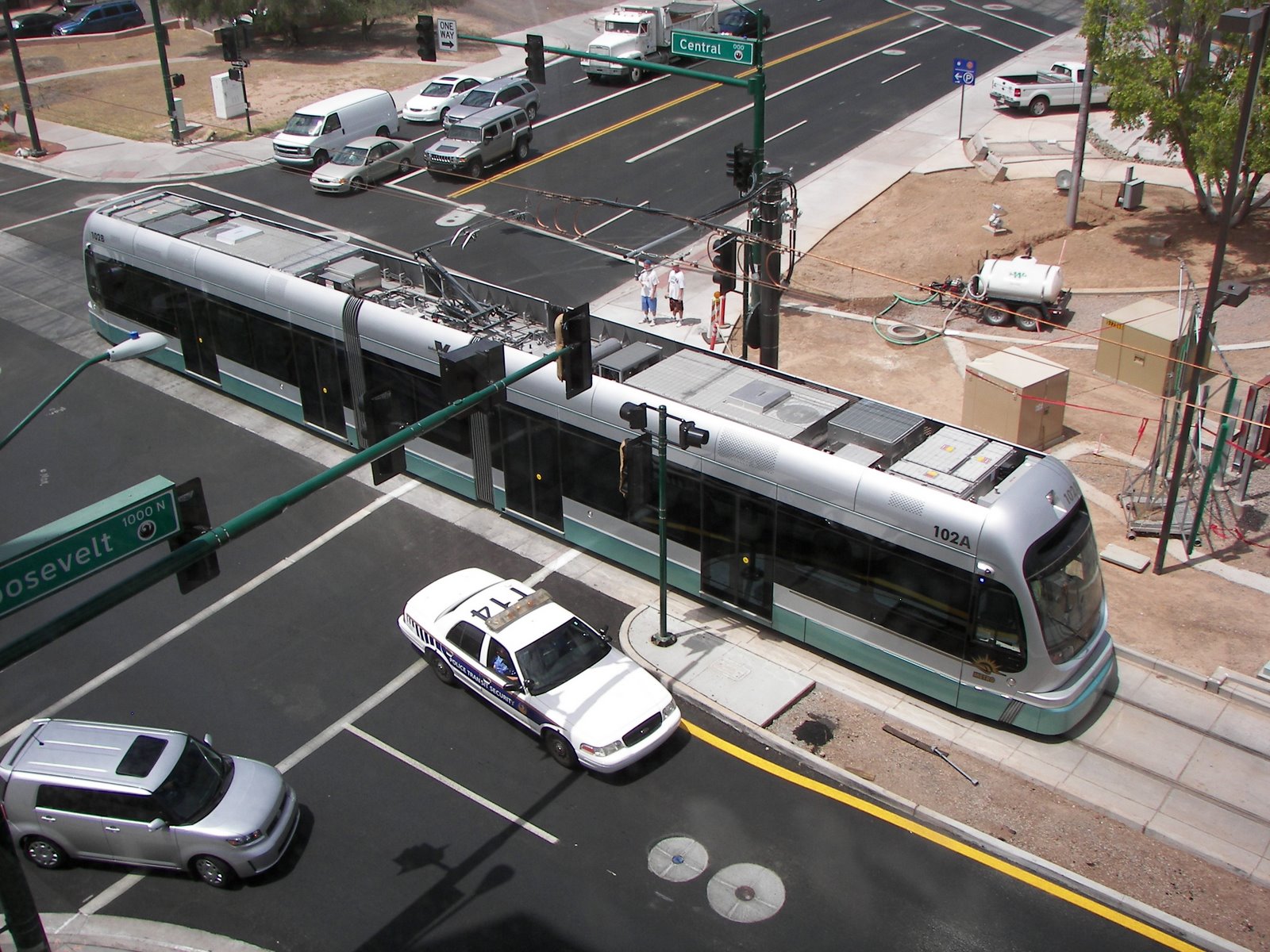
A picture that Vancouver’s SkyTrain lobby do not want the public to see! Modern LRT on a lawned rights-of-way.

Eric Chris’s letter to Vancouver media and politicans.

SkyTrain is by far the worst possible alternative for theAi?? proposed Evergreen Line from Burnaby to Coquitlam in Metro Vancouver.Ai?? HereAi?? are some highlights from a recent UBC research paper comparing tram lines andAi?? light rail transit (LRT) lines to SkyTrain lines:

Cost

Total cost per trip (Figure 22 on page 10 of researchAi?? paper):

Tram = $3.04 (best)

LRT = $7.64

SkyTrain = $12.34 (worst)

Total cost per passenger mile (Figure 21 on page 10 ofAi?? research paper):

Tram = $1.22 (best)

LRT = $1.68

SkyTrain = $2.66 (worst)

Environment

Lifecycle carbon emissions per passenger mile (page 7 ofAi?? research paper):

Tram = 32.59 (best)

LRT = 51.6

SkyTrain = 156.3 (worst)

Efficiency

Energy use in kWh per passenger mile (page 5 of researchAi?? paper):

Tram = 0.11 (best)

LRT = 0.13

SkyTrain = 0.30 (worst)

Occupancy

Number of passengers by transit mode (page 4 of researchAi?? paper):

Tram = 155 (close second best)

LRT = 178 (best)

SkyTrain = 105 (worst)

By any measure and by a huge margin, modern tram lines areAi?? superior to outdated SkyTrain lines.Ai?? Tram lines move more people and useAi?? much less energy than SkyTrain lines.Ai?? Tram lines are much more economicalAi?? than SkyTrain lines, and on an trip by trip basis, SkyTrains are 306% moreAi?? expensive than trams to operate.Ai?? SkyTrain isnai??i??t just a financialAi?? disaster; however, SkyTrain is also an environmental disaster.

According to the UBC research paper, carbon emissions for aAi?? SkyTrain line ultimately exceed carbon emissions for a tram line by 380%.Ai??Ai?? All SkyTrain lines require extra diesel buses to shuttle transit users to theAi?? distantly spaced SkyTrain stations.Ai?? When carbon emissions from theseAi?? diesel buses are included, carbon emissions by SkyTrain are far worse than theAi?? UBC research paper suggests.Ai?? Moreover, SkyTrain lines rely on redundantAi?? rapid bus routes (articulated diesel or hybrid diesel bus routes) to fill in theAi?? gaps of the SkyTrain network and to connect SkyTrain lines (99 B-Line routeAi?? operating underneath existing trolley bus lines in Vancouver, forAi?? instance).Ai??

These rapid bus routes, which would not be necessary with tramAi?? lines, often operate in parallel to existing bus routes and increase carbonAi?? emissions tremendously.Ai?? From an environmental perspective, tram lines areAi?? far more effective in the fight against climate change than SkyTrain lines ai??i?? SkyTrain lines are lemons.Ai??Ai??Ai??

SkyTrain is inconvenient to use and deters transit use (byAi?? drivers who donai??i??t have to take transit) ai??i?? most transit users donai??i??t live near aAi?? SkyTrain station and have to walk a long distance or transfer from a bus toAi?? reach a remote SkyTrain station located every two kilometres apart in distanceAi?? on average.Ai?? Tram lines have closely spaced stops and result in fasterAi?? overall trip times than SkyTrain lines for the vast majority of transit usersAi?? because the bus transfer or long walk required for the SkyTrain line isAi?? avoided.Ai?? Really, SkyTrain is being promoted by certain individuals whoAi?? wonai??i??t admit that it is terrible mistake because if they do, they will be out ofAi?? a job.Ai??

Supposed urban planning and transportation guru, Gordon PriceAi?? of SFU, as well as self professed transportation expert and City of VancouverAi?? Councillor, Geoff Meggs have little credibility and donai??i??t know the first thingAi?? about civil, electrical or mechanical engineering to give any worthwhile adviceAi?? on the efficient design of transit networks; yet, they never miss theAi?? opportunity to support more taxes to pay for more SkyTrain when simply cuttingAi?? our losses to switch to tram lines would be the shrewd move.Ai?? Perhaps theirAi?? inflated egos just prevent them from admitting that they are wrong aboutAi?? SkyTrain.Ai?? Gordon Price and Geoff Meggs are entitled toAi?? express theirAi?? simple thoughts in the media; however, for the media to ignore technicallyAi?? qualified university professors and professional engineers who disagree withAi?? Gordon Price, Geoff Meggs and the rest of the Mickey Mouse club at TransLink isAi?? censorship.Ai?? For the media to withhold the truth and to print liesAi?? favouring SkyTrain is tantamount to propaganda, and the media appears to beAi?? promoting SkyTrain for TransLink to reward the media with thousands to millionsAi?? of dollars annually in bribes advertising.

Peter Fassbender who is the vice-chair of the Mayorsai??i?? CouncilAi?? has capitulated with TransLink to obtain his rapid bus route for Langley.Ai??Ai?? He is a toady for TransLink, and it is disgusting to read articles about PeterAi?? Fassbender wanting to raise taxes for more SkyTrain lines by TransLink.Ai??Ai?? SkyTrain is a scam as far as doing anything significant to reduce vehicle useAi?? (it does reduce some vehicle use but it also reduces walking and cycling,Ai?? too).Ai?? SkyTrain is primarily being used to spur development alongAi?? SkyTrain lines for developers to profit.Ai?? This is not the purpose ofAi?? transit; the purpose of transit is to move students, retirees… tourists in aAi?? cost effective and sustainable manner.Ai??

After the Canada Line fiasco (SNC Lavalin submitted a low bidAi?? to win the job and then open cut rather than bore Cambie Street to save moneyAi?? while businesses on Cambie Street paid the price and went bankrupt as a result) ai??i?? it is incredible to see TransLink attempting to build another SkyTrain lineAi?? (Evergreen Line) with SNC Lavalin ai??i?? unbelievable.Ai?? The depth of depravityAi?? at TransLink is amazing.Ai?? Because TransLink is spending too much onAi?? SkyTrain lines, conventional transit is being sacrificed,Ai?? consequently:

  • TransLink operates diesel buses on trolley bus routes to saveAi??Ai?? money and air quality suffers to increase respiratory and heart diseasesAi??Ai??Ai??
  • TransLink reduces the budget for buses to save money andAi??Ai?? transit buses become overcrowded at peak hours
  • TransLink gouges drivers and homeowners who are unfairlyAi??Ai?? taxed to pay for over priced SkyTrain lines

Fundamentally, TransLink is a make work program created toAi?? increase employment.Ai?? Not one inch of the proposed Evergreen Line will beAi?? built by existing TransLink staff.Ai?? Everyone at TransLink could be purgedAi?? and the new palace being built to house the 500 staff at TransLink in NewAi?? Westminster could be sold to raise cash for transit.Ai?? TransLink is an awfulAi?? drain on the economy and employs overpaid economists, planners… accountantsAi?? who are not required to operate transit.Ai?? In March of 2012, ShiroccaAi?? Consulting ranked TransLink as the worst run transit organization in Canada ai??i?? transit could only improve if current Metro Vancouver staff replaced everyone atAi?? TransLink ai??i?? at least Metro Vancouver is staffed by competent planners andAi?? engineers who are in touch with the communities in the LowerAi?? Mainland.

This isnai??i??t a game; people are being harmed and cheated whenAi?? the bungling buffoons (accountants and economists) making the decisions atAi?? TransLink commit to build more SkyTrain lines with money raised by taxingAi?? drivers and homeowners.Ai?? Do your readers a big favour and write the truthAi?? for a change ai??i?? expose TransLink for what it is ai??i?? a sick organization headed byAi?? corrupt individuals building SkyTrain lines when tram lines would lower carbonAi?? emissions from transit and lower personal taxes for transit.Ai?? Here is theAi?? UBC research paper for your perusal:

http://www.sxd.sala.ubc.ca/8_research/sxd_FRB07Transport.pdf

TransLink’s Desperate Ploy

The Canada Line and SkyTrain light-metro’s are the real cause of TransLink’s financial mess!

Wednesday morning October 3, 2012, from about 8:50 amAi??to 10 am, TransLink took to the airwaves on CKNW radio (the Bill Good Show)Ai??to try to convince the great unwashed, that TransLink really needs your tax money to survive. On board with the Bill Good and his show were Bob Paddon, Executive Vice President Of Strategic PlanningAi??and Public Affairs, TransLink, Nancy Olewiler, TransLink Board Chair, andAi??Eric Miller, Professor, University Of TorontoAi??and Ai??Director of the University’s UrbanAi??Transportation Research andAi??Advancement Centre.

Click here for NW’s audio vault.

http://www.cknw.com/news/audiovault/index.aspx

The first question I pondered was, “why did we not have a local academic, like ProfessorAi??Patrick Condon (UBC)Ai??on the panel“, but soon my question was answered as the befuddled Toronto professor, when trying to answer a question from Good, claimed; “that TransLink is used as a model for Toronto and the rest of Canada………“.

Really?

Well Vancouver doesn’t operate streetcars or trams nor does it operate a heavy-rail subway and Toronto is tearing down it’s SkyTrain (Scarborough Line) to be replaced by light rail. While TransLink does operate a very limited commuter train service (5 trains & 5 trains out), Toronto has the Go Trains, offering a regular scheduled regional passenger rail service for the immediate region. I do not think Toronto even considers Vancouver a model for transit, I rather doubt that Toronto considers Vancouver at all!

The 75 minute “Support you local TransLink” radio show had everything that TransLink’s ‘spin doctors’Ai??are famous for, but not for one instance was real the problem with TransLink’s insatiable financial appetiteAi??discussed and that was the hugely expensive SkyTrain mini-metro andAi??massive amounts of money it sucks from the transit budget, both TransLink’s and the provincial governments (almost $300 million annually from the provincial government alone!). Predictions by real transit experts in the 80’s that SkyTrain would be a financial burden on local taxpayers have proven true, yet SkyTrain is held up as a model for other cities byAi??our localAi??media and the porkers who regularly slurp at the TransLink trough.

Then there was the call for BRT, which like SkyTrain, is based more on ‘huff & puff’ than fact. Really, just where has BRT been all that successful?

Those who tell the SkyTrain or BRT lie over and over again, soon come to believe in the lie!”

Until TransLink and the mainstream media come to terms with the real reason for TransLink’s financial malaise and that is building light metro on routes that do not have the ridership to support the mode, TransLink will make annual pilgrimages to the politicians with cap in hand for ever more tax money. Until the public actually vote for politicians who have demonstrated a knowledge of regional transit and transportation issues and have the courage to stop Translink’s annual shakedown of the regional taxpayer, the financial black-hole known as TransLink will just expand until the region is made pauper.

Tours ‘architecture in motion’ tram unveiled

The new Alstolm trams being delivered to Tours certainly demonstrates the 21st century streetcar or tram. The 43.7 metre (143.3 feet), seven section articulated tram has a nominals capacity of 300 persons, with seating for 88. This equals the capacity of a four car rake of Mk.1 vehicles.

Being 100% low-floor, means easy access for the mobility impaired without the need of complicated and expensive lifts and elevators, something that is generally overlooked by TransLink’s planners and engineers.

The Citidis 402 tram, operating on Broadway eacould move over 9,000 persons per hour per direction at 2 minute headways;Ai?? 13,500 pphpd at 90 second headways and 18,000 pphpd at 1 minute headways.

Tours ‘architecture in motion’ tram unveiled

October 2, 2012

FRANCE: The first Alstom Citadis 402 tram for the line under construction in Tours was unveiled to the public during an open day at the maintenance depot on September 30.

Transport authority SITCAT awarded Alstom a ai??i??73m contract to supply 21 of the seven-section trams in September 2010, and the first was delivered from Alstom’s La Rochelle plant two years later. The Tours cars are 43Ai??7 m long and 2 400 mm wide, with 12 double doors, four single doors and a capacity of about 300 passengers, including 88 seated.

Styling agency RCP developed the ‘architecture in motion’ theme for the trams. A mirrored outer covering applied as 300 pre-cut pieces of adhesive film is intended to reflect the surrounding urban environment and resemble the River Loire. The tram fronts feature two vertical strips of LEDs aligned with the rails.

Construction of the 15 km north-south line from LycAi??e Vaucanson to LycAi??e Jean Monnet with 29 stops began in 2010, and opening is planned for September 2013. APS catenary free-operation will be used on a 1Ai??8 km section where the line runs through the World Heritage city centre.

http://www.railwaygazette.com/news/urban-rail/single-view/view/tours-architecture-in-motion-tram-unveiled.html

Next-generation streetcars arrive in Toronto for trials

National Post

http://news.nationalpost.com/2012/09/27/next-generation-streetcars-arrive-in-toronto-for-trials/

Although it will not be accepting passengers until 2014, the TTCai??i??s next generation of streetcars arrived in the city by freight train this week.

Still the property of its builder, Bombardier, the train is in town for a series of trials to see whether it can smoothly navigate Torontoai??i??s streets.

The vehicle, which includes air conditioning, low floors and articulating sections, will be shown to the media sometime in October.

Darren Calabrese/National Post

Darren Calabrese/National Post

TransLink’s Demands and the Mainstream Media’s Embarrassment

Liz James, whoAi??pens opinion pieces for the North Shore News has taken the time to study and understand our regional public transit debacle, unlike the immortal scribes who inhabit the mainstream media andAi??are nothing more than shills for TransLink.

The failure by the mainstream media to understand why TransLink is in economic peril is breathtaking and what little investigative reporting that is done, amounts to a phone call to one of TransLink’s highly paid spin-doctors. One is tired of the old shtick that “SkyTrain is driverless, so it costs less to operate“, which is completely untrue because SkyTrain employs more personnel than comparable LRT systems and wages do account for over 70% of operating costs. The fact is SkyTrain, costs about 40% more to operate than comparable LRT systems and a good reason why automatic (driverless) transit systems have mostly fallen out of favour with transit planners.Ai?? TransLink is somehow stuck in a loop with SkyTrain and are unable to plan for affordable transit options.

Ms. James also hints, as Zwei has predicted, of large future costs to recondition the aging Expo Line guideway, which maybe the final straw in TransLink’s demise.

Zwei asks; “Where is the mainstream media?” Of course, transit is an ‘apple-pie and motherhood’ issue, something the mainstream media in BC will not touch as they lack the moral courage to so. As a result, they stick with the non-stories like fare evasion, as it is safer that way and will notAi??offend anyone. Real transit news is made un-news by the mainstream media, just as Orwell predicted.

SkyTrain the real reason why TransLink is in a financial pickle.

OPINION: Cutting service is not finding ‘efficiencies’

By Elizabeth James, Special to North Shore News – September 26, 2012
“We need sound long-term [transportation] policies based on agreed principles so that future governments, of any stripe, have a blueprint. How can we make arbitrary decisions to spend billions on roads and bridges with no contiguous planning and investment for systems to move people?”

Mayor Richard Walton

As chairman of the Mayors’ Council on Regional Transportation, District of North Vancouver Mayor Richard Walton put that billion-dollar question to me in an email following a TransLink meeting in Richmond Saturday.

It was the third time in six days the agency had presented its 2013-2015 Plan and Outlook.

He went on to explain that Metro Vancouver councillors and MLAs from both parties attended that meeting, while the two earlier events were held to present the plan to the media and to the mayors’ council.

The only answer to Walton’s question, of course, is that with an estimated three-year revenue shortfall of $472 million, TransLink has little hope of improving its planning or service performance during the life of the plan.

The picture can only get worse if, on Oct. 18, Richmond Mayor Malcolm Brodie persuades his mayors’ council colleagues to continue their rejection of property taxes as a solution to the agency’s woes.

In the meantime, the South Coast B.C. Transportation Commission – Martin Crilly, commissioner – has set aside a budget for an independent analysis of the TransLink plan.

Apart from the fact that Crilly was appointed as an independent overseer of TransLink, what is the point of contracting for a consultant’s opinion of a plan that may well be materially altered weeks before the $75,000 analysis is ready for the printer – especially when many of us can do the work free of charge?

Earlier this year, after the mayors’ council rejected its first property-tax increase, TransLink buckled down to find some financial “efficiencies” throughout its operation.

Turns out, all it had to do was look and – Eureka! – there they were, all $294 million of them. Well, sorta.

We don’t save it all at once, you understand; that would be indigestible. The relief is spread over three years.

How will they do it? Eliminate some severance packages? Build light-rail transit at a third of the cost of SkyTrain?

Heck no; silly me. They’re going to save money by not providing transportation services. You know, small items like 306,000 hours of planned regional bus services and the ephemeral third SeaBus the North Shore has been promised since before Pat Jacobsen took up the mantra in 2001 when she became CEO.

That promise is always good for a political comment – like the recent good suggestion from City of North Vancouver Mayor Darrell Mussatto who believes it could be paid for by the carbon taxes.

“But hold on,” you say. “Didn’t we already launch that third boat in January 2010, just before the five-ring circus began?”

Now you see it, now you don’t – because, no sooner had the new one left the slipway than one of the aging original vessels was taken out of service for a refit or retirement, take your pick.

SeaBuses aside, if you thought “$98 million in efficiencies” meant you’d just saved a considerable amount of money, you’d be wrong.

When the main focus of a transportation authority is to provide a region-wide transit system, how can you call it “efficiency” to cancel or fail to build essential elements of that system?

Have the touted savings truly been realized when the agency immediately speaks the caveat that it will still need to find another $30 million in revenues if it is to continue operating even at the projected reduced level of service? Or are we down to $68 million with a sweep of the pen?

How will that amount look after factoring in the unmentionables – like the looming need to spend millions on a major refurbishment of the 30-yearold Expo Line and its aging concrete guideways?

Never one to blush at its own lack of long-term thinking, TransLink had the temerity to mention yet again that its revenues from gasoline taxes – which do not include the carbon tax portion – had declined “faster than anticipated.”

Speaking of gas-taxes: Before the Millennium Line was even opened, I kept asking, “If projections about the number of cars SkyTrain will take off the road are close to being accurate, how will TransLink manage without the lost gas-tax revenues?”

Why listen to common sense, when you can spend millions to “attract the best minds and expertise”?

While we’re on the subject of ridership, the new report repeats TransLink’s ongoing claims of an increase in ridership numbers relative to the increase in regional population.

Good news, maybe; but the gauntlet taxpayers should throw down to TransLink board chairwoman Nancy Olewiler is this: How do you conduct an accurate ridership count to prove that claim?

To which the only truthful answer is, “We can’t; not in a system that may clock the same rider two or three different ways in one trip, we can’t.”

Nor does the TransLink promise to “live within its means” mean exactly what it says.

If it did, then the agency would not need to draw down its reserve accounts in order to balance the books – give or take the $30 million shortfall that is.

When it comes to SkyTrain decisions, it would be unfair to adjourn this discussion without acknowledging the perverse and dominant role Victoria has played in TransLink misfortunes.

In 1999, Glen Clark was all smiles as he included responsibility for the SkyTrain expansion project as part of the transportation authority. He knew he was down-loading to the region a project that had become his multi-billion-dollar headache – without an appropriate funding formula to pay for it.

That said there has been nothing, other than salaries and honoraria, to stop any of the CEOs, quasi-elected boards, councils and/or commissions from flat-out refusing to participate any further in the continuing disaster that is our transportation authority.

That they have not speaks volumes about their willingness – or ability – to protect the public interest.

Lastly, if Crilly repeats his opinion that pouring a property tax hike into TransLink’s bottomless pit is “reasonable,” maybe this time the provincial government will hear our message: Regional citizens in the third largest city in Canada are entitled to and are taxed for an efficient, affordable transportation system.

Taxpayers understand that all British Columbians benefit from that, albeit some only indirectly via tourist revenues and reduced costs for transportation of goods.

So let’s stop wasting money on propertytax ideas, carbon taxes and cumbersome, inequitable bridge tolling.

Instead, Crilly should ask professional actuaries to calculate the true costs of the entire transportation network that would include infrastructure projects that are necessary province wide.

Once we have that information, the provincial government should then recover all transportation costs via a sliding scale of increased income tax, using that new revenue for nothing but transportation.

Only then can we engage Walton’s “contiguous planning” and invest in affordable “systems to move people” throughout British Columbia.

rimco@shaw.ca

Ai?? Copyright (c) North Shore News

Lyon tram-train service launched

The French city of Lyon is opening a new TramTrain line, while in METRO Vancouver TransLink still dreams of massive (and massively expensive) SkyTrainAi??light-metro lines.Ai??After two years, TransLink still Ai??refuses to deal honestly with the RftV/Leewood TramTrain study for the former BC Electric Vancouver to Chilliwack Interurban.

The cost for Lyon’s new 26 km TramTrain line works out to about $7.3 million/km. and fits in quite comfortably with the price range of the RftV/Leewood Study.

TransLink is broke, there is talk of massive road pricing and/or tolling schemes to fund the ponderous bureaucracy, yet no one will deal honestly with the real reason of TransLink’s financial problems which is the SkyTrain light-metro system.

Until TransLink plans for affordable ‘rail‘ Ai??transit for the entire metro Vancouver/Fraser Valley region, which means planning for light rail and its variants instead of SkyTrain light-metro, there should be absolutely no talk from regional and provincial politicians of new taxes and user fees for TransLink.Ai??It should be known by all that any additional tax money sent TransLink’s way will be consumed by its massive and unchecked bureaucracy, with little or no benefit for the regionalAi??transit system.

Ai??

Lyon tram-train service launched

September 25,Ai??2012

FRANCE: SNCF began operating tram-train services from Lyon Saint-Paul to Sain-Bel on September 24, following an official opening ceremony two days before.

On weekdays there is now a service every 30 min, increasing to every 15 min between Lyon and L’Abresle during the peaks. It is hoped that ridership will double from present levels to 13 200 passengers a day by the end of 2012.

It is the first of three routes from Lyon Saint-Paul serving the city’s western suburbs that are to be converted to tram-train operation. Subject to obtaining the necessary safety approvals, Alstom Citadis Dualis vehicles are expect to begin operating to Brignais in December, followed by the route to Lozanne that has required construction of a new east to south chord at Tassin.

Total cost of the infrastructure work required for the west (approx. 26 km)Ai??Lyon tram-train programme is estimated at ai??i??150Ai??2m (CAD $190.06 mil.), of which ai??i??91Ai??4m (CAD $115.66 mil.)Ai??is being provided by the RhA?ne-Alpes region, ai??i??16Ai??5m (CAD $20.88 mil.) by the French government and ai??i??15Ai??9m (CAD $20.12 mil.)Ai??by infrastructure authority RFF. Greater Lyon authority has contributed ai??i??13Ai??1m (CAD $16.57Ai?? mil.), the RhA?ne departement ai??i??12Ai??5m (CAD $15.82 mil.) and SNCF ai??i??800 000 (CAD $1.01 mil.).

Infrastructure work comprised doubling some sections of single line, lengthening passing loops, track renewals, electrification and resignalling. Platforms have been rebuilt to provide level boarding, while a ai??i??35m (CAD $44.28 mil.) station modernisation programme included the installation of a real-time passenger information and improved facilities for cyclists. A new station has been built at Lentilly-Charpenay, and Dommartin-Lissieu relocated; both now provide park and ride facilities.

Within a ai??i??650m (CAD $822.47 mil.) framework agreement between SNCF and Alstom for up to 200 vehicles, a fleet of 24 Citadis Dualis tram-trains has been acquired for ai??i??100m, entirely funded by the RhA?ne-Alpes region. The 42 m long vehicles have 100 seats and can accommodate 150 standing passengers, with a maximum speed of 100 km/h.

Maintenance is undertaken at a new facility built on a 1Ai??5 ha site near L’Arbresle station, funded by the RhA?ne-Alpes region (ai??i??11Ai??48m) and SNCF (ai??i??3Ai??82m).

http://www.railwaygazette.com/news/urban-rail/single-view/view/lyon-tram-train-service-launched.html

The Light Rail Revolution in France

The one country that has spurred on the “light rail revolution” is France, yetAi??in the late 70’s and early 80’s French politicians and planners were going the light-metro route with the French VAL rubber tire mini-metro system.

MATRA, the massive French Arms consortium, were the owners of the VAL proprietary light-metro system and the French government was very generous to cities that built with theAi??VAL light-metro. French politicians as well as MATRA executives, wanted to see almost every sizable French city operate a VAL mini-metro because; “it would showcase French technology, especially for weapons export.” Cities not building with VAL would be considered unpatriotic.

Sounds familiar doesn’t it.

Despite generous subsidies provided by the French government, the good burghers of of the small French towns of RoubaixAi??and TourcoingAi?? found it was much cheaper to completelyAi??refurbishAi??the localAi??worn out tramway, locally known as the ‘Mongy‘, than build with VAL. With the local taxpayers very much in mind, politicians in both cities rejected the very much more expensive VAL and went ahead modernizing the 22 km. Roubaix and Tourcoing tramway.

InAi??Ai??Saint-Ai??tienne, politicians again Ai??found it much cheaper to refurbish an existing tramway than build a new VAL mini-metro despite heavy inducements by the French government.

It is Nantes, where the real light rail revolution started and has been the blueprint for 21st century French public transit philosophy.

The first tramway in Nantes opened in 1879 and closed in 1958 due to bombing damage during World War II, city planners wanted to reintroduce a “rail” transit system to aleviate ever increasing traffic gridlock in the city. Again, a VAL system was proposed, but due to its extremely high construction and operating costs only a small line could be built and this after substantial subsidiy by the French government. Planners felt that extending the initial line would be cost prohibited. Instead, planners in 19981 opted for classicAi??light rail, complete with new three section articulated tramcars (with a capacity of 253 persons per car – 58 seating, 285 standing) with a low-floor centre section.

Success of the new tramway was instant and today, the 42 km./83 station Nantes tramway carries almost 300,000 persons a day.

It became apparent, to the chagrin of French national politicians that modern light rail, not only proved to be much cheaper to build than light-metro, but it was also cheaper to operate. All important was the fact that modern LRT was able to attract the motorist from the car! Even the BRT/GLT types have been not very successful in using bus based technology for regional transit as LRT can be built for just a few Euro’s more and provide a much bigger bang forAi??ones Euro.

Today there are twenty cities, including Paris, that operate light rail lines and the VAL light-metro has been relegated to a ‘niche‘ transit mode.

France provides the lessons learned about modern LRT but in BC, Canada, and the USA, most transit planners remain deaf about the LRT revolution and design LRT as a sort-of ‘poorman’s‘ light metro at great expense, a laai???, Seattle. Sadly in North America, dated transit planning and a grand ignorance of successful modern public transit philosophy reigns supreme, as the transit Ludites (especially the SkyTrain Lobby in BC)Ai??are still in operator’s seat.


TransLink Just Doesn’t Get It – Increasing Fares Via The Park & Rides

In one of TransLink’s moreAi??daft ideas, a strict cash grab by bureaucrats, TransLink is going to charge at the park & rides that service the transit system.Ai??For many, this amounts to a 20% fare hike for 3-zone transit customers, which in the end will just provideAi??an incentive for transit customers to go back commuting by car.

This price gouge shows is how desperate the mandarins running TransLink are in trying toAi??squeeze more dollars from transit customers who already pay top dollar for inferior transit service.

Park and rides are generally built to service areas which have poor or nonexistent transit services to entice car drivers to transit and making them a cash cow will just deter transit customers in the long run.

Oh by the way, has TransLink cancelled the generous car allowances and other perks for the well paid staff?

No? Thought so.

Sadly, TransLink just can’t seem to trim its own staff, nor plan for an adequate public transit and both regional and provincial politicians must decide, whether it is time to pull the plug on TransLink and start anew.

Bus users balk at park-and-ride fees

By Dan Ferguson – Peace Arch News Ai??Published: September 19, 2012

The planned end to free parking at the South Surrey TransLink park-and-ride lot and a proposed shift to a $2-a-day minimum fee has local commuters unhappy, but resigned.

ai???Thatai??i??s ridiculous,ai??? said White Rock resident Virginia Tomkow, a flight attendant who relies on the King George lot to get to work at Vancouver International Airport.

ai???We pay enough for that (already),ai??? Tomkow told Peace Arch News Tuesday.

The only positive, she said, was the parking fee might reduce congestion at the often-overcrowded lot.

Tomkow said she will pay the fee, because she has no practical alternative.

ai???Itai??i??s essential,ai??i?? she said. ai???I work (late) shifts and I canai??i??t get a bus in the evening in White Rock.ai???

Crescent Beach resident Bob Semaniuk, who was waiting in his car for a parking spot to come open, said TransLink is ai???nickel and dimingai??? riders who are trying to save money.

ai???I donai??i??t think that would be fair,ai??? Semaniuk said of the parking fee.

ai???People are already strapped.ai???

Commuter Kim Ross was dismayed to hear a parking charge was being contemplated.

ai???That sucks,ai??? Ross said.

The former White Rock resident, who returned by bus Tuesday to visit relatives, predicted the additional expense will deter people from using the transit system.

ai???It just adds up,ai??? Ross said. ai???Thatai??i??s (another) $10 a week, $40 a month.ai???

Another regular rider, Kelly Craik, agreed.

ai???It adds up,ai??? Craik said. ai???Thatai??i??s not right.ai???

Among the half-a-dozen commuters whom agreed to be interviewed by Peace Arch News, only one person, a visitor from Vancouver Island who didnai??i??t give her name, supported the notion.

ai???Itai??i??s user pay,ai??? she said. ai???Someone has to pay for it (transit).ai???

The planned minimum parking fee of $2 a day was revealed in TransLinkai??i??s new draft 2013 plan unveiled Monday (see page 8).

ai???Prices will vary depending on the local markets,ai??? TransLink vice-president Bob Paddon said Monday. ai???It will bring us much needed revenues.ai???

TransLink projects it will raise $2.2 million by charging at the free lots and raising the prices at some of the pay lots.

The South Surrey park-and-ride is already heavily overcrowded, which led TransLink this year to start towing incorrectly parked vehicles.

Paddon said imposing pay parking should give motorists much better odds of finding a space at crowded lots in the future.

The hope is that more drivers who use park and rides will simply leave their cars at home and catch feeder buses nearby to avoid the parking fees.

TransLink plans to develop more park-and-rides in the future, including ones to serve the Evergreen Line in Port Moody and Coquitlam.

About 3,500 of the 4,300 park-and-ride spaces TransLink controls are already pay parking.

– with files from Jeff Nagel

Memo To TransLink – The Regional Mayors Did Not Blink – Well At Least For The Moment.

It seems TransLink’s game of chicken has failed at the regional level; well for the time being.

The real problem why TransLink is on a financial precipice, is the SkyTrain light-metro system and light-metro systems, especially driverless light-metro systems, cost a lot to build and operate. Like many who work for TransLink, regional mayors have been lulled into a SkyTrain ennui and believe, golly gee whiz, that because it has no drivers, it costs very little to operate and hip, hip, hooray, it is a world-class transit system. That very few citiesAi??(a total of seven counting Vancouver) operateAi??SkyTrain, despite it being on the market for over 33 years isAi??a strongAi??indication that SkyTrain is not aAi??good transit system nor is it world class, Ai??is quietly ignored.

The fact of the matter is rather simple, SkyTrain not only costs a lot more to build than light rail (up to 15 times more per route/km.), it costs a lot to operate because by not having drivers, you have to have an expensive small army of technicians and attendants (250 full time attendants at last count) to ensure smooth operation, which translates into having much higher operating costs. In fact, SkyTrain costs about 40% more to operate when an ‘apples to apples’ comparison is made with LRT. This goes a long way to explain why SkyTrain has been almost universally rejected by transit planners around the world.

Here is the kicker, the provincial government quietly subsidizes SkyTrain and the Canada Line by well over $250 million annually and helps explain why the province is not so forthcoming with extra cash for the somewhat bloated bureaucracy.

Building a SkyTrain Evergreen line will only exacerbate TransLink’s dire financial chaos, but then all this was predicted back in the 1980’s, but no one listened. Even when the Canada Line light-metro was being planned, overseas consultants were amazed by Vancouver’s SkyTrain/light-metro voodoo planningAi??and let one company’s consultant, John Jordan to comment; “Certainly I can imagine that the powers that be in Vancouver cannot begin to imagine the daft reputation they have managed to generate in the wider transport community around the world.”

Mayors put off axing of property-tax rise for TransLink

By FRANK LUBA, The Province September 19, 2012

Itai??i??s looking increasingly as if mayors in the Lower Mainland will reject more property tax for TransLinkai??i??s latest three-year plan.

Richmond Mayor Malcolm Brodie was ready Wednesday to axe the tax, which would be an average of $23 per home.

But his motion to drop the property tax at Wednesdayai??i??s meeting of the regional Mayorsai??i?? Council on Transportation was tabled until the councilai??i??s next meeting Oct. 18 because some municipal leaders wanted more time to consult with their councils and residents.

ai???I want to cut it right now so itai??i??s not used for the next two years,ai??? said Brodie.

ai???Iai??i??m guessing the vote will ultimately be similar to the one we had in April,ai??? he said of the Mayorsai??i?? Councilai??i??s initial rejection of the idea of giving TransLink more property tax.

ai???Will it be a death blow?ai??? said Brodie. ai???No, it will mean more adjustments have to be made.ai???

Even Surrey Mayor Dianne Watts, whose community would benefit from a proposed B-Line bus service on King George Boulevard that is part of TransLinkai??i??s draft base plan, agreed property tax is not the answer.

ai???The system doesnai??i??t work,ai??? said Watts. ai???The legislated options given by the province are unsustainable and at the tipping point.

ai???We have to start having a different conversation.ai???

Watts wants to have that conversation with the provincial government.

If Victoria chooses not to talk, the mayors can ask TransLink for a supplemental plan without the $30 million property tax in 2013 and 2014.

TransLink has already found what it called ai???efficienciesai??? of $98 million annually in 2013-2015 to deal with a projected shortfall of $472 million during that period.

But another option for operating without the $30 million from property tax is service cuts.

The $30 million represents about 10 per cent of the five million bus service hours that cost the transportation authority $300 million in 2011.

The Surrey B-Line bus and the Highway 1 Rapid Bus from Langley over the new Port Mann Bridge envisioned for 2013 would cost about $2 million each to operate.

fluba@theprovince.com