What have the Romans ever done for us?
Apart from the Aqueduct, Sanitation, the Roads, Irrigation, Medicine, Education, Public Health, Wine, Public Baths andAi??Law & Order.

http://www.youtube.com/watch?v=hSELOCMmw4A
Taking the contemporary view;
What have Translink ever done for us?
http://www.youtube.com/watch?v=3DtVyH801FM
Apart from:
-
The U-Pass Fraud
-
Fare Evasion
-
The Evergreen Line
-
Increased Transit ticket fees
-
The Canada Line
-
Express Bus Lines
-
and the Broadway subway
there was a deathly silence; looks as though the Romans win on points
Sleeping with the Enemy
All too often public transit advocates are refused access to politicians, in Britain the Light Rail Transit Association LRTA has been instrumental inAi??the setting up of a forumAi??where ministers and their advisors can meet with the industry leaders, campaigners & Light Rail advocates.
– the All Party Parliamentary Light Rail Group [APPLRG]
http://www.applrguk.co.uk/
APPLRG stands for All Party Parliamentary Light Rail Group.
The All Party Parliamentary Light Rail Group is an independent forum for MPs and peers from all political parties and Industry to come together and raise awareness of matters concerning Light Rail & Tramways best practice and sustainable development.
The All Party Parliamentary Light Rail Group holds regular inquiry sessions in order toAi?? to provide a holistic package of policy proposals that will drive forward best practice, leading to affordable light rail & tramways with resultant physical and economic regeneration, carbon reduction, improved air quality, congestion relief, affordable transport. to the UK and its’ citizens.
Why Light Rail
Ai??Ai??Ai??
For public transport to become a force in dealing with urban congestion, carbon reduction,Ai?? improving air quality and to be an attractive alternative to the car, it must be built quickly and operate affordably.

Croydon Tramlink
Some benefits
ai???Light rail systems have proven track record
ai???Growing the public transport market
ai???Creating modal shift in some cases 32%
ai???Supporting regeneration , renewal and inward regeneration
ai???Assisting in the creation off a new urban framework
ai???An extremely green mode of transport
ai???Will drastically reduce the nations carbon footprint
ai???Can be used to re-engineer city districts
Light Rail is a mode of transport in which uses vehicles which are more versatile than conventional ai???heavy railai??? trains. A light rail vehicle can negotiate sharper curves than a conventional train (both vertical and horizontal), can negotiate steeper gradients and can stop much faster.Thus the systems available provide the ability to follow the curves and gradients of the urban environment which a conventional train cannot do. Light Rail systems offer an attractive and effective system, reducing congestion and pollution by offering motorists an alternative to car use, helping to create pollution-free zones in cities (clear zones). It moves large passenger flows in a more cost-effective way than buses, but at a fraction of the cost of a full urban railway.
Light rail vehicles which are adapted to street running (either on-street or alongside the street on reserved track) are called TRAMS.
The Tyne & Wear Metro and the Docklands Light Railway in London are examples of fully segregated light rail systems in the UK.
However most light rail systems feature mixed running including non-segregated running and are referred to as tramways.
Examples of tramways in the UK are:
Croydon Tramlink, Manchester Metrolink, Midland Metro, Nottingham Express Transit, Sheffield Supertram, Leeds Supertram, Docklands Light Railway
In addition there is an existing tramway between Blackpool & Fleetwood which operates in the traditional old British manner using ai???heritage or historicai??? double-deck trams etc. track sharing with modern LightAi??Rail VehiclesAi??(LRV)
When Should Light Rail be Used?
Light rail is mainly appropriate in urban or inter-urban systems in medium-sized cities where full metro systems are inappropriate. In the largest cities underground/metro systems tend to be the mainstay of public transport but such cities might use a light rail solution to supplement the metro system.
Examples are:
Paris: The Metro provides radial public transport where flows are heavy and tramways are being built to replace buses on orbital routes.
Central London: The stations on the London Underground system are further apart than on the Paris Metro and a tramway is being proposed on a north-south axis to provide access to intermediate points and to help relieve the Underground.
However smaller towns may also have corridors appropriate to a tramway and even where the size of a town would not be considered sufficient to support a tramway there may be over riding conditions which might make a tramway feasible. These can range from the status of a town, such as Bath, as a tourist attraction or to the availability of disused railway routes which might reduce the cost of provision.
Why are Trams so successful?
Light Rail vehicles can provide the ambience of a train, but can run in places where a train cannot. They are thus able to attract motorists out of cars where a bus would not be successful. Even when running on former rail alignments, light rail vehicles can offer a better service because they can offer a more frequent service. They can stop at more places because the stops are much easier and cheaper to construct than railway stations. On roads they can offer attractive journey times in comparisons with cars and buses by taking advantage of segregated alignments and the latest traffic engineering techniques to avoid road congestionAi??.
A frequent light rail service provides security in city streets throughout the day, both on and off the vehicle. Low-floors together with a spacious layout provide easy access to mainstream public transport for everyone including parents with buggies and disabled people using wheelchairs.
Trams areAi?? generally electric vehicles which produce no pollution at the point of service delivery, may use locally produced “green” electricity and the visible path makes sharing precincts with pedestrians a safe option. Thus pedestrian precincts with trams can provide access to city centre areas where buses and cars would be obtrusive.
A significant part of the success of any system is the demonstration that changingAi?? peoples life styles awayAi?? from the car can be of considerable benefit to them and their surroundings.
The Design of Tramway Systems
Design of a tramway system should start with a consideration of the public transport needs of the area under consideration. One needs to know the origins and destinations of commuters, shoppers, leisure travellers and tourists etc.
If the flows of passengers are not sufficient to justify metro or heavy rail construction then we can proceed further.
The next step is to consider whether it is possible to build a tramway to serve the above needs. The versatility of light rail is very important here.
Tramways can run on the following alignments:
ai???Ai??Ai??Ai??Ai??Ai??Ai??Ai??Ai??Ai?? On former rail routes
ai???Ai??Ai??Ai??Ai??Ai??Ai??Ai??Ai??Ai?? On new Greenfield or Brownfield routes
ai???Ai??Ai??Ai??Ai??Ai??Ai??Ai??Ai??Ai?? Along the highway mixed with other traffic, or mixed with buses
ai???Ai??Ai??Ai??Ai??Ai??Ai??Ai??Ai??Ai?? Along the highway on dedicated lanes
ai???Ai??Ai??Ai??Ai??Ai??Ai??Ai??Ai??Ai?? Alongside the highway
ai???Ai??Ai??Ai??Ai??Ai??Ai??Ai??Ai??Ai?? On the central reservation of a dual carriageway
ai???Ai??Ai??Ai??Ai??Ai??Ai??Ai??Ai??Ai?? On elevated sections
ai???Ai??Ai??Ai??Ai??Ai??Ai??Ai??Ai??Ai?? In tunnel
ai???Ai??Ai??Ai??Ai??Ai??Ai??Ai??Ai??Ai?? In pedestrianised areas
ai???Ai??Ai??Ai??Ai??Ai??Ai??Ai??Ai??Ai?? On main-line railways (with special arrangements)
The optimum combination of these possibilities needs to be selected bearing in mind the following:
ai???Ai??Ai??Ai??Ai??Ai??Ai??Ai??Ai??Ai?? The need to adequately serve origins and destinations of passengers
ai???Ai??Ai??Ai??Ai??Ai??Ai??Ai??Ai??Ai?? The need to minimise construction costs
ai???Ai??Ai??Ai??Ai??Ai??Ai??Ai??Ai??Ai?? The need to achieve fast transit times
It has to be remembered that there is a tendency for City & Town Planners, Politicians etc., to use this opportunity to at times re-engineer the City or Town which is fine and good provided that the re-engineering costs, landscaping etc., are treated separately and not hidden in the Tramway building costs. A good example of this is Edinburgh Tram were around A?170M has be allocated against the tramway from moving the utilities to flowers for Princess Street. The utilities do not need to be moved, stop the trams and give access.
Light Rail Fits in
Light Rail Fits in, that is unless you live in Vancouver where corruption, Canadian Transit Politics and incompetence threatens logic and commonsense
Of all the modes of transport electric railways have proven to be the most successful in providing an alternative choice that entices people to leave their cars at home. With light rail it is possible to combine the attractiveness of traditional railways with the ability to penetrate city centres at street level…
http://citytransport.info/Trams01.htm
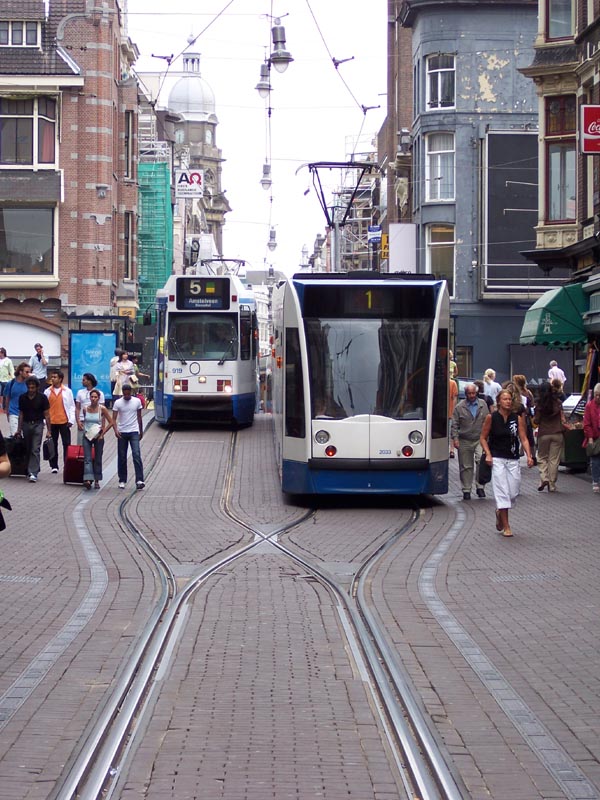
Amsterdam
Mayor of Moscow commits to tram investment – Why Not Vancouver?
The Mayor of Moscow, Russia, with a population 11,500.000 is committing investment for the renewal of the city’s extensive tramway network. Until a few years ago, Moscow’s trams were under threat of abandonment, but not to day.
Even with the world’s largest cities, trams, streetcars and LRT have proven their ability to affordably move large numbers people with the minimum of investment. Something that a certain vocal NDP surrogate and Vancouver councillor, Geoff Meggs, should consider before misinforming the public about the virtues of a SkyTrain subway under Broadway. Even though Megg’s is echoing the City of Vancouver’s long stated policy of demanding subways (especially if regional taxpayers foot the bill) for urbanAi??’rail’ transit because subways make the city “world-class“.
Megg’s and the C of V’s embarrassing anti-LRT mumbo-jumbo is doing public transit and the regional taxpayer a great disservice.

Mayor of Moscow commits to tram investment
30 November 2012
RUSSIA: Mayor Sergei Sobyanin confirmed his commitment to the future of Moscow’s 416 km tram network during a visit to a section of modernised track on Krasnoprudnaya Ulitsa on November 26.
‘We are not going to stop the tram traffic in the city’, the Mayor said. ‘On the contrary, we intend to work to make the Moscow tram service more convenient and comfortable for the passengers, as well as speedier.’
Daily ridership is currently around 600 000, and this is expected to increase by 20% once a three-year upgrading programme is completed.
A total of 57 km of the 1 524 mm gauge tramway is to be modernised this year, followed by 71 km in 2013 and 55 km in 2014. Bids have been invited for a contract to supply a potential 300 modern low-floor trams in 2014-15, and the winner is scheduled to be announced after December 15. Tram tracks are to be segregated from other traffic, and 1 min headways are planned. Work will also be undertaken to reduce noise.
Consideration is being given to the reinstatement of six former sections of tramway totalling 26 km.
Vancouver’s SkyTrain Subway Gambit

With great manipulations of the truth and terror tactics, abetted by Vision mayor and council majority,Ai??designed to scare local merchants the City of Vancouver has outlined its desire to have regional taxpayers ante up for a politically prestigious, $2.8 billionAi??SkyTrain subway, under Broadway to UBC.
The same old dated anti-LRT rhetoric, that has been used since 1980, when SkyTrain was first foisted on the taxpayer has been dusted off and used again by Vancouver’s bureaucrats and politicians. Even though modern LRT has made SkyTrain obsolete two decades ago, dated transit thinking and land-grab developer mentality, still rules regional politics.
Ever notice, no one buys with SkyTrain anymore? Well, Vancouver politicos and bureaucrats still remain blind deaf and dumb to that fact.
The NDP leaning Vision(less) Vancouver mob that controls Vancouver City Council think that premier to be, Adrian Dix, will give the city a blank cheque to fund the dated SkyTrain mini-metro subway, but financial storm clouds on the horizon may dampen any provincial funding for the project for many decades to come.
The joker in the deck is the transit bare City of Surrey and its popular mayor Dianne Watts who just may turn Vancouver’s blinkered transit planning for a hugely expensive, TransLink inspiredAi?? SkyTrain subway into a major politicalAi??bid to become Premier in 2017. The rest of the mayors and politicians South of the Fraser may agitate for secession from TransLink and even Metro Vancouver, leaving the City of Vancouver and the the rest of the muni’s North of the river at risk of seeing property taxes double, if not triple to pay for politically prestigious, but financially ruinous SkyTrain light-metro.
Let there be no mistake, if Vancouver gets a $2.8 billion plus SkyTrain subway, there will be no money on the table for Rail for the ValleyAi??or major transit improvements South of the Fraser.
Rapid transit push from Vancouver and Surrey a ai???regional investmentai??i??
Ai??Cities working together makes sense, says Vancouver councillor Geoff MeggsSurrey and Vancouver are using their combined clout to push for rapid transitAi?? projects in Metro Vancouver, despite being rivals for the scant transportationAi?? dollars available.
Vancouver Coun. Geoff Meggs said the two cities canai??i??t afford to fight overAi?? which one should get a new rapid transit line first, noting both projects haveAi?? regional significance. About 50 per cent of transit users using the BroadwayAi?? corridor, for instance, come from outside Vancouver.
ai???Thereai??i??s a strong need for regional investment,ai??? Meggs said. ai???We have a lotAi?? of people going back and forth from one city to the other.ai???
His comments come a day after a Surrey planner joined VancouverAi?? transportation manager Jerry Dobrovolny at City Hall as he outlined a vision forAi?? a $2.8-billion subway for the Broadway corridor.
The proposal, along with a rapid transit line for Surrey, are the next twoAi?? high-dollar rapid transit projects earmarked for Metro Vancouver, although noAi?? decision on which one will be built first, or when, has been made.
Meggs argues the Broadway corridor has been in line for rapid transit for atAi?? least a decade and already has more population density and economic activityAi?? than other areas in the city with access to rapid transit.
Serving the University of B.C. and the central Broadway business districtAi?? spanning from Main to Burrard streets, the route sees about 160,000 dailyAi?? transit trips. The 99-B Line, for instance, runs frequently on the BroadwayAi?? corridor, but an estimated 2,000 people are passed up by overcrowded buses everyAi?? day.
And itai??i??s no faster to drive. A recent report by the Urban Futures InstituteAi?? found UBC is one of the most difficult areas to travel to by car in MetroAi?? Vancouver.
ai???[UBC] is tucked away so even if thereai??i??s no traffic on the road it takes aAi?? long time to get there,ai??? said Andrew Ramlo, director of Urban FuturesAi?? Institute.
TransLink is studying seven options for the Broadway line, including addingAi?? extra buses at a cost of $325 million to light rail ($1.1 billion), rapid railAi?? ($3.2 billion) or a combination of the three. A recommendation is expected nextAi?? year after a technical study on the corridor is completed.
Richard Walton, chairman of the mayorsai??i?? council on regional transportation,Ai?? said any decisions on whatai??i??s built will ai???depend on the funding available and theAi?? politics at the time.ai???
He acknowledges itai??i??s ai???good politicsai??? for Surrey and Vancouver to workAi?? together, noting they have significant clout as combined they represent nearlyAi?? one-third of B.C.ai??i??s population.
This should bode well ahead of the provincial election next May, Walton said,Ai?? because ai???the size of infrastructure projects in Metro Vancouver are a huge partAi?? of provincial needs.
ai???Thereai??i??s no question that with the funding impasse the way it is, anythingAi?? that goes ahead is going to require significant capital funding in the future,ai??? he said. ai???Surrey and Vancouver are going to have to continue to lobby theAi?? business case. Theyai??i??re doing what every community should be doing and advocatingAi?? for their needs.ai???
Both projects would take at least five years to design and another five toAi?? build, meaning they wouldnai??i??t even be likely be built until 2020-2022. ai???We needAi?? to get the wheels turning and the finances in place,ai??? he said.
Meanwhile, Adrien Byrne, spokesman for the Urban Development Institute, saidAi?? Vancouver should be developing a land-use policy for the Broadway corridor. ThisAi?? would allow the city to get buy-in from the community and developers, whichAi?? would help finance the project through community amenities.
Developers are now cashing in on projects along the Canada Line, he said, yetAi?? the city isnai??i??t using developer levies for transit. And the city has failed toAi?? reap benefits along the Expo and Millennium lines as many of those stationsAi?? havenai??i??t realized higher density. Richmond, on the other hand, has built its newAi?? Capstan station using development funds.
ai???Many of those stations (along the Expo and Millennium lines) havenai??i??t beenAi?? leveraged with developments,ai??? Byrne said. ai???In many other jurisdictions transitAi?? and land use go hand in hand and in Vancouver, thatai??i??s not the case.ai???
Broadway needs SkyTrain rather than light rail, Vancouver city staff & Translink trot out the same old, same old.
Broadway needs SkyTrain rather than light rail, Vancouver city staff say
http://www.straight.com/article-843831/vancouver/broadway-needs-skytrain-rather-light-rail-vancouver-city-staff-say

By Yolande Cole, November 27, 2012
Vancouver city staff believe a subway SkyTrain line to UBC is the best way to meet the growing demand along the Broadway corridor, outweighing the option of a light-rail system that they say would not accommodate the transit needs along the busy route.
Vancouver transportation director Jerry Dobrovolny told city council today (November 27) that staff have ai???major concernsai??? about the anticipated impacts of a surface rapid transit system west of Arbutus Street, and see a subway line as the best mode to meet the projected growth in trips along what they say is the busiest bus route in North America.
ai???Weai??i??ve tried very hard and weai??i??ve looked at it for years, to see if there was a surface solution west of Arbutus, and our conclusion today is no there is not a surface solution west of Arbutus that moves the number of people that need to move in that corridor, without tremendous impacts on the corridor,ai??? Dobrovolny told reporters following his presentation to council.
Those anticipated impacts include turn restrictions on over 90 percent of the intersections along the corridor, removal of over 90 percent of the parking spaces, narrowed sidewalks, the removal or replacement of street trees, and ai???an entire reconstruction of the street corridorai???, according to Dobrovolny.
Long-term city policy has identified rapid transit along the Broadway corridor as a priority, he noted. Council has also identified a tunnel SkyTrain along Broadway to Arbutus Street as the preferred rapid transit option.
ai???This project has been identified as a priority for decades,ai??? he said. ai???The time for a decision we feel is now. And itai??i??s important to understand that a major project like this could take five years or longer to be realized, in terms of design and construction.ai???
Broadway currently sees over 100,000 people moving down the corridor daily, and approximately 2,000 passengers are passed by full buses during the peak morning hours at Commercial-Broadway, noted Dobrovolny.
ai???What that tells us is that transit capacity is not there to meet the job and population demand that currently exists in that corridor,ai??? he told council, noting the number of passengers travelling along the route is anticipated to balloon faster than projected.
Vision Vancouver councillor Geoff Meggs said todayai??i??s presentation clarified why staff believe a subway is the preferred option over a light-rail transit system.
ai???I think thereai??i??s been a lot of interest in the LRT from people who are very committed to transit, and if the cityai??i??s going to keep going ahead on the bored-tunnel option, citizens need to know why staff take a strong position, so we got a lot more clarity on that,ai??? Meggs said in a phone interview with the Straight.
ai???I think itai??i??s also important from a regional perspective to underline why weai??i??re proposing a technology which superficially looks more expensive, but we believe would deliver more in the long run, by a country mile,ai??? he added.
The ai???high-levelai??? estimated cost of an underground SkyTrain from VCC Clark to UBC is $2.8 billion, according to Dobrovolny. The price tag for an initial phase of subway construction to Arbutus Street is estimated at $1.5 billion.
City manager Penny Ballem noted the operating costs of a machine-operated SkyTrain are lower than a driver-operated LRT.
ai???SkyTrain is one of the only technologies in the world that actually costs less to deliver than the revenues it receives once itai??i??s built,ai??? she told council.
University of British Columbia officials indicated they remain concerned about guaranteed funding for the rapid-transit line all the way to the west-side campus.
ai???Weai??i??re still concerned that once the funding discussion has been held, that if there is not enough money to make the solutions as proposed happen all the way to UBC, that we might get stranded with buses running between Arbutus and our campus, which is the one solution we really donai??i??t want,ai??? Pascal Spothelfer, the vice-president of community partnerships at UBC, told the Straight in a phone interview.
Derek Zabel, a spokesperson for TransLink, said the authority is currently conducting a study that will identify and evaluate various possible solutions for the transit corridor, which will be followed by a ai???regional dialogueai??? with municipalities. He expects results of the study to be released early in the new year.
According to city staff, over half the trips made along the Broadway corridor to Central Broadway or UBC originate from outside Vancouver.
Meggs said from Vancouverai??i??s point of view, the next votes on the rapid transit issue should take place at the regional level.
ai???All transportation investment is regional, so youai??i??ve got to make the argument to all 22 municipalities that they have a stake in the outcome..because rapid transit is expensive,ai??? he said. ai???But in this case, at least half the riders are from all over the region, so this is something citizens in every municipality would benefit from.ai???
Why Is TransLink’s Price for Light Rail Triple What Other Cities Pay?
Arguments for spending billions on SkyTrain along Broadway rest on oddly high estimates for the alternative: light rail.
ByAi??Kathryn Mandell and Patrick M. Condon, Today, TheTyee.ca
http://thetyee.ca/Opinion/2012/11/28/TransLink-Light-Rail/

Future interrupted? Why is Vancouver light rail assumed to be three times more expensive than elsewhere? Image source: Steer Davies Gleave.Ai??Ai??Ai??
An extremely expensive decision for taxpayers looms near, and those making it are working with costs figures for light rail systems that seem inexplicably high, demanding closer scrutiny.
TransLink will soon be releasing its decision on a proposed transit technology for the Broadway Corridor. Two rounds of public consultation were completed for the study — in the springs of 2010 and 2011. And now both the City of Vancouver and the University of British Columbia are already calling for a bored tunnel to accommodate a SkyTrain-like system along Broadway.
TransLink’s discussion has revolved around the choice of system technology, with the options of improved bus service, a SkyTrain extension in a deep bore subway tube, a surface light rail line, as well as different combinations and iterations of each. Hired consultants Anthony Steadman and Associates estimated that the total capital cost of choosing a 12-km light rail system from Commercial-Broadway SkyTrain Station to UBC would be $1.1 billion. This compared to a $3-billion cost for a fully underground “SkyTrain” type system.
While the cost savings for a surface light rail system are clearly substantial, the advantage erodes when the “combination” systems are examined. “Combo 1” would have a subway extend from Commercial Drive station to Arbutus St., there to shift to a light rail system extending to UBC to the west and back via Grandville Island and Science World to end downtown. This alternative has received the most formal and informal support in the city. However, at a cost of $2.4 billion, many logically question why you would want to have two different technologies on the same line when for a “mere” half billion more you could zip all the way to UBC underground and in less time.
Lost so far in this conversation is an oddity. It appears that the assumed price for the light rail option is roughly three times higher than the actual costs incurred to construct similar systems in Europe and the U.S.
The cost per kilometre for the surface rail option also approaches the cost per kilometre for the recently completed Canada Line, a largely underground system. For a surface system to cost as much per kilometre as an underground system seems hard to fathom. Such a high cost for surface light rail seems even more inexplicable given the fact that the European systems navigate urban infrastructure which is much more complex to adjust for new light rail infrastructure — all at a fraction of the cost per kilometre.
Ai??
Absent a detailed explanation for this huge disparity, it would seem that a correspondingly low price tag should be realistic for the construction of a surface light rail system in Vancouver. Using figures from European examples allows us to speculate that a light rail system (exactly as pictured in consultation documents emanating from TransLink), could be built between the Commercial Drive station and UBC in the range of $360 million — $740 million less than TransLink’s estimate.
Curious about this discrepancy we investigated, as best as we could, using publicly available documents. In the interest of enhancing the conversation before this important decision is made, we share our results below.
How we got our figures
To make this comparison as fair and complete as possible, we provide cost and capacity comparisons between the current TransLink estimates and the actual construction costs for similar systems worldwide. We have also adjusted these figures to 2012 dollars. Finally we have ascertained the hourly capacity of these systems. This last point is important, as many knowledgeable voices have argued that only a SkyTrain type subway has the capacity to serve the Broadway corridor. This argument has convinced many that SkyTrain is the only reasonable option. However, many of the systems in our comparison exceed the capacity requirements for the corridor. In some cases they exceed capacity requirements quite substantially. In others they could easily exceed the capacity requirements for the Broadway corridor if more and longer cars were added and/or electrical systems were upgraded for more trains.
This question has a regional significance. Should a lower price tag be achieved, the savings could presumably be passed on to transit projects elsewhere in Vancouver and the Lower Mainland, improving access to zero greenhouse gas transit, helping our region meet its 2020 and 2050 GHG reduction targets (Greenhouse Gas Reduction Targets Act of 2007). The research conducted here is preliminary, seeking principally to provide a frame of reference for Vancouverites (and those elsewhere in the region and province) who take a keen interest in the future of public transit, and the long term sustainability of our region.
What do we mean by light rail?
The variety of terminologies used for light rail transportation projects can be confounding. Here, we are concerned specifically with transportation systems that are nearly identical to the light rail technology assumed by TransLink for its alternatives study. These run at-grade, on the street, in lanes that are separate from car traffic, and at a speed that is high enough for the express service. All of the systems we compare are double-track (two trains, running in opposite directions, operating simultaneously), and none run on former railroad lines. As there are plans to plant grass along segments of the tracks, we give some special consideration to similar applications elsewhere.

Light rail systems in other cities.
Why does the cost of Vancouver’s system stand alone as the most expensive of the lot, in one case by a factor of four? The comparison systems do not sacrifice speed or capacity. They carry more than 20,000 passengers per hour on average, and could carry many more if frequency or car length was increased. They each use vehicles with level boarding, meaning passengers can disembark at a curbside stop, rather than at a raised platform. The stations are simple, like our existing bus stops. With the exception of Minneapolis, the systems have at least partial grass tracking.
A note on the Minneapolis system. The higher price for the Minneapolis LR system in comparison to the European examples is attributable to a 3-km tunnel bored through the ground under the airport. That infrastructure is not needed on Broadway; and still, the line was completed at less than half the cost per kilometre of assumed for a similar Vancouver system.
SkyTrain vs. light rail: How much is one minute worth
A favoured point of opposition to light rail is its lower speed when compared to a SkyTrain system. Here, we look to details of the UBC Line Study for answers. TransLink estimates that a trip by LRT from Commercial-Broadway Station to UBC would take 26 minutes, while a SkyTrain subway transit ride would take 20 minutes. If that is the case, what is the price of each minute saved?
With the SkyTrain priced at $3.2 billion, the SkyTrain will cost $25 million a year per minute saved, over an amortization period of 30 years.
That means that, for every one of the 50,005,000 riders expected in a year, taxpayers will pay $3.00 for each trip, or a total of $150 million annually, to save six minutes.
Capacity
A modern street-level tram system has, maybe surprisingly, the same or higher capacity than SkyTrain. By looking at the light rail model that was chosen for the temporary Olympic tram one can see why. These trams can be conjoined to be very long. Thus the only element limiting capacity is the length of blocks along the route. Even Vancouver’s shorter blocks are 80 meters long (most on Broadway are twice that). An articulated Flexity tram under that length would provide an hourly capacity of up to 40,000 passengers per hour.
This is higher than the Canada line, the capacity of which is limited by its short stations and consequent two car maximum length per train. (See sidebar to see how we calculated comparable capacity in other cities.)
Why is the estimated cost for Broadway light rail so high?
Seeing projects that are even less expensive than those in our comparison, such as the recent light rail extension in Helsinki, emphasizes the need to ask questions about over-design and efficiency when we make choices to implement new transportation systems. If the high cost of this estimate derives from gold-plated requirements for completely rebuilding streets traversed, is this really required?
Portland recently added rail transit downtown with a bare minimum of street disruption. No major intersection reconstruction. No major utility changes. Bare bones platforms. Current cost estimates provide little in the way of detail to assess the portion of the budget attributable to rebuilding intersections, locating platforms, accommodation for ticket vending and platforms, etc.
But there’s no time like the present to push for the better use of transit dollars, to the benefit of taxpayer wallets, commuters, and residents across the region. Our region has come to the verge of committing to surface rail too many times to be derailed yet again by unrealistic and potentially unfair cost and function comparisons with SkyTrain.
Here then is our request to TransLink, Vancouver City Hall, and other public transportation researchers in the Lower Mainland: Why is the estimated cost for Broadway light rail so high? Let’s find out. The answer could be worth billions.
NOTES ON CALCULATIONS
Capacity Calculations for:
1. Angers: Trams run every six minutes, and are not linked together.
2. Barcelona: The trams run at a minimum headway of 2.5 minutes, with two rail cars linked together.
3. Lyon: Monday through Friday, trams run at a three-minute headway, with two rail cars linked.
4. Minneapolis: With minimum headways of five minutes, used during special events in the city, and three cars linked together. The system currently runs with two- and three-car trains during peak hours, and will switch to only three-car trains in 2014.
5. Nantes: Line 2 trams run at minimum headways of two minutes.
6. Strasbourg: Line B trams, with a crush load capacity of 400 passengers, run at minimum headways of three minutes.
A Broadway LRT or streetcar could look like this
LRT operating on Broadway could look like this.
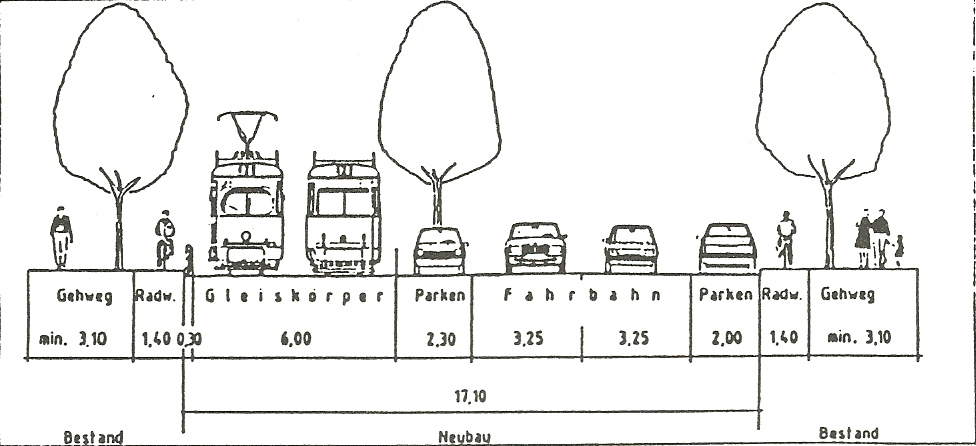
The preceding picture shows a German concept of LRT operating on a city street. Pedestrians, cyclists and motorists have good access to the city street, with the trams providing the “capacity” for high traffic flows.
If the city of Vancouver ever wished to actually reduce auto traffic, while at the same time, provide an ambient and affordable public transit, a complete rethink must be done on about major city streets and the concept of “arterial” roads. In the future, an “arterial” road, may mean a road that has a tram or streetcar!
From the Globe and Mail.
“Direct light-rail line to campus the way to go, UBC says
FRANCES BULA
VANCOUVER ai??i?? The Globe and Mail
Published Tuesday, Nov. 27 2012, 8:00 AM EST
Last updated Tuesday, Nov. 27 2012, 8:00 AM ESTUBC is urging the city to advocate for a rapid-transit line all the way out to the university right away.
Officials say the two-phase system for the Broadway line, which Mayor Gregor Robertson has been pitching, is not workable for them.
UBC has 140,000 people a day coming and going from the campus by transit, with nothing but increases on the horizon. The Broadway B-Line bus service, which currently connects the campus on the western tip of the city peninsula with a Commercial Drive station in east Vancouver, frequently has to pass up people waiting at bus stops during peak hours.
A two-phase rapid-transit line “is just not a solution,” said Pascal Spothelfer, the university’s vice-president of community partnerships. “Over 50 per cent of our passenger volume coming to UBC is by transit. That’s despite the fact that a large number of people are being passed up.”
Having a line all the way out to the university will spark even more of a transformation at UBC in how people get there and how the university develops, he said.
“It is a real game-changer, a generational shift.”
Mr. Robertson said recently the city is advocating to regional transportation authority TransLink for a first phase along Broadway with a tunnelled SkyTrain to Arbutus ai??i?? an option everyone knows is going to be expensive.
From there, he said, rapid buses could take people the rest of the way to UBC, and a SkyTrain could be extended to the campus at some undefined point in the future.
The extension was supposed to have come quickly after the Millennium Line was built from Coquitlam to Vancouver in 2001.
But it was moved down the queue after the province pushed for the Canada Line to be built in time for the Olympics.
TransLink is currently reviewing plans for the Broadway extension, along with plans for a light-rail extension for Surrey.
But UBC is saying that it might be better to build one cheaper light-rail line in order to get the whole route covered within TransLink’s budget, instead of one expensive SkyTrain for half and then buses for the other half.
“I’d rather see whatever the solution is to be a complete solution,” said Mr. Spothelfer.
Mr. Spothelfer said the two-phase solution just moves the problem down the line for the passengers trying to get across town.
“So if a train is full, do we have 20 buses waiting to take them?”
A two-phase approach also guarantees that UBC wouldn’t get rapid transit until some long-distant new round of funding, because TransLink typically only takes on a big transit expansion once a decade.
“If we miss this opportunity, it’s not like this will come back in the next two years. If a line gets built to Arbutus with no continuation to UBC now, only my grandchildren will get it.”
University officials are hoping that they hear a new message from the city as soon as Tuesday, with Vancouver’s two top engineers scheduled to give an update on the Broadway-line plans.
The university and city have been in a “very active dialogue” since the mayor made his remarks about a two-phase approach 10 days ago, said Mr. Spothelfer.
UBC has seen its students, staff and faculty shift their commuting patterns dramatically in the past 14 years, going from 77 per cent private-vehicle use to 43 per cent.
About 138,900 transit trips are now made to and from the university on an average weekday.
Mr. Spothelfer pointed out that the university is the province’s third-largest employer, with a huge number of commuters. It also has a large number of its medical students and faculty travelling regularly to the growing hospital-and-research precinct near Broadway and Oak, which is about 10 kilometres east of the university.
The mayor’s reference to a two-phase solution with buses came as news to the university.
“I was a bit surprised by him bringing up the buses again,” said Mr. Spothelfer.
He said he understands the city’s priority is serving the density it has along Broadway.
“They’re pretty set in what serves their immediate purpose.”
But he and others at the university are anxious to prove that serving UBC with good transit sooner rather than later is also in the city’s interest.
Broadway rapid transit- Is the SkyTrain subway option a done deal? – From July 2011
Broadway rapid transit- Is the SkyTrain subway option a done deal?
Posted by zweisystem on Friday, July 22, 2011 Ai?? Reprinted November 27, 2012
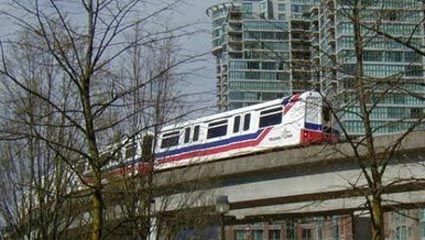
It seems that Surrey mayor, Dianne Watts, hasAi??to look over her shoulder and see what her counterparts are up to in Vancouver, before she supports a gas tax increase.
It seems a Broadway SkyTrain subway is a done deal and this gas tax money she wants to fund light rail in surrey, will probably not go to fund the stale-dated (N)Evergreen line, butAi??a SkyTrain subway in Vancouver. Any agreement on transit funding must be regarded as a mere scrap of paper that will soon be discarded at the first politically opportune time.
I think it is time for Mayor Watts and the rest of the South Fraser mayors lobby strong and hard for the BC government to cut TransLink in two; those who have SkyTrain and want to continue building with SkyTrain and those who want to build with cheaper transit options.
The refusal of Vancouver politicians to consider modern LRT for Broadway, just confirm that South Fraser taxpayers are regarded as peasants and vassals, country bumpkins, who are nothing more than tax ‘milch-cows’ to fund Vancouver’s ambitious and extremely expensive SkyTrain subway building program.
Update: Nothing has changed as the City of Vancouver Engineering Dept. is hell bent to secure a SkyTrain subway for Broadway, no matter what the cost. Vancouver Councillor Geoff Megs and a sundry of NDP types are cheer-leading a multi billion dollar subway for Broadway, paid for – well you guessed it, the long suffering South Fraser taxpayers. The question is; “Has, NDP premier in waiting, Adrian Dix, alrady agreed to fund a SkyTrain subway for Broa
Vancouver mayoral candidates Push for Broadway tunnel
but business owners, pointing to Cambie Corridor Canada Line experience, fear business loss if subway option is approved.
By Glen Korstrom ai??i?? Business in Vancouver
Vancouverai??i??s mayoral candidates are pushing for a SkyTrain tunnel link under the Broadway corridor to be the regionai??i??s top transit priority once Evergreen Line financing is confirmed.
The proposed link would connect with the Millennium Line and go as far west as Arbutus ai??i?? a route that will inevitably cause friction given that many Broadway business owners fear any type of tunnel construction along their corridor will kill their enterprise.
TransLink spokesman Ken Hardie told Business in Vancouver that TransLinkai??i??s board has yet to determine the top regional priority after the Evergreen Line.
ai???Everything from Surrey rapid transit to Broadway rapid transit to gondolas going up Burnaby Mountain all fall into the queue,ai??? he said.
Vancouver Mayor Gregor Robertson and his Non-Partisan challenger Susan Anton agree that reducing congestion on the Broadway corridor is vital for the region.
ai???Itai??i??s crucial that we have the Sky-Train technology through the Broadway corridor,ai??? Robertson told BIV in an exclusive interview June 29.
ai???The growth and population and the traffic challenges in the Broadway corridor are unsustainable, so weai??i??ve got to see the Broadway corridor served by the big pipe.ai???
Anton described the proposed link as a ai???regional line with regional importance.ai???
The Broadway corridor is the second busiest employment centre outside the downtown core, and TransLink estimates that there are 110,000 trips along the Broadway corridor each day.
ai???In central Broadway, the only way you can manage the number of trips is with SkyTrain technology,ai??? Anton said.
Anton’s and Robertsonai??i??s mutual belief that SkyTrain is the only viable technology in the Broadway corridor worries business owners and frustrates light-rail advocates. Ray’s Beauty school for Hairdressing owner Gina Ray told BIV that she will close her 12-year-old business if regional politicians approve any form of tunnel along Broadway.
She likes the idea of a burrowed tunnel but fears that construction will cause more disruption than authorities say.
ai???I donai??i??t trust them,ai??? she said. ai???On Cambie Street there were so many businesses that went bankrupt or had to close. They did not expect to have the cut-and-cover [construction method].ai???
Indeed,Ai?? Hazel & Co owner Susan Heyes suffered a drastic drop in customers for her maternity wear store when the Canada Line construction consortium dug a tunnel outside her store.
She lost aAi?? B.C. Court of Appeal judgment after she sued to recover $600,000 in damages from the consortium for business losses. Her only hope now is for the Supreme Court of Canada
to agree to hear the case.
The West Broadway Business Improvement AssociationAi?? (WBBIA) officially opposes a tunnel. Its directors have examined TransLinkai??i??s seven options for improved transit in the Broadway corridor and decided that at-grade transportation, whether it involves more buses or a light-rail system, is preferable.
ai???We donai??i??t want a SkyTrain tunnel. Whether it is cut and cover or a bored tunnel doesn’tai??i??t matter to us, because bored tunnels take longer and construction would cut off all the east-west traffic on West Broadway for a number of years,ai??? said WBBIA director Donna Dobo, who owns the West Broadway costume store Just Imagine.
Light-rail advocate Malcolm Johnston has been lobbying to build light rail on Broadway for decades. Light rail would not require construction of a tunnel. It would instead run at grade along the existing corridor.
Now part of Rail For The Valley, Johnston spends much of his time lobbying to have light rail in the Fraser Valley. But he still thinks light rail on Broadway is the more practical and a better value than building a subway.
ai???TransLinkai??i??s planning is arcane,ai??? Johnston said. ai???Itai??i??s dated, and they misinform the public. What else can I say? I wouldai??i??t trust them to build an outhouse.ai???
Johnston, who is familiar with TransLinkai??i??s seven proposals, believes the transportation authority has skewed its figures to make rapid transit appear to be a more viable option than either light rail or buses.
He believes TransLink pulls numbers out of the air, such as its assertion that 110,000 bus trips are made daily in the corridor.
Despite BIVai??i??s repeated requests for details about that figure and estimates, TransLink was unable to provide that data.
ai???TransLink says SkyTrain attracts more ridership than light rail. This is absolutely unproven,ai??? Johnston said.
ai???Sit down for this. Light rail has a bigger capacity than SkyTrain. This is contrary to the spin that TransLink has. De facto, a streetcar or even light rail has proven to have higher capacity than a subway unless you build a London-style metro [with multiple lines and longer trains].ai???
gkorstrom@biv.com
Dead Parrot Sketch
Want fast express bus service?
Simple, run it point to point without any intermediate stops.
This is what TransLink is going to do on the proposed new 555 Port Mann express bus service from the newAi??Carvolth bus exchange in Surrey to the Braid SkyTrain station in New Westminster, without intermediate stops.
Er….excuse me TransLink, isn’t a bus service supposed to stop along the way to pick-up or set down transit customers?
Evidently not and it seems potential bus customers have to “magic” themselves on the bus if they want to travel from Surrey to Vancouver.
Sadly, TransLink seems completely out of its depth trying to run a transit system and hopefully it is only a matter of time for the powers that be put TransLink out of its misery. TransLink and its ponderous and equally expensive bureaucracy is like Polly Parrot from the famous Monty Python pet shop sketch, “is no more“, “has ceased to be“, “bereft of life, it rests in peace“, “ ****ing snuffed it!”
Let us hope regional politicians feel the same.
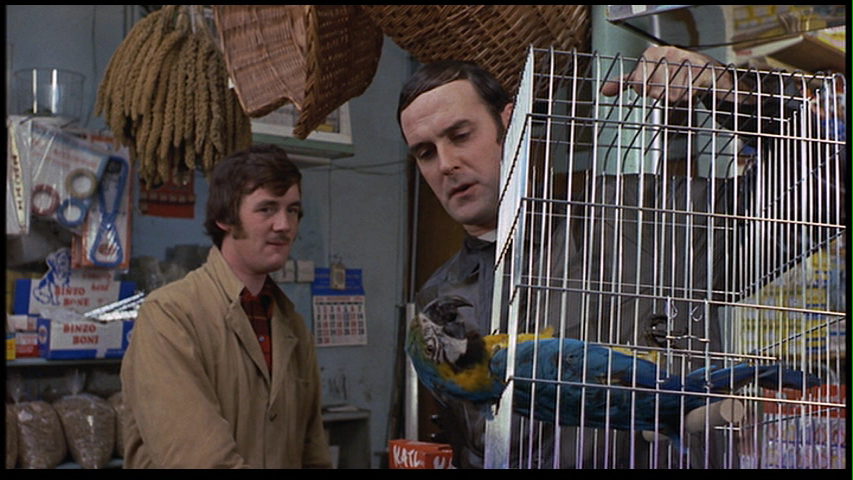
Port Mann express bus from Langley to bypass Surrey
Ai??Abandoned plans for transit exchange likened to a Monty Python skit
By Tara Carman, Vancouver SunNovember 22, 2012
Surreyai??i??s mayor and residents are angry that rapid bus service over the new Port Mann Bridge will not stop in their city, despite the fact they are being hit with the brunt of the tolls and live in the regionai??i??s second-largest city.
Surrey Mayor Dianne Watts compared the absence of a bus stop in her city for a new express bus between Langley and Burnaby to a comedy skit.
ai???The tolls are being implemented on the Port Mann Bridge, and now youai??i??re not going to put a stop in Surrey?ai??? Watts said, adding that it is ai???unreasonableai??? for the rapid bus line to bypass a city of half-a-million people.
ai???Youai??i??ve got the province that built the infrastructure, youai??i??ve got the city (of Surrey) thatai??i??s always expected it and youai??i??ve got TransLink saying it was never there. Itai??i??s like a Monty Python skit.ai???
Plans floated by the provincial Ministry of Transportation as part of the Gateway program depict a new transit loop and park-and-ride at the intersection of 156th Street and Highway 1 as part of a rapid bus service between Langley and Lougheed Mall. But there are no plans for that bus, which will start running when the new bridge opens Dec. 1, to stop in Surrey.
Watts said she is continuing to press TransLink and the province for a Surrey stop on the rapid bus line.
ai???However it gets worked out, we need to have a bus stop and pickup for those residents in that part of the city.ai???
Watts said that until a few days ago, city engineers were working under the assumption that there would be a stop at 156th and were discussing it with officials from both TransLink and the province.
Transportation Minister Mary Polak said the initial plan, from 2007, included a transit interchange at 156th Street, but TransLink abandoned the concept.
ai???At this stage and as far as I know, fairly early on in the discussions, TransLink ruled out that possibility for the initial launch of the express bus,ai??? Polak said Thursday.
But that does not mean the bus wonai??i??t stop at 156th in the future.
ai???We have built infrastructure into the 156th part of Highway 1 in anticipation of (the transit interchange) happening eventually.
ai???The concept, in essence, remains and thatai??i??s why weai??i??ve built in the infrastructure because eventually that will become something that they will put in place. They made the decision not to do so now, but itai??i??s still contemplated in the future.ai???
But TransLink spokesman Derek Zabel said a stop for the rapid bus line at 156th Street was never part of the plan.
An earlier concept under consideration by local and provincial government officials, developers and TransLink involved the creation of a larger development and transit exchange at 156th, Zabel said.
ai???I know that there are some maps that would show that, but ai??i?? no commitments were ever made and discussions didnai??i??t continue.ai???
When the express bus ai??i?? called the 555 Port Mann ai??i?? hits the roads next month, it will run between the Carvolth transit exchange at 86th Avenue and 202nd Street in Langley and the Braid SkyTrain station in New Westminster. The western terminus will change to Lougheed Mall when the appropriate ramps are built, Zabel said.
The bus will run every 10 minutes during the morning and afternoon peak periods and every half-hour during non-peak hours.
Surrey residents supported the new bridge and the rapid bus line in part because it would have provided a faster and more direct commute option for residents of communities near the bridge, such as Fraser Heights and Guildford, Watts said. The alternative for transit users such as Daryl Dela Cruz is to take a longer bus route along 104th to Surrey Central station.
ai???This is absolutely unfair treatment to the citizens of a city that is years overdue for proactive investment in competitive rapid transit services,ai??? said Dela Cruz, a Surrey transit advocate who lives near 156th Street and had planned to use the bus.
He was surprised to learn that it would not stop there while checking for schedule information several days ago.



Recent Comments