The Cardinal has recently returned from a short holiday in Budapest, Hungary.
Budapest is a walking city and theSeptember weather makes it ideal to wander around on foot with many cozy cafAi??s and restaurants offering their retreat if needed when temperatures cool down. With over 100 museums and galleries the city also offers many indoor attractions and activities to suite every interest.
Budapest has an extensive, affordable & reliable public transport system, the Metro, diesel buses, trolley buses and of course the famous Budapest trams
Budapest is a fascinating place-a mix of East and West, old and new, castles and shopping malls. Decades after the collapse of communism, most of the young people are learning English as a second language and have been picked up a few lessons in common courtesy from the western service industry. After all, they wouldnai??i??t want to be thought of as Eastern European
Not surprising that Vancouver’s bureaucrats have rejected a proposed Vancouver streetcar; why build a cheap streetcar when you can sucker Fraser Valley politicians to fund a $4 billion SkyTrain subway under Broadway. Oh no, you say: Anton’s proposed streetcar has nothing to do about the Broadway rapid transit project. Well, sorry to say, it does, because city mandarins and TransLink desperately do not want any streetcar operating anywhere in Vancouver or the Vancouver Metro region, lest a modern streetcar operation will expose 32 years of inept planning, deliberately misleading politicians and professional misconduct.
Vancouver, bureaucrats have a lot to lose if a modern streetcar system were to be built in the city.
Operational note: The Eurotram, pictured below, having a capacity of 225 persons (all seats occupied and standees @ 4 persons per metre/2); at 2 minute headways can carry 6750 persons per hour per direction; at one minute headways, 13,500 pphpd. Two car trains can carry 13,500 pphpd at 2 minute headways and 27,000 pphpd at 1 minute headways.
A modern streetcar in Strasbourg France, doing what Vancouver bureaucrats claim can’t be done.
Vancouver city staff reject NPA’s streetcar network proposal
By Yolande Cole, September 22, 2011
The Georgia Straight
A proposal from NPA mayoral candidate Suzanne Anton to fast-track a downtown streetcar line was shut down by City of Vancouver staff today (September 22), who said the city shouldn’t pursue the project independently of TransLink.
The streetcar proposal came up during a city council discussion on the 2012-2014 capital plan, when COPE councillor David Cadman asked city staff whether the project could be funded through the three-year plan.
“It’s not a project that the city would pursue on its own – it’s a project that has to be pursued integrally with TransLink,” said city engineer Peter Judd, in response to repeated questions from Cadman.
Judd added that the city’s focus and priority is on a Broadway corridor strategy.
“The Broadway line will have a far higher improvement and impact on transit use than the streetcar,” he said.
City manager Penny Ballem said while the streetcar idea is something that city councils of the past have discussed, she noted it would be “a very significant capital expenditure”.
“It would be a challenge for us, and almost not feasible to try and find that within our existing plan,” she said. “To actually even remotely consider that it would be a question of incurring more debt.”
“This is something that we don’t want to close doors in the future, but we’re a long way from being able to seriously consider putting this in place,” Ballem added.
Anton wasn’t discouraged by the answers from city staff.
“The streetcar is my priority – I am very confident that the streetcar can be built,” she told the Straight in an interview. “The reason it’s being framed in that way is because this council has given no direction and no support for a private partnership. I believe it can be done with private partnership.”
“If you bring that element into it, and if there were to be other grants from other levels of government, which is possible, and which I intend to pursue vigorously, I think those answers would change quite dramatically,” she added.
Anton announced Wednesday (September 21) that if elected mayor, she would establish a task force within 60 days to begin work on fast-tracking the streetcar network.
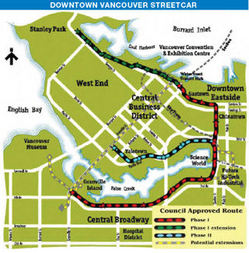
The proposed network would run from Granville Island to Waterfront Station.
The government has set out its intention to trigger a light rail renaissance in the UK and while specialists welcome the move some are concerned about costs
Major cities such as Leeds and Bristol are missing out by not having either a tram or underground system, says Friends of the Earth.Ai??Ai??
The government has set out its intention to trigger a light rail renaissance in the UK, as part of efforts to cut carbon and create growth.
The findings of a much-delayed government review of light rail was finally unveiled this week by transport minister Norman Baker.
The Department for Transport (DfT) report concluded that light rail ai??i?? better known as tramways ai??i?? has a future in the UK if capital costs can be reduced and officials called on the industry to implement a universal design standard to bring down costs.
Once a common sight in every major UK town and city, trams are now seen as an expensive transport solution by local authorities ai??i?? costing an average of A?25m per mile to build in urban areas.
This image crisis has been exacerbated in recent years by the beleaguered Edinburgh tram project, which has been subject to delays, contractor disputes and an astronomical rise in cost.
The report revealed the cost of the Edinburgh tram project is actually four times higher than that of other similar schemes. It cited problems with utility diversions as playing a major role in pushing up the costs by some A?200m.
The DfT has also recommended looking at cheaper tram projects on the continent and urged the industry to set up a centre of procurement excellence to advise on procurement options.
In 2010, an inquiry by the All Party Parliamentary Light Rail Group ai??i?? of which transport secretary Philip Hammond is a member ai??i?? suggested tram schemes could be made more “deliverable” if the UK market was encouraged by more projects.
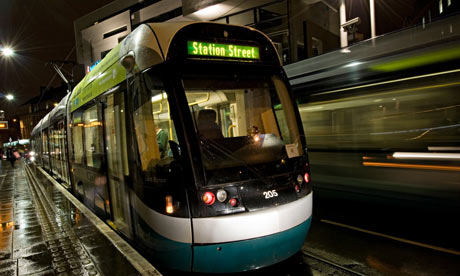
Despite the majority of UK tramways being dismantled during the 20th century as the popularity of motoring soared and prompted new road building, some new schemes have opened up in recent years. These include Manchester’s Metrolink, the West Midland Metro, and others in Croydon, Sheffield and Nottingham.
Work is now underway in South Yorkshire to develop a ‘tram-train’ service between Sheffield and Rotherham.
Such transport systems are cheaper than conventional tram and railways and are popular throughout Europe.
We asked five transport specialists for their views:
Norman Baker, transport minister
Light rail is good for passengers, good for local economics, good for the local environment and it’s a mode of public transport that passengers really enjoy using ai??i?? that is why I’m committed to doing everything we can to bring costs down to make it a viable option for more communities.
In the past light rail systems have been seen as expensive and an unaffordable option for local authorities to pursue ai??i?? I initiated this review so we can get to the nub of the problem. I now urge all parts of the light rail sector to work together on implementing these recommendations and I look forward to working with them towards these exciting opportunities.
Adept recognises that light rail can have economic benefits, reduce congestion in town centres and de-carbonise transport networks, however the association is concerned about the high infrastructure costs associated with developing a light rail network when there are many competing transport maintenance and infrastructure projects for the reduced funding that is currently available.
We would wish to be involved in discussing the issues and recommendations in this report with the DfT, UKTram and other interested parties in order to develop a sector-led implementation plan for developing light rail as part of the UK’s integrated transport system
Trams are a low-carbon solution to congestion ai??i?? the report’s call for the network to be expanded is spot on.
Major cities such as Leeds and Bristol are missing out by not having either a tram or underground system. Providing green alternatives for short journeys should be a higher priority for the government than spending billions of pounds on High Speed Rail.
A major opportunity has now opened up to deliver more, and more affordable, tram schemes through effective joint working between the government, local transport authorities and the light rail industry.
Across Europe tram-trains are now revolutionising urban transport systems and bringing down the costs of providing those systems. The UK trial of tram-train technology has been far too stop-start so far and there’s a need to pick up the pace to get this trial fully underway as soon as practical. It’s now a matter of when, and not if, tram-trains come to Britain’s major cities so let’s make the ‘when’ as soon as possible.
[We] look forward to help meeting this challenge in the forthcoming industry debate and tram summit by citing the low cost designed tramways such as those in Besancon, France and Portland USA. In both Besancon and Portland the projects were designed to a fixed cost.
The minister’s recommendation of having a centre for procurement excellence will help promoters obtain clear contract and specification guidance which has been based on prior experience and will avoid contractual disputes such as in Edinburgh’s tramway.
We welcome the DfT beginning a consultation exercise on proposals to devolve the capital funding for local major transport schemes and the minister pointing to tax incremental schemes as forms of possible finance for authorities promoting affordable schemes.
What will happen next?
The DfT will launch a consultation to seek views on how diverting utilities beneath planned tram routes can be simplified and made cheaper. A high profile summit will also be held between Whitehall and the industry to agree an implementation plan to move forward.
A candidate for mayor in Vancouver has promised a city-initiated streetcar system, but Watts says Surrey is still waiting for something in return for all the money it has poured into TransLink.
"Folks south of the Fraser have continually paid for infrastructure, whether it's in Richmond, Burnaby, Vancouver, wherever, we continue to pay without the expansion of our own system."
She wants more benefit for the taxpayer dollar. "I mean I looked at my tax bill and me personally, I pay $916 a year to TransLink."
Watts says TransLink is open to the idea of light rail and points out the transit authority will have to do something sooner rather than later. "I come back to the fact that over the next 15 years, 70 per cent of the region's growth is going to be south of the Fraser."
Watts wants to get light rail out of long term plans and make it a short term requirement, but she admits there's a major hurdle in the way of transit expansion in BC's second largest, and fastest growing city. "Nothing is going to move forward unless the Evergreen Line gets built."
So in the meantime, Watts says she's going to work with local mayors and the transportation ministry to come up with alternative funding options for TransLink to make sure service can be expanded everywhere.
Those ideas may include advertising and station naming rights.
Interesting and welcome news from Vancouver where right leaning mayoralty candidate, Susan Anton, is endorsing streetcars for Vancouver.
Vancouver’sAi??current streetcar planning is extremely amateur, and what can one expect from a city, whose engineering departments have been so anti LRT! I do not think a private consortium will step forward to fund the current inept streetcarAi??plans, but may offer to be involved in a real winner such as a Marpole to downtown streetcar, using the Arbutus Corridor or a Hastings Street to Stanley ParkAi??or Broadway to UBC streetcar instead.
What Ms Anton has really done is open up the streetcar/LRT Pandora’s Box of public transit debate, where a lot of very old anti LRT rhetoric will tossed about by the ‘roads‘ and ‘SkyTrain‘ lobbies. Their main fear, of course, is to prevent any workable streetcar/LRT solution other than a heritage lineAi??for the city, lest politicians, the public and importantly, the bean-counters, make an apples to apples comparison with LRT/streetcar and SkyTrain or bus.
The sad part of this announcement is the so-called green Vancouver Vision civic party and the recently dumped COPE councilor, the self proclaimed environmentalist David Cadman, have been left in the dust with this announcement.
Ms, Anton, I believe, is doing what the taxpayer wants, build streetcars and whether this ultimately happens, only the future will tell.
The Siemens Combino tram, offers one of the largest streetcars in the world, with a capacity of 350 persons.
It carries more customers than a 4-car SkyTrain Mk1 train set!
VANCOUVER (NEWS 1130)
A candidate for mayor in Vancouver promises to bring back the downtown streetcar as a top priority. Suzanne Anton says her team will act within 60 days, if elected, to speed up the city’s transit plan. The announcement comes ahead of Anton’s platform being released next month.
She says the city already owns all the right of ways but stations would have to be built and streetcars brought in. She tells News1130 it will likely pay for itself within a decade.
“Ridership forecasts for the streetcar exceeds some of Vancouver’s most heavily-used bus corridors by providing a year-round connection to two transit lines and Granville Island’s 11 million visitors a year.”
The initial route would connect Granville Island with the Canada Line, Science World, Chinatown, and Waterfront Station. A second and third phase would include extensions to Yaletown and Stanley Park.
In a 2005 report, the cost for phase one was $80 million, a number Anton admits needs an update. It would be a public-private partnership and she doesn’t expect TransLink to invest, but hopes they can work out an agreement on fares with two rapid transit lines connected.
“But they will need to be a partner, and it needs to be integrated with the regular transportation system. Assuming at the moment that the cost will be the same as the TransLink ticket, people expect all their transportation to be integrated.”
A downtown streetcar plan has been in the works for decades and has been the subject of numerous trials and studies. The latest happened during the Olympics when Bombardier demonstrated its cars on a line between Granville Island and the Canada Line.
Anton says shutting that transit line down after the 2010 Games was a big mistake.
Interesting local news about implementing a modern streetcar line in the greater Vancouver region.
Modern trams are not as expensive as one would think as the following shows, but if TransLink is involved, the cost of a new tram/streetcar would be at almost ten times more!
On October 11, 2006 he Spanish town of Véléz Malaga finally opened its tramway for public service. Over 15000 passengers were carried on the first two days. The 4.6-km line links the town (20 km east of Malaga) with its beach resort of Torre del Mar and cost EUR 18 million (CAD $24.59 million). The cost of the 4.6 km Véléz Malaga tram works out to about $5.4 million/km!
One wishes the promoters on the North Shore and Vancouver well, but I have my doubts that myopic politicos will allow a streetcar to be built; while in Vancouver, politicians may feel that Surrey may get streetcar funding before they do.
What is of particular interest is that the right leaning Vancouver NPA civic political party is endorsing a streetcar, which certainly tells Zwei that the public are on board for such a venture, nothing is promoted in Vancouver without extensive polling of the publics opinion.
Modern streetcars fit into the urban landscape.
End of the line
North Shore News September 21, 2011
In a perfect world, a streetcar service connecting North Vancouver’s utilitarian but depressing Phibbs Exchange with West Vancouver’s quaint and quirky community of Dundarave would be packed with tourists flinging cash out of the windows at local businesses.
Unfortunately for Coun. Bob Fearnley’s idea, startup costs in today’s environment of fiscal prudence make it a non-starter.
Municipal, regional and provincial coffers are filled by the same taxpayers who are already turning white from blood loss and have no appetite for underwriting TransLink’s current plans to expand service. For this concept to be taken seriously, a private benefactor willing to pay the infrastructure costs is necessary. Monday night’s City of North Vancouver council meeting made no mention of such backers.
Then there is the congestion issue. East-west traffic on the North Shore – especially at the Marine Drive level – gets more difficult by the month and will continue to get worse. Additional residential development is planned in Lynnmour/Second Narrows, Lower Capilano and Park Royal. We know it is likely in Lower Lonsdale, Mosquito Creek, Harbourside, Ambleside Park and Ambleside. Surely we are not going to add rails to the road on a corridor that is already choked to breaking point.
We would be far more supportive of an idea previously discussed by city council about running North Vancouver’s restored Streetcar No. 153 along a short rail line, perhaps connecting Mosquito Creek and the shipyards.
Portland’s Skoda Inekon low-floor articulated trams (streetcars) has a capacity of 157 customers.
Mayoral candidate Anton hops aboard Vancouver streetcar plan
By Kent Spencer, The ProvinceSeptember 21, 2011 12:02 PM
Suzanne Anton promises to bring streetcars to Vancouver if she is elected mayor of Vancouver in November’s civic elections.
“The benefits would far outweigh the initial costs,” she told a press conference that kicked off the NPA’s election campaign.
Anton provided few details of how the $80-million line, from Waterfront to Granville Island, would work or who would pay for it.
She said the NPA would seek private investors within 60 days of being elected.
The Vancouver Sun, Like the old Soviet "Pravda" of old, is interesting for what it prints and for what it doesn't print. The Sun has been a long supporter of SkyTrain and the paper and its editorial board has gone so far as to play fast and loose with the truth about light rail.
Anyone who knows anything about metros and light rail, knows that they age and appropriate measures are taken to ensure smooth operation. SkyTrain is now 26 years old and by all news reports, is in need of mid-life refurbishment, yet TransLink, it seems, has no plan nor no money for midlife renewals – why is this?
More and more, it looks like the two cent a litre gas tax proposed by TransLink is nothing more than a ruse to let more taxpayer's monies, without telling the whole truth why more tax monies are needed. It seems the wily mandarins on Kingsway are trying to fool regional politicians and regional taxpayers as to the real reason for more and more tax money must be shoveled into TransLink.
I think regional taxpayers should put their foot down and reject TransLink's demands and let the chips fall where they may, as it stands, TransLink is like a spoiled child which has temper tantrums every time it doesn't get what it wants and regional and provincial politicians cave in giving TransLink more of "other people's monies" to stay quiet.
For a start, why not we rid ourselves of TransLink altogether as it really doesn't do a thing but give nonproductive bureaucrats a free ride, then hire real experts to plan and design the transit system we need, just like what Rail for the Valley did two years ago!.
Renew SkyTrain with greater share of gas tax
By William Zander, Vancouver SunSeptember 21, 2011
Re: Expect more breakdowns if fare hike and gas taxes rejected, Trans-Link says, Sept. 17
This article is alarming, to say the least. A SkyTrain renewal is needed more than ever to relieve gridlock, not to mention pollution, noise, and the escalating cost of roads, renewal, and maintenance.
Rather than letting the system deteriorate, it would be more productive to take a positive stance on its muchneeded upgrading.
Consider how money and faith were put into the system to start with.
Lay out the problems and convince us that it is an absolutely necessary way to reduce greenhouse gases, and that we must find the money not only to improve but also to renew the 25-year-old system.
The Expo Line has been allowed to become a noisy, screeching, rattletrap system, inside and out. Why has this been allowed to happen?
Increasing fares is counterproductive; property taxes have already sucked up downloading from the provincial and federal governments on services and infrastructure renewal.
It's a transportation issue of a magnitude to warrant both provincial and federal support and a larger share of the gas tax.
Well, lots of news about SkyTrain and how it's getting older and whole lot of money must be spent to refurbish the metro system. Well, hasn't TransLink planned for this or do they just think that the taxpayer will shell out more money to keep the aging behemoth running.
All transit systems age and transit managers should take into account that mid-life refurbishments must take place and have the appropriate plan to deal with the problem. It seems TransLink's mandarins have not.
Long predicted by transit experts, proprietary metro systems like SkyTrain to not age well, especially driverless transit systems, where the delicate and complicated signaling kit gets very balky as each year passes, as evidenced by SkyTrain's many stoppages this month alone. This of course, drives up operating costs, and i just wonder if TransLink deliberately put off necessary maintenance of the signaling system to pretend that SkyTrain's operating costs were much cheaper than they really are to both help securing a SkyTrain Canada line and help Bombardier sell a SkyTrain to Hawaii.
This sort of thing is not new, as back in the 90's BC Transit deferred maintenance schedules on buses and SkyTrain in order to successfully win a CUTA transit award. Only months later the transit system collapsed because buses broke down regularly and for many, taking transit for several months was a nightmare. This episode actually made Zwei with to the car to commute to Vancouver!
I think TransLink has a nasty surprise for those mayors wanting to vote for the two cent a litre gas tax and the surprise is, the extra monies will not go to fund better transit service in the region, rather to keep a badly aging SkyTrain in operation.
Transit riders better brace for a 12 per cent fare hike in the spring of 2013.
That's what TransLink has planned, TransLink Commissioner Martin Crilly told Metro Vancouver mayors Thursday.
Crilly, whose office vets such proposals, said it's too early to say whether he will rule that big a fare hike reasonable or not.
"It's a substantial increase," he said, noting it is far above inflation.
"We will want to satisfy ourselves the increase is justified and can't be deferred and not reduced in amount."
More modest fare increases for inflation are also scheduled for 2016 and 2019.
Some mayors questioned whether the 2013 hike is too much given the region has high fares already relative to some other transit systems.
TransLink estimates the 12 per cent fare hike in 2013 will only result in a loss of two per cent of revenue from riders refusing to pay that much more, leaving a net fare revenue gain of 10 per cent.
Crilly was giving the region's Mayors Council on Transportation his analysis of TransLink's proposed plans to raise revenue for future expansion.
One big cost driver Crilly flagged was TransLink's plan to replace buses with more expensive diesel-electric hybrid models.
But he found overall the plans are "not unreasonable" and would leave TransLink financially sustainable.
He noted the transportation authority has a history of failing to actually spend all the capital money it promises to after new revenue increases are granted.
It is annoying, not only to commuters, but those who support other transit modes, that the SkyTrain Lobby continue this silly nonsense that it trundles back and forth with nary a problem. In just the past few weeks, the SkyTrain system has stalled due to many problems.
TransLink wants desperately to build more SkyTrain and continues to pretend that when the system goes down, it's really nothing at all.
The one problem SkyTrain has is that it is an aging and complicated proprietary light-metro system and aging gadgetbahnen tend to have a lot more problems than light rail and service stoppages will only increase with time, but you will never get the SkyTain lobby to ever to admit to that.
SkyTrain service returning to normal after disruptions in Surrey
By Evan Duggan, Vancouver Sun September 16, 2011 6:42 AM
METRO VANCOUVER – SkyTrain service is returning to normal this morning after disruptions at the four Surrey stations due to a power supply problem.
By 7 a.m., train service should be back up and running east of Royal Oak on the Expo line, said TransLink spokesman, Drew Snider.
The stretch between Columbia and Braid on the Millennium is also operating again.
During the delay, a series of bus bridges were set up to link King George and New Westminster; Surrey Central and New Westminster; New Westminster and Lougheed, New Westminster and Royal Oak; and Columbia and Lougheed.
Commuters are asked to be patient, as station platforms are expected to be very crowded due to the early-morning delays.
Officials say the disruption was caused by a power supply problem with one of the vehicle control computers.






 Report: Green light for light rail (PDF – 561 KB)



Recent Comments