Coast Mountain buses passed by stops more than 200,000 times in 2010
The following story, “Coast Mountain buses passed by stops more than 200,000 times in 2010“, is one of bad management rather than anything else. What we see is TransLink’s policy of “to hell with the customer“.
What is sad is that there areAi??many politically inspired bus routes, designed specifically to placate civic politicians in the region, that carry very few customers a day and one would question why they are being operated at all.
In South Delta, the 609, C-84Ai??& C-89 buses, which operate an hourly service or better seven days a week, barely altogether carry 20 customers a day! The 620, Bridgeport station to Tsawwassen Ferry terminal, via Ladner exchange, operates almostAi??empty articulated buses, during the slack weekdays, where standard buses should be used instead, freeing up the artics. for more congested routes in Vancouver. If South Delta isAi??indicative of marginal bus operation, then marginal bus operationAi??elsewhere in the region must be rampant.Ai??If we had competent management thenAi??there should be ampleAi??transit resources to eliminate passenger congestion and pass-ups elsewhere on the transit system.
The question is: “Is TransLink and West coast Mountain Bus competently managed?”
Zweisytem is a perfect example on how bad bus service drives customers back to the car.Ai??’Zwei’ used to commute every day from South Delta to downtown Vancouver, but the reliability of the bus service, plus constant pass-ups was such that IAi??began takingAi??the car. What I found was that I was spending about 20% more, byAi??commuting byAi??car, with the commute time being shortened by almost 30 to 45 minutes a day, plusAi??I had the ability to alter my commute to shop or meet the wife.
What this all means is that West Coast Mountain Bus and TransLink do not give a damn about the transit customer and the public without aAi??vehicle to compel TransLink to provide a better transit service, the TransLink’s ossified central bureaucracy will not lift a finger to improve bus services on over crowded routes.

Documents reveal Coast Mountain buses passed by stops more than 200,000 times in 2010
Company says thereai??i??s little they can do to help frustrated riders
By CHAD SKELTON, Vancouver Sun –
To Simon Fraser University by funicular!
Last year there was much talk of an aerial tramway, linking theAi??Millennium Line to Simon Fraser University, but like all transit projects in the region, it has stalled for lack of funding. The SFU aerial tramway project is projected to cost nearly $70 million, which breaks down into $38.2 million for manufacturing the actual lift and $30.7 million for construction of terminal buildings, purchase of land, and other related costs. Annual operation expenditures are estimated to be just over $3 million.
http://www.bclocalnews.com/tri_city_maple_ridge/tricitynews/news/121532939.html
http://www.the-peak.ca/article/21838
Is there a cheaper way to connect SFU, on its mountain top location?
The answer couldAi??be yes,Ai??by building a funicular.
A funicular, also known as aAi??Ai??inclined railway, is a cable railway in which a cable is attached to a pair of tram-like vehicles on rails moves them up and down a steep slope; the ascending and descending vehicles counterbalance each other. Being cable hauled means that it can operate in all weathers.

Cairn Gorm funicular at the passing point.
The Cairn Gorm funicular in Scotland, which opened in 2001 had an estimated to have cost of around A?19.6 million (Approx. Cad $31 million) for the two kilometre line. The funicular costs about $15 million/km to build, which makes it cheaper than the estimated $70 million for the proposed SFU aerial cable car.
http://www.funimag.com/funimag22/CairnGorm01.htm
The recently rebuilt Sierre-Montana-Crans funicularAi?? is the worlds longest funicular at 4.1 kilometresAi??(or just over 2.6 miles) and links the city of Sierre, in the Rhone valley, to the Crans-Montana-Vermala resortAi??with a 12 minute ride.
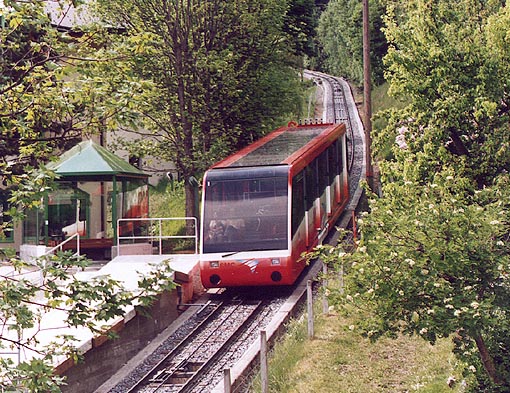
The Sierre-Montana-Crans funicular stopping atAi??one of four intermediaryAi??stations along its route
It is realisticAi??proposition that a 3 kilometre SFU Funicular connecting to the Millennium LineAi??would costAi??between $45 million to $50 million and with modern funiculars being automatic (driverless), it would have cheaper operating costs. The trip time, which would be unimpeded by snow and freezing rain, would be about 8 toAi??9 minutes or slightlyAi??longer if there was an intermediary stop.
The two cabins (what funicularAi??vehicles are called) can accommodate as many as 120 persons apiece and with aboutAi??6 trips an hour, the SFU funicular could carry as many asAi??720 persons per hour per direction. With a station at the midway point, the SFU funicular could also provide a local transit service for residents who live in the Forest Grove residential area, something that the aerial tramway would not do.
It is always wise to consider many Ai??transit option for a proposed new transit line and with the SFU funicular, it may have less capacity than an aerial tramway, but it would be able to service residents along its route guaranteeing high ridership in all seasons.
A SFU funicular would not only be cheaper to build, it would also cheaper to operate and maintain, with the bonus of providing a transit option to local residents. A funicular, connectin SFU with the Millennium Line certainly makes the grade!
Trams are good for your health – 3
postedAi??from:
The Regional Transport Strategy role of Tramways & Light Rail
Health Impact of Airborne Pollutants
Evidence has now emerged which confirms that the long-term effects of particle air pollution are considerably more significant in damaging Public Health than heart disease.
The Committee on the Medical Effects of Air Pollutants Report published May 2001, considers that the total effect of long-term exposure on life expectancy for the whole population is about 10 times greater than that estimated for the short-term effects of Air Pollution.
The Committee emphasised that although long-term health effects were larger than the short-term effects, there were more uncertainties in these calculations.
More people die from respiratory disease in the UK than from coronary heart disease or cancer. In fact the UK has one of the highest death rates from respiratory disease in Europe. Death rates are nearly twice the EU average and well above the European average.
ai???A significant number of deaths can now without doubt be attributed to transport; mainly tail-pipe emissions, road, brake & tyre wear related air born pollutants.ai??? British Thoracic Society Report 2001
The relative burden of respiratory illness & death in the UK is increasing as the burden of heart disease decreases. Respiratory diseases are now killing one in four.
The health impacts of pollutants are not just only restricted to individuals afflicted by respiratory disease but contribute to a whole range of other illnesses such as heart problems, liver disorder etc.
The benefits of the tram in this arena alone, to the wider community and the nation are tremendous and should be included by Government when calculating the Cost Benefit Ratio (CBR). Currently they are excluded as is clearly demonstrated in the latest Light Rail Guidance Dec 2006 from DfT.
A year-on-year reduction of demands on the National Health Service, by reducing the major respiratory demands on beds will reduce in simple terms the cost to the community. A case could be argued for allocating funds from NHS budgets towards tram schemes. This pump priming would free up NHS resources at a local and national level over the cumulative generational lifecycle of the tramway for the overall benefit of the community.Ai??
Health Consequences of Pollution and Congestion
The health evidence now available when the present Air Quality Strategy Objective for particles was set focused primarily on acute health effects. Medical evidence is now emerging which suggests that the long-term effects of particle air pollution (PM 2.5 to PM 1 0s) are considerably more significant. In simple terms PMs are products of combustion soot etc.
In its report published in May 2001, the Committee on the Medical Effects of Air Pollutants considers that the total effect of long-term exposure on life expectancy for the whole population is about 10 times greater than that estimated for the short-term effects.
The Committee emphasised that although long-term effects were larger than those in the short-term, there were more uncertainties in these calculations.
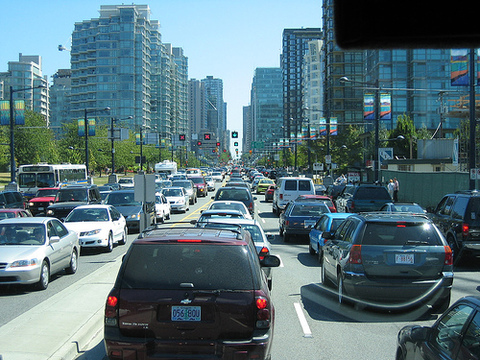
A significant number of deaths (between 25% – 40% (depending on which government figures are used) can now, without the slightest doubt, be attributed to transport related pollution.
The relative burden of respiratory in the UK is increasing as the burden of heart disease decreases.
Health Impacts ai??i?? Costs to the Community
It is not just individuals afflicted by respiratory disease who are impacted by this kind of pollution.
There is a whole range of other related illnesses such as heart problems, liver disorder that are also caused by this kind of pollution.
The rising level of stress (that can be seen every day in road-rage incidents) is contributing to the lowering of the quality of life for everyone.
Direct annual health costs to the UK are enormous. UK health consultations in respiratory disease by
General Practice (Local doctors) was over 38 million. Three quarters (76%) are consultations with a GP at the practice-base, around one fifth (22%) are with a GP at the patientai??i??s home, the remaining 2% are with a nurse (either at home or at a practice). Overall Inpatient hospital treatment exceeded 740, 000 inpatient cases treated for respiratory disease in National Health Service hospitals in 1999/2000.
These represent 9% of all inpatient cases in men and 5% in women.
In children aged 0ai??i?? 14 years there were over 210,000 inpatient cases for respiratory disease. Indeed, 12% of all NHS hospital admissions are in this age group in 1 999/2000
Around two thirds (67%) of respiratory inpatients are emergency admissions and one-tenth (9%) day cases.
In 1999, drug treatment in England alone comprised around 49 million prescriptions dispensed for the prevention and treatment of respiratory disease. Just under half of these prescriptions were for
bronchodi lators used in the treatment of asthma. The volume of respiratory prescript ion has increased in recent years. Between 1994 and 1998 the prescription rate from GPai??i??s rose by 13%. Is it a coincidence that this was a similar figure to the rise in car usage?
Trams are good for your health – 2
Public transport is good for your health and your wallet, according to scientists
Switching to public transport could help you lose nearly half a stone a year in weight, new research suggests.
Daily Telegraph
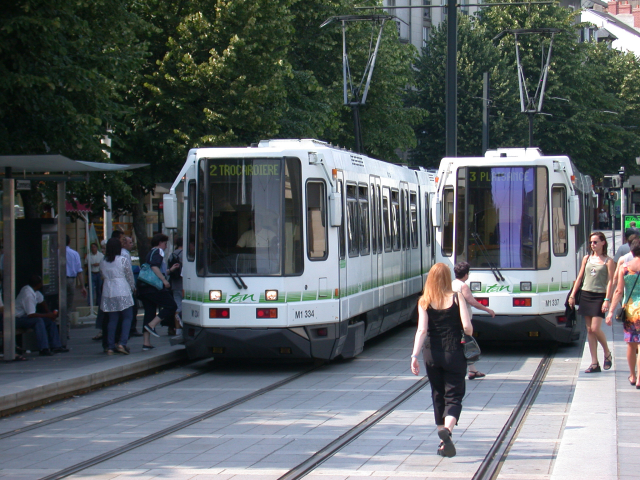
Nantes Light Rail
Taking the train, tram or bus instead of your car increases physical activity so much that the average person drops more than six pounds in as little as a year.
The findings suggests that increasing the use of public transport could improve health and lower obesity levels.
"The built environment can constrain or facilitate physical activity. Understanding ways to encourage greater use of local environments for physical activity offers some hope for reducing the growth in the prevalence of obesity," said lead author Dr John MacDonald, at the University of Pennsylvania.
In a study published in the August issue of the American Journal of Preventive Medicine, researchers from the University of Pennsylvania, Drexel University and the RAND Corporation found that construction of a light-rail system (LRT) resulted in increased physical activity (walking) and subsequent weight loss by people served by the LRT.
In a study published in the American Journal of Preventive Medicine, researchers found that construction of a light-rail system (LRT) resulted in increased walking and subsequent weight loss by people served by the LRT.
An added benefit of public policy investments in LRT, on top of the general transportation benefits accrued, is the potential reductions in obesity in the population, " said Dr MacDonald.
Using two surveys, one collecting data prior to the completion of an LRT in Charlotte, North Carolina, the second after completion, investigators found that using light rail for commuting was associated with reductions in body mass index (BMI) over time.
LRT reduced BMI by an average of 1.18 kg/m2 compared to non-LRT users in the same area over a 12-18 month follow-up period.
This is equivalent to a relative weight loss of 6.45 lbs for a person who is 5'5. LRT users were also 81 per cent less likely to become obese over time.
Survey questions assessed level of physical activity, BMI, perception of the neighborhood environment, public transit use before and after LRT construction, any plans to use LRT when available, and actual LRT usage. http://www.cptdb.ca/index.php?showtopic=13192

Trams are good for your health
Woman gives up car to avoid buying gas
http://www.azfamily.com/news/local/Woman-gives-up-car-to-avoid-buying-gas-121424504.html
PHOENIX – Two months ago, Nicole Underwood had an epiphany.
ai???When gas prices hit $3.50 I was like, thatai??i??s it!ai??? she said.
She realized that at $3.50, gas stations were charging the same for one gallon of gas as it costs for an all day pass on the Light Rail.
So, she ditched the car and started taking mass transit everywhere.
ai???It really wasnai??i??t that hard to do,ai??? she smiled.
Work at the Red Cross, different charity events, social engagements, etc., with the exception of the occasional carpool, she went everywhere only by Light Rail.
ai???Sometimes I had to talk friends into go to hip or trendy restaurants that just happened to be near the Light Rail tracks,ai??? she said.
The average American family now spends close to 9 percent of their household income on gas. And sure, there are financial implications, but Nicole took her foot off the gas pedal to save more than just the money in her wallet. She is saving the environment and helping the local economy.
ai???I would rather give my money to mass transit, the local economy, than big oil,ai??? she said.
The transition to mass transit wasnai??i??t that rough. Because of the traffic, the commute time is about the same. And, because she doesnai??i??t have to watch the road anymore, she can catch up on her reading.
“Its fun. I can talk to people. I am not stuck in that box alone going from point A to point B,ai??? she said.
For more information on the Light Rail, check out:Ai??http://www.valleymetro.org/metro_light_rail/
Ai??Ai?? 
It would be too much to hope, that the obese population of BC might just give up their cars and take transit?
Surfboards allowed on Coast light rail
http://www.goldcoast.com.au/article/2011/05/07/313075_gold-coast-lead-story.html
Ai??
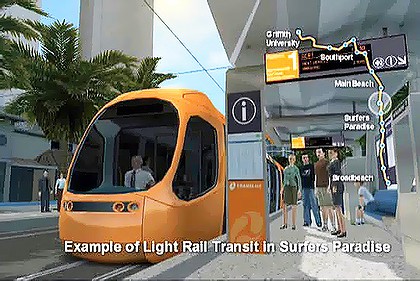
NSW, Australia. IN an Australian first surfboard racks have been specially designed to cater to Gold Coast surfers wanting to ride the city’s new Rapid Transit system.
Premier Anna Bligh told the Bulletin exclusively yesterday that a group of Gold Coast localsAi?? who are part of GoldLinQ, the new company announced to build and run the systemAi?? had felt the rare design was needed to cater to the city’s large surfing culture.
The news has been given the ultimate tick of approval by the surfing industry, who believe it will attract more people to our beaches and relieve parking congestion.
Premier Bligh also revealed yesterday that the 13km ride, from Griffth University to Broadbeach, would cost $3.11.
Travelling one zone, approximately half the system’s line, will be $2.65.
The light rail will open in 2014 and construction will create more than 6300 jobs.
Ai??
Good to see a new transport facility being responsive to particular local sport-related needs!
For a moment I had a vivid image of surfers riding the wave behind the trams (you might manage it with a skateboard or a bicycle if you did not fall foul of the authorities) – but actually this is a great story of a transport facility being designed with specifically local needs in mind.
At least they’re considering it
The `it' is Light Rail, the `they' include:
- Nashville
http://www.nashvilleledger.com/editorial/Article.aspx?id=52855
- Ottawa
- Minnesota
http://www.metro-magazine.com/News/Story/2011/04/FTA-awards-Minnesota-474M-for-light-rail.aspx
which is more than you can say about Vancouver British Columbia,
Covered in Price Tags
http://pricetags.wordpress.com/2011/04/26/transportation-transformation/
This Policy Study is published by the Canadian Centre for Policy Alternatives CCPA
http://www.policyalternatives.ca/transportationtransformation

All about funiculars!
FlA?ibanen
The FlA?ibanen in Bergen Norway
Zwiesystem has always been interested in alternative transit modes and this web site on Funiculars has peeked Zwei’s interest.
http://www.funimag.com/index.htm
I can think of two or three locations in the lower mainland where Funicular operation could be an asset …… how about SFU for a start?
US, UK, French & Australian Light Rail & transport news
Plans for New Eco-Trams In Bristol
Ai??
Wednesday, May 4th 2011 13:17
Ai??
An artistai??i??s impression of a tram in Bristol
Ai??
A consortium has put forward plans for a new eco-tram system in Bristol that would run between Ashton Meadows and Temple Ai??Meads station.
If it is given the go ahead, the route would originate at a new park and ride site that would be built on a brownfield site in Ashton Meadows and go along Cumberland Road and along the Harbourside past the M-Shed museum and terminate at Temple Meads Rail Station.
The scheme is being headed up by the Sustraco Tram Consortium, and it is claimed the system would be a pioneer for the transport.Ai??The plan is that itAi??would run on biomethane gas as opposed to electric lines.
The plans are not approved yet and the West of England Partnership needs top decide whether or not to put this proposal forward for government funding, or the bendy-bus scheme – that would use a similar route. But those backing the tram system say as well as its greener benefits, it would be cheaper to run as the route is based on existing tram and rail track lines.
Residents along the route are also said to be in favour of the tram. Pip Sheard is the spokesperson for residents group Trams For Bristol, she told us people in Bristol have wanted trams for a number of years: “The previous Labour government told us we could not have trams because they’re too expensive. But that’s because a conventional, electrified tram would cost around A?12-15million per kilometre, we think this whole route will cost A?12million.
“It is not just a tram route, it’s a tram route, a park and ride and two transport interchanges, because that’s what people involved thought we needed.”Ai??Ai??
also:
http://www.thisisbristol.co.uk/news/NEW-TRAM-VISION-FUTURE/article-3517420-detail/article.htmlAi??
Sydney’s $180 million light rail planAi??
The Daily Telegraph May 6th 2011
Vikki Campion
Ai??
Ai??
Artist’s impression Sydney City Council’s vision for the light rail. Source: The Daily Telegraph
SYDNEY Council has put its money where its mouth is with a $180 million investment to run light rail down the city’s spine and clear cars out for good.
Draft budget plans reveal the council will make its single biggest investment in a decade to give George St to the people and run trams down the city heart.
Its bold plan is to pedestrianise up to 1km of George St from Bathurst St, near Town Hall, to Hunter St, near Wynyard Station.
Lord Mayor Clover Moore yesterday promised the changes would make it easier for motorists who had to drive through the city.
“Many international cities have pedestrianised roads in their city centre and these cities continue to thrive – we only have to look at New York’s Broadway, London’s new West End and our own Pitt St Mall to see evidence of how it works well,” Ms Moore said. “George St will flourish if we remove the traffic congestion currently choking it. We want to open up a network of vibrant lanes and small plazas that encourage shops, bars and other small
The cash will be on condition the State Government runs light rail down George St, transporting up to 8000 people an hour. “Light rail is the solution to the gridlock in the city,” Ms Moore said. “Our investment is dependent on the State Government building light rail down George St, which all our research shows is the optimal route into the city centre.”
The council’s investment will be spent on streetscaping, signs, laneways, landscaping and traffic management works to redirect vehicles around George St.
“This is about making it easier for people who need to drive to be able to do so,” she said.
“While we are looking at pedestrianising a part of George St if light rail is introduced, other easier routes will be found for motorists and buses.”
Ms Moore said bold changes were urgently needed to stop the gridlock gripping Sydney, which costs $3.5 billion a year.
“Congestion is crippling our city and it’s not going to get any better unless we radically rethink the way our city works and how people move around,” she said.
“Congestion costs are expected to more than double to $7.8 billion by 2020 if we do nothing.”
The $180 million will be set aside in the new long-term financial plan to be discussed next week.
Gold Coast transit
GoldLinQ win Rapid Transit bid

Sue Lappeman Ai??Goldcoast.co.auAi??Ai??May 6th, 2011
Ai??
http://www.goldcoast.com.au/article/2011/05/06/312931_gold-coast-news.html
Ai??
CONSTRUCTION of the Gold Coast Rapid Transit system will begin in earnest later this year with the long-awaited appointment of a consortium to construct and operate the $1 billion service from the new University Hospital to Broadbeach.
Premier Anna Bligh will this morning announce GoldLinQ, which includes companies Keolis, Downer EDI, McConnell Dowell, Bombardier and Plenary, is the successful bidder for the first public passenger transport project to be delivered through a public-private partnership.
Ms Bligh said each of the companies in the consortium, chosen from a short list of three, had a proven track record of transport construction within Australia and overseas. http://www.youtube.com/watch?v=CTfO-ddjXVw
Gold Coast light rail builder announced
http://www.abc.net.au/news/video/2011/05/06/3210208.htm
America’s transport infrastructure
Life in the slow lane
Ai??
Americans are gloomy about their economyai??i??s ability to produce. Are they right to be? We look at two areas of concern, transport infrastructure and innovation
Ai??
The Economist Apr 28th 2011
http://www.economist.com/node/18620944?story_id=18620944&fsrc=rss
 Ai??
Ai??
ON FRIDAY afternoons, residents of Washington, DC, often find a clear route out of the city as elusive as a deal to cut the deficit. Ribbons of red rear-lights stretch off into the distance along the highways that radiate from the cityai??i??s centre. Occasionally, adventurous southbound travellers experiment with Amtrak, Americaai??i??s national rail company. The distance from Washington to Raleigh, North Carolina (a metropolitan area about the size of Brussels) is roughly the same as from Londonai??i??s St Pancras Station to the Gare du Nord in Paris. But this is no Eurostar journey.
Trains creep out of Washingtonai??i??s Union Station and pause at intervals, inexplicably, as they travel through the northern Virginia suburbs. In the summer, high temperatures threaten to kink the steel tracks, forcing trains to slow down even more. Riders may find themselves inching along behind a lumbering freight train for miles at a time, until the route reaches a side track on which the Amtrak train can pass. The trip takes six hours, well over twice as long as the London-Paris journey, if there are no delays. And there often are.
America, despite its wealth and strength, often seems to be falling apart. American cities have suffered a rash of recent infrastructure calamities, from the failure of the New Orleans levees to the collapse of a highway bridge in Minneapolis, to a fatal crash on Washington, DCai??i??s (generally impressive) metro system. But just as striking are the common shortcomings. Americaai??i??s civil engineers routinely give its transport structures poor marks, rating roads, rails and bridges as deficient or functionally obsolete. And according to a World Economic Forum study Americaai??i??s infrastructure has got worse, by comparison with other countries, over the past decade. In the WEF 2010 league table America now ranks 23rd for overall infrastructure quality, between Spain and Chile. Its roads, railways, ports and air-transport infrastructure are all judged mediocre against networks in northern Europe.America is known for its huge highways, but with few exceptions (London among them) American traffic congestion is worse than western Europeai??i??s. Average delays in Americaai??i??s largest cities exceed those in cities like Berlin and Copenhagen. Americans spend considerably more time commuting than most Europeans; only Hungarians and Romanians take longer to get to work (see chart 1). More time on lower quality roads also makes for a deadlier transport network. With some 15 deaths a year for every 100,000 people, the road fatality rate in America is 60% above the OECD average; 33,000 Americans were killed on roads in 2010.
There is little relief for the weary traveller on Americaai??i??s rail system. The absence of true high-speed rail is a continuing embarrassment to the nationai??i??s rail enthusiasts. Americaai??i??s fastest and most reliable line, the north-eastern corridorai??i??s Acela, averages a sluggish 70 miles per hour between Washington and Boston. The French TGV from Paris to Lyon, by contrast, runs at an average speed of 140mph. Americaai??i??s trains arenai??i??t just slow; they are late. Where European passenger service is punctual around 90% of the time, American short-haul service achieves just a 77% punctuality rating. Long-distance trains are even less reliable.
The Amtrak alternative
Air travel is no relief. Airport delays at hubs like Chicago and Atlanta are as bad as any in Europe. Air travel still relies on a ground-based tracking system from the 1950s, which forces planes to use inefficient routes in order to stay in contact with controllers. The systemai??i??s imprecision obliges controllers to keep more distance between air traffic, reducing the number of planes that can fly in the available space. And this is not the systemai??i??s only bottleneck. Overbooked airports frequently lead to runway congestion, forcing travellers to spend long hours stranded on the tarmac while they wait to take off or disembark. Meanwhile, security and immigration procedures in American airports drive travellers to the brink of rebellion.
And worse looms. The countryai??i??s already stressed infrastructure must handle a growing load in decades to come, thanks to Americaai??i??s distinctly non-European demographics. The Census Bureau expects the population to grow by 40% over the next four decades, equivalent to the entire population of Japan.
All this is puzzling. Americaai??i??s economy remains the worldai??i??s largest; its citizens are among the worldai??i??s richest. The government is not constitutionally opposed to grand public works. The country stitched its continental expanse together through two centuries of ambitious earthmoving. Almost from the beginning of the republic the federal government encouraged the building of critical canals and roadways. In the 19th century Congress provided funding for a transcontinental railway linking the east and west coasts. And between 1956 and 1992 America constructed the interstate system, among the largest public-works projects in history, which criss-crossed the continent with nearly 50,000 miles of motorways.
But modern America is stingier. Total public spending on transport and water infrastructure has fallen steadily since the 1960s and now stands at 2.4% of GDP. Europe, by contrast, invests 5% of GDP in its infrastructure, while China is racing into the future at 9%. Americaai??i??s spending as a share of GDP has not come close to European levels for over 50 years. Over that time funds for both capital investments and operations and maintenance have steadily dropped (see chart 2).
Although America still builds roads with enthusiasm, according to the OECDai??i??s International Transport Forum, it spends considerably less than Europe on maintaining them. In 2006 America spent more than twice as much per person as Britain on new construction; but Britain spent 23% more per person maintaining its roads.
Americaai??i??s dependence on its cars is reinforced by a shortage of alternative forms of transport. Europeai??i??s large economies and Japan routinely spend more than America on rail investments, in absolute not just relative terms, despite much smaller populations and land areas. America spends more building airports than Europe but its underdeveloped rail network shunts more short-haul traffic onto planes, leaving many of its airports perpetually overburdened. Plans to upgrade air-traffic-control technology to a modern satellite-guided system have faced repeated delays. The current plan is now threatened by proposed cuts to the budget of the Federal Aviation Administration.
The Congressional Budget Office estimates that America needs to spend $20 billion more a year just to maintain its infrastructure at the present, inadequate, levels. Up to $80 billion a year in additional spending could be spent on projects which would show positive economic returns. Other reports go further. In 2005 Congress established the National Surface Transportation Policy and Revenue Study Commission. In 2008 the commission reckoned that America needed at least $255 billion per year in transport spending over the next half-century to keep the system in good repair and make the needed upgrades. Current spending falls 60% short of that amount.Ai??
How trams could save us from the ai???tyranny of the carai??i??
Robert Williams 26th April, 2011
The Ecologogist
Ai??
Back in 2000 John Prescott mooted 25 different tram projects across the UK, but a decade later where has that dream gone? Robert Williams laments how we have lost a solution to cutting cars and reclaiming our urban streets
Transport has been the Cinderella department of almost every British government since the Second World War. Successive ministers, both Labour and Conservative, have failed to address the challenges of growing mobility, the funding and provision of public transport and the increase in cars on the road.
Over the last 30 years, most British cities have suffered from increasing traffic congestion, so that in many cases streets are at, or near, gridlock. Average traffic speeds in London, at 11mph, are slower than they were a century ago. Pollution, noise and stress for drivers and pedestrians have increased dramatically and the quality of life in urban centres has suffered. Even the most enthusiastic members of the road lobby would admit that motorists are being driven slowly, so very slowly, round the bend.
Many cities have been abandoned to what has been described as the ai???tyranny of the carai??i??. Buses were deregulated by the Conservative government of the 1990ai??i??s, everywhere except in London, and passenger numbers fell precipitously, everywhere except in London.
Labour’s big tram plans

When Labour came to power in 1997, it promised an integrated transport policy. But transport policy was one of Labourai??i??s greatest domestic failures, and nowhere was the short term, unimaginative, bean-counting failure more evident than in the failure to invest in trams (or Light Rail) schemes.
In 2000 the then transport minister John Prescott promised that there would be ai???up to 25 new light rail lines in major cities and conurbationsai??i??. In fact, there are currently eight tramway/light rail systems in the UKai??i??in Croydon, London’s docklands, Birmingham, Manchester, Sheffield, Newcastle, Nottingham and Blackpool. In Edinburgh a new tram network is currenlty under construction. Systems were also proposed in Bristol, Leeds, Liverpool and Portsmouth, although funding was refused by the government, and they remain unlikely to proceed.
Letting tram schemes hit the buffers was a terrible error. Trams are flexible modes of transport that fit between the bus and the underground systems or conventional railway. Tram routes are certainly more expensive to construct than the bus based alternative but, in the long term, trams are cheaper to operate for a given capacity, have lower whole-life costs, offer higher commercial speeds, reduce pollution, and are more successful in attracting motorists to public transport.
In busy cities, trams can carry significantly more passengers than conventional bus networks, including the higher quality bus-based alternatives such as guided busways. Trams can carry flows of up to 20,000 passengers per hour per direction which is about four times more than conventional buses and twice that of the largest, tram-like bus alternatives.
Bus usage would have to increase in the order of 500-900 per cent just to keep the level of traffic congestion standing still, so to speak, in any case, where there is high demand (at least 2,500 passengers/ hour/direction) trams are cheaper than buses. Large numbers of buses are needed to provide equivalent capacity, leading to high staffing and vehicle costs, and roads becoming congested with (empty) buses, as anyone who has travelled along Oxford Street in London will recognise.
If we want to attract motorists away from their cars, alternative forms of public transport must be put in place first. All the evidence shows that people will not switch to public transport unless it is reliable, frequent, efficient, safe and clean, with affordable fares. Tram systems meet these criteria.
Trams cut car use
A study for the Passenger Transport Executive Group (PTEG) found that light rail has generated levels of modal shift from road that bus upgrade schemes rarely match. Typically about 20 per cent of peak hour passengers using British tram systems previously travelled by car. At weekends up to 50 per cent of British tram passengers used to travel by car. Overall light rail takes around 22 million car trips off the roads every year in Britain, and there is evidence, particularly in Manchester and Croydon, of reduced road traffic levels following their opening.
Ai??Ai??Reims Tramway
http://www.urbanrail.net/eu/fr/reims/reims.htm

Vancouver considers higher-density housing plans for Cambie Street corridor – Have we given land developers a $2.5 billion subsidy?
From the ‘Well I told you so department’.
In Vancouver, expensive subways are built not to move people, but toAi??subsidize land development.
Readers of the Rail for the Valley blog know that this announcement was predicted and why there much hype and hoopla in the mainstream media with the recently opened Canada line metro; the Canada Line must be seen to be successful for leverage to build the Broadway – UBC subwayAi??in Vancouver toAi??subsidize more high density development along the route.
Sorry folks in Coquitlam and Port Moody,Ai??you have won second prize again, as you have already had your land boom and high density development,Ai??no need to build a metro there anymore!
This announcement will have all the Transportation oriented Development crew in ecstasy, but there is a drawback and a very big one.
We have spent our ‘rail’ transit money on a few prestigious light-metro lines, while leaving the rest of the transit system to stagnate, we have no transit network, let alone aAi??‘rail’ network that would provide a realistic alternative to the car. If the people moving into the new high density housing in ‘ high rise towers’ along Cambie Street, do not work along the Canada Line, they will take a car to their work instead. TOD may very well exacerbate traffic congestion and gridlock in Vancouver! This is not a foolish statement, rather it is an observation of what will happen if we do not invest in a realistic transit network that will provide an attractive alternative to the car. With subways costing $200 million or more a kilometre to build and the lack of tax revenue or political willAi??to build such a subway system, SkyTrain/TOD transportation philosophy will turn out to be a fiasco for future generations.
It is sad to think, that if modern LRT ran along Cambie St., it would have provided more capacity than the truncated Canada Line subway, at about one tenth the cost and no need to massively densify Cambie Street.
http://www.railforthevalley.com/latest-news/the-sunday-supplement-essay/
Ai??
The Canada Line is not a SkyTrain at all, as it is not propelled by Linear Induction Motors or LIMs, rather
it is a standard heavy rail metro. The $2.5 billion Canada Line has a mere 100,000 boardings a day and needs
three or four times this amount to justify its construction. Thus the need to densify Cambie St.
Vancouver considers higher-density housing plans for Cambie Street corridor
Vancouver is considering a comprehensive land use plan for five neighborhoods along the Cambie corridor and Canada Line that will fundamentally alter the way the area looks and develops.
From 16th Avenue to Marine Drive, postwar bungalows, ranchers and modest single-family homes have long occupied most of the frontage of Cambie’s wide heritage boulevard. But under a proposal now before council, over the next 30 years the corridor would transform into a series of denser “transit-oriented” neighbourhoods with multiple-unit condos ranging from four stories in the north to 12 stories at Oakridge to 36 storeys at Marine Drive.
The plan, which could see as many as 14,000 new residents in the corridor by 2040, would capitalize on the new Canada Line and result in taller buildings lining the corridor. It is being supported by developers and hailed as visionary planning by some of the city’s leading architects.
Planning director Brent Toderian described it to council as “the largest and most complex area planning exercise in the city’s history.” It covers the Riley Park, Oakridge, Langara, Marpole and South Cambie neighbourhoods.
But it’s also raising concerns of some longtime residents who worry the dramatic changes being proposed will wreck their quiet neighbourhoods.
Todd Constant was the second of 125 speakers signed up to give council their thoughts. He’s lived around Cambie and King Edward all his life and watched with consternation as five years of construction for the Canada Line caused his neighbours hardship.
“Now you tell me that because of that (line) you’re going to double the density of the neighbourhood?” he told council Thursday. “From my point you’re destroying the neighbourhood and the community where we live. And you don’t have to.”
He said under the plan his home would be surrounded by four-storey buildings that would eliminate his privacy.
But further down Cambie Bill Konnert had a different view. He’s lived in the Langara Gardens area for half a century. He remembers when Oakridge and the Langara towers were first proposed and his neighbours set their hair on fire thinking the developments would destroy the area.
“Many of my neighbours signed petition after petition against the Langara highrises, and now they live in them,” he said.
“I and many of my neighbours welcome this plan. Not only do we want it, but we need it.”
The proposal, which is the second phase of a planning exercise the city started in 2009, has some controversial elements. The city is insisting that 20 per cent of all new housing to be rental, although several councillors questioned how effective that can be when the city has been unable to achieve more than 12 per cent in False Creek. The city also wants to take a high proportion of any potential rezoning profits ai??i?? as much as 75 per cent ai??i?? from developers in the form of “community amenity contributions” to pay for daycare services, seniors centres, parks and other public services.
Despite those concerns, groups like the Urban Development Institute and the Marpole Business Improvement Area believe the proposed plan would be good for the city.
In the first video recorded address to council ever, architect Peter Busby said the city needs to densify the corridor to take advantage of the $2 billion invested in the Canada Line.
“The transit nodes represent fantastic opportunities to create mixed-use communities within walking distance of those transit access points,” he said. “There are many other people in Vancouver who will thank you for supporting the Cambie corridor plan. It’s the right thing to do.”
Council expected to hear from only about half of the speakers by Thursday night. It will continue the discussion at a later date.
jefflee@vancouversun.com
Twitter.com/sunciviclee
Blog: www.vancouversun.com/jefflee
LIGHT RAIL FOR SURREY – The Whalley – King George – White Rock (WKW) Line
Surrey wants light rail, but where will the first LRT line go and what line would attract the most customers to the new light rail line?
If the goal of the new light rail line is to serve customer needs and offer the ability to provide an attractive alternative to the car, it must serve a multitude of destinations, as well service where people live. Those planning for LRT, presently have not much expertise and tend to treat the mode as a poor man's SkyTrain. Building LRT as an extension of the SkyTrain light-metro system will fail to meet expectations as LRT will not be designed to its best advantage. It is not 'rocket science' to design a transit line to be an attractive alternative to the car and the following plan may prove useful.
The Light Rail Line
The 23 kilometer Whalley – King George – Rail for the Valley – White Rock line (WKW Line for short) may be just the trick in laying a foundation for an attractive light rail system in Surrey. The light rail would be a classic LRT, operating on a 'reserved rights-of-way (RoW) in the median of the road. The route of the WKW Line would start at Gateway SkyTrain station at 108th Ave & 134th St. and continue a short distance east (500 m) to the King George Highway, From the KGV Hwy and 108th St, the KWK Line would travel South (7.5 km) to the Southern RR of BC (formerly the BC Hydro railway, running in the median of the KGV highway. This portion of the route would service the Central City shopping district; Surrey Memorial Hospital; Queen Elizabeth Secondary School; Bear Creek Park; and the Newton shopping district.
The WKW Line would then network south-east along the former BCE interurban and proposed Valley Rail Vancouver to Chilliwack TramTrain route to 152nd (4 km). Traveling mainly through industrial lands, which would provide the ideal location for the Light Rail storage and maintenance yards. The 4 km. of track involved would be double tracked and adequately signaled for safe freight/Interurban/tram operation.
Included on this line, is the possible joint operation with the RftV/Leewood interurban, enabling South Surrey and White Rock transit customers to continue on the Scott Station or even into downtown Vancouver, if the "full build" Interurban project is built.
From 152nd Street, the KWK Line would go straight south to White Rock (11 km) crossing the Nicomekl /Serpentine River Valley. Along here the line must be raised above flood plain and three new bridges across the Superport Railway Line, and the Serpentine and Nicomekl rivers must be built. It is this portion of line that will be the most expensive. Rising out of the small river valley the KWK Line continues south along 152nd Ave. terminating in downtown White Rock.
Map of South Surrey & the City of White Rock

In the summer, the White Rock the light rail line would bring congestion relief by providing a quality transit alternative for the many thousands of people who come in cars to the popular beaches. Also close to the KWK Line is the South Surrey Athletic fields, which many fields and arenas are constantly busy with hockey, baseball, soccer, rugby, and football games, twelve months of the year. The KWK Line would also provide an excellent transportation access for the burgeoning housing estates in South Surrey and White Rock.
The Cost
The the total cost of the KWK Line, including bridges and/or viaducts should cost no more than $690 million, based on an average of $30 million/km to build. The high cost of major engineering in the Nicomekl/Serpentine valley, would be mitigated by simple on-street construction on 152nd and the King George Highway and track sharing for 4 km on the Southern Railway of BC Line bisecting Surrey .
It is interesting to note that the total cost for the 98 km RftV/Leewood Chilliwack to Scott Road Interurban using Diesel LRT and the 23 km KWK Line would be under $1.2 billion or put another way we could build 121 km of modern LRT lines in the Fraser Valley for $200 million cheaper than the 11 km Evergreen Line!
Unlike present light rail planning, where development is encouraged to take place along a LRT/SkyTrain route, the KWK Line can pass through sensitive agriculture and ecological areas, without the need to densify along its entire route. By building the KWK Line a potential capacity of 20,000 persons per hour per direction is available to handle future passenger loads, yet still can be built much cheaper than its Skytrain/light-metro competitors. The cost for a SkyTrain along the KWK Line? About $2.3 billion at a conservative cost of $100 million per km to build!
A modern LRT Line in Madrid, Spain – A template for the WKW Line?

The WKW Line will provide a high capacity light rail line with a potential of carrying over 20,000 persons per hour per direction, without increasing road space. Using low-floor trams, with convenient stops, ensures an obstacle free journey for all transit customers, including the mobility impaired, without the need of expensive stations and equally expensive to maintain elevators and escalators.
The KWK Line can provide traffic calming where needed, yet still supply ample capacity for future transit needs. By providing a regular and efficient transit service from White Rock to Surrey Central and servicing many destinations along its route, would attract ample ridership, including the all important motorist from the car, to the new light rail line. The KWK Line would also easily integrate with the RftV TramTrain interurban service from Vancouver to Chilliwack and could provide in the not too distant future a direct White Rock to Vancouver TramTrain service, faster than the present bus and Canada line service.
The WKW Line would bring 21st century transit solutions to Surrey, transit solutions that are too long overdo.



Recent Comments