Election – VOTE VOTE VOTE! – quotes from candidates on RAIL
VOTING TIME! Monday May 2.
VOTE VOTE VOTE VOTE VOTE

Of course, there are many factors to consider in deciding how to vote this federal election.

On the issue of Rail for the Valley, the federal government plays a supporting role, with the provincial government providing specific direction. Still, federal politics matter - just ask those who were involved in getting the West Coast Express up and running 20 years ago.

-Your vote matters. Even if you're in a riding where you don't think your vote will make a difference, it makes a difference, because, first of all, you might be wrong. And second of all, when all the votes across the country are all added up, your vote will still be seen as a part of that total, regardless of whether or not your local candidate gets in.

Here are some last quotes to consider when you go to vote tomorrow. Thank you to all candidates who stuck their neck out and actively spoke up on the campaign trail, for passenger rail service for the Fraser Valley.

Some quotes from Candidates (west to east)

"In the current federal general election transportation is the most important local issue for Cloverdale residents. I believe citizens specifically want (they deserve) delivery of an economically feasible public transit alternative to fossil fuel-devouring cars. It's about time we elected a federal MP who advocates for a better transportation option involving a sustainable way to feed into the Lower Mainland transit system. I favour investigating using the old Interurban right-of-way in Cloverdale." -Hardy Staub, Liberal Candidate, Surrey-White Rock-Cloverdale

(On Transportation) "I think the best option right now is to look at a light rail system [as proposed by Rail for the Valley] south of the Fraser River, and we hook into it [via the Golden Ears Bridge]. That would be the most immediate, feasible solution at this point." -Peter Tam, Green Party Candidate, Pitt Meadows-Maple Ridge-Mission

"From a purely economic perspective light rail for the valley on existing right of ways is an excellent deal. I think from a federal perspective investing through a three tiered system of fed, prov, and regional governments with some private partnership would make this the most cost efficient system available to move large amounts of  people within the valley. I believe the intent of this system should not be to create a "commuter" system that would ferry people out to Vancouver but rather a regional network built to service the south fraser valley region. This line would open up development opportunities along the route especially focused around the stations which currently are mostly in areas that have little or relatively older commercial and residential activity. Currently, the development in the South Fraser region, especially in the east is along the Number 1 hwy corridor and is directed to auto- mobile individuals. By having light rail an entire different set of commercial opportunities will appear for a completely different type of entrepreneur. This would be another way to strengthen the economic ties between these communities. The huge financial return on this small investment is too good to ignore any longer and I haven't even begun on the social and ecological benefits of the light rail system. We need this now!" -Daniel Bryce, Green Party Candidate, Abbotsford

"With all the government spending that is wasted, 1 billion dollars would be a fantastic deal, "Rail for the Valley"- Chilliwack to Vancouver. Getting people out of their cars, helping the environment, creating sustainable communities around each stop along the way. Jobs that the Rail for the Valley would create, not only the building of the infrastructure of the line itself but the spin-off it would have in jobs in the future would far exceed any start up costs of this endeavour. If elected in Ottawa, I would make this a priority in getting this important project started. Currently their are 700,000 people living in the Valley on this side of the Port Mann, by 2040 their will be a projected 1.5 million." -David Murray, NDP Candidate, Abbotsford

"I've read the study and I do feel that rail for the valley is viable. Support Rail For The Valley."  -Gwen O'Mahony, NDP, Chilliwack-Fraser Canyon

"If there's one thing I know about Greens, is that we're for public transportation and everybody I know is right behind this. We actually have a plan right now pushing for high-speed public transportation in heavy community corridors like the Fraser Valley so this is one of the areas where we'd like to see high-speed rail, not just for students, but for workers as well. I see workers every single day at work who are driving into Vancouver to work, that's time away from family, that's time away from their kids, that's time sitting in cars eating junky food half the time and wasting gasoline. So, high-speed rail, rail for the valley is definitely something that we're pushing for and definitely supporting the Rail for the Valley organization." -Jamie Hoskins, Green Party, Chilliwack-Fraser Canyon
IS IT TIME TO HAVE A ROYAL COMMISSION ON URBAN TRANSPORTATION?
Recent angst and confusion in local and national blogs concerning bus, light rail, metro, and commuter train makes Zwei wonder if a Royal Commission on Urban Transportation is needed. There are no national standards that readily defines transit mode and one is needed, so the average Canadian (read Canadian taxpayer) can engage in honest debate on urban transportation. To date, most transit modes are defined by those promoting particular transit projects and the mode chosen for that project. There is no national definition for light rail, metro and bus and confusion is endemic in the mainstream media, the political arena, as well in academic circles.
 A good example of this confusion is BRT or Bus Rapid Transit. Outside of BC, BRT is a an express bus system that is either guided by rail like the GLT (Guided Light Transit) bus systems; a bus system guided by a raised curb, like the German O-bahn; or a bus system that has the exclusive use of busways, such as used in Ottawa. In BC, BRT is merely a limited stop express bus service, such as the B-Line express buses, which is not BRT at all.
Light rail also needs a standard definition as there are many different definitions given to modern LRT. Example: in BC, TransLink claims that modern LRT can not carry more than 10,000 persons per hour per direction, yet in Europe many LRT type installations carry more than double this number in daily revenue service!
The North American variant of LRT, the streetcar also needs a standard definition. In Europe there is no distinction between a tram operated as a streetcar or a tram operated as LRT, the only difference between the two is that one operates in mixed traffic, while the other operates on a reserved rights-of-ways. One tram line in Europe can operate as a streetcar and LRT combined.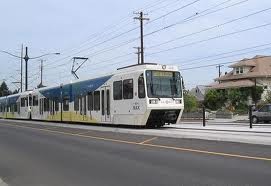
The newest variant of LRT, the TramTrain also needs a new definition and a completely new understanding of the application of light rail in alleviating traffic congestion and pollution. TramTrain has created a new dynamic to urban transportation planners in Europe, as TramTrain can operate as a streetcar, LRT and a passenger/commuter train. Operating TramTrains in Canada will require a overhaul of the Canadian Transportation Act, which governs how our railways operate.
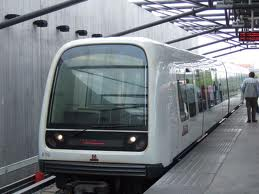 What constitutes a metro also needs to be discussed as there are several variations including light metro and monorail. In BC, our automatic proprietary light-metro (SkyTrain) system is sometimes called advanced light rail and not a metro. As the SkyTrain system is driverless, it can't operate in mixed traffic and definitely not of the light rail family. Also the terms rapid rail and rapid transit are used to describe transit projects, yet there is no official definition what rapid rail or rapid transit is.
"Why do we build public transit?" and "What do we wish to achieve with new transit installations", are questions that are mostly ignored by the powers that be, as most politicians regard transit projects, mega-projects built to secure photo-ops for the next election.
Do we build public transit to shape growth, as the TOD transit philosophy dictates, or do we build transit to move people, with a customer comes first policy, as what is evolving in Europe?
Should a transit project achieve a minimum modal change from car to transit? If there is to be a modal shift, what numbers should we be aiming for? And what would be the consequences if a planned new transit line failed to achieve minimum standards of operation?
The lame statement that the Canada Line would take 200,000 car trips off the road each day, may never be achieved in the foreseeable future and the claim probably would not have been made if their were guidelines for transit mode and implementation.
The question should be asked, "Should metro or light-metro be built on routes with passenger loads that can be easily handled by LRT?" Presently the Vancouver Metro area is spending four or five or more times more money for a transit line that could have been built with a much cheaper, but just as effective alternative. TransLink has spent at least six times more for two SkyTrain metro lines, yet the two lines carry about the same ridership as Calgary's three line LRT system. Another question that needs to be answered, "Is tunneling necessarily good for LRT projects or do they turn affordable LRT into unaffordable metro?"
What we are lacking in Canada is a national standard for building enhanced transit projects, with many being built strictly for political whim, like TransLink's Canada Line. To rectify the the current situation a Royal Commission on urban transportation may just be the ticket for a more affordable and more customer friendly urban transportation for more urban and suburban customers.
B.C. government willing to talk about light rail to Langford – From the Victoria Times Colonist
Good news from Victoria!
Though I find the proposed cost of $950 million rather steep ( the full build 136 km. Rail for the Valley Leewood TramTrain report cost less than $50 million more to build), that the provincial government is actually talking LRT is ground breaking. Victoria’s geography may play a part in this as acquiring land for new highways may cost more than acquiringAi??lands needed for rail, in fact by using light rail existing rail corridors/railway tracks can be utilized.
As for the E & N railway, if the provincial government can’t ante up $7.5 million to maintain the tracks is just shameful, considering that they subsidized the SkyTrain light-metro system by over $250 million annually and just the Hwy 17/Gateway HwyAi??interchange in South Delta must cost well over $500 million alone.
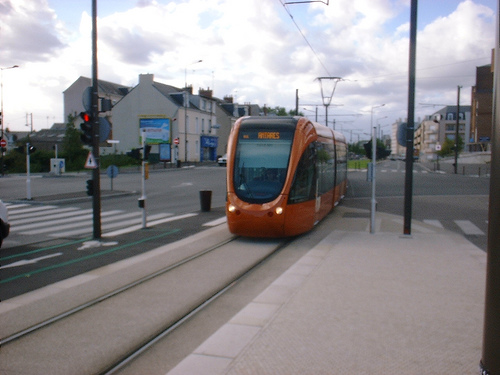 Le Mans, France, recently opened a newAi??15.4 km.Ai??light rail system in November 2007 and it is interesting to note that the city of Le mans has a population of 150,000, yet can afford a quality public transportation service. The cost of Le Mans new tramway (streetcar) ai??i?? 302, or a little over $425 million! By using TramTrain and streetcar operation in downtown Victoria, the cost for LRT in Victoria should be considerably less than $950 million.
Has anyone dared to ask; “How cheaply can we build light rail in Victoria?”
An Alstom Citadis 302Ai??Le Mans Tram

B.C. government willing to talk about light rail to Langford
By Rob Shaw and Bill Cleverley, timescolonist.com
Port Moody mayor calls for public pressure on TransLink to build Evergreen Line – From the Vancouver Province
From the “Bin there, done that department“.
I think Port Moody mayor Joe Trasolini now understands that the Evergreen (locally called the Nevergreen) is probably not going to be built, in his tenure in office. There are now three strikes against the Evergreen line; not enough money to fund the metro; Vancouver wants a SkyTrain subway under Broadway; and Surrey mayor, Diane Watts, demanding much cheaper LRT be built in her city – NOW.
Like a long running Greek Tragedy, the proposed Evergreen Line has driven high density development in the Tri-Cities, but this dream of TOD, has been lost on the realities of metro construction and Balkanized civic politics.
The truth of the matter is that South of the Fraser municipalities are demanding a fair share of tax monies be spent on their turf and not funding someone else’s exotic transit line. As more and more South Fraser mayors demand equal billing for TransLink’s planning follies, there is a growing realization that belonging to TransLink is nothing more than being joined with a financial parasite, forever sucking the lifeblood from South Fraser taxpayers.
For a comparison, the $1.4 billion (now probably $1.5 billion or more) 11 km. Evergreen Line could build at leastAi?? 56 km of modern LRT/streetcar in Surrey!
56 km of new LRT/streetcar in Surrey would go a long way to attracting the all important motorist from the car, while a 11 km. The Evergreen SkyTrain, probably will not do much in attracting the motorist from the car, as it just mirrors the existing BRT route.
With TransLink’s propaganda department going full tilt, extolling the virtues of the Canada Line, while hiding the fact that a great portion of the ridership consists of former bus customers, now forced to transfer onto the metro and YVR employees who drive toAi??and park in the vast employee parking lots on Sea island and ride the Canada line for free to their work place.
The desperation in Mayor Trasolini message is clear, he is in panic mode as he now realizing that the Evergreen Line will not be built in the near future or not ever as a SkyTrain, as funding allocated for the metro will be spent elsewhere. He also knows that if Stephen Harper is elected with a majority government, funding for all public transit projects will dry up.
The Evergreen Line, an election promise for two decades, will still make a good election promise for a few decades to come.
Ai??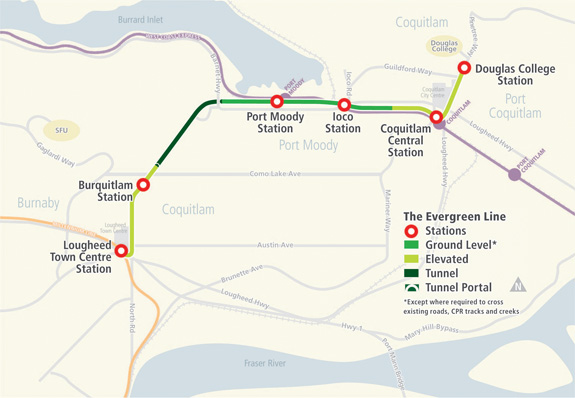
Port Moody mayor calls for public pressure on TransLink to build Evergreen Line
Is a Customer First Transit Policy Foolish?
In addition to Cardinal Fang’s most excellent postAi??last Sunday, one has to reflect on the question; “Should a customer first policy take priority over transit oriented development or TOD?” Certainly TOD has become the great philosopher’s stone for transit planners in METRO Vancouver, where most lands around SkyTrain stations and along the SkyTrain route have been redeveloped into higher densities. Along the Canada Line, there are large moans from land developers that it is now too late to assemble lands for redevelopment as homeowners now want a lot more money for their properties; in layman’s terms, homeowners want a piece of the action!
Despite the hype and hoopla that the Canada Line has over 100,000 boardings a day, bus patronage South of the Fraser is lagging, so much so, that many of the extra bus services added by TransLink for South Delta, were quietly canceled at the New Year. It seems that the predicted thousands of new customers to transit did not materialize as expected. Now the transit customers, who formerly had a no-transfer service to Vancouver, now must transfer onto the metro at Richmond adding time to their commute. Transfers and longer commute times are not user friendly and deter ridership.

WhenAi??Mrs. Zwei works late in Vancouver, with her evening commute home, I have to drive toAi??Landsdown Station (Bridgeport Station is designed to take the transit customer into the casino and is not amenable for customer pick-up, again customer unfriendly)Ai??to pick her up as there is no convenient bus services to the suburbs; in fact I now just drive into Vancouver to pick her up at night because it is cheaper, faster and safer for her. A hell of a way to operate a transit system. Of course this makes the regional transit system grossly user-unfriendly for many would be patrons and taking the car becomes the only option.
Has anyone noticed that no one is chortling that the predicted 200,000 car trips taken of the road each day has not happened?
To be successful a transit system must take a transit customer, from where he lives to where he wants to go, quickly, safely, efficiently, and affordably. If a transit system does not provide the service demanded by the customer, he or she will seek an alternative which in most cases is the car. Metro systems like SkyTrain seldom provide such a service as theyAi??so expensive to build, that they only operate on a ‘trunk‘ line with the transit customer forced to transfer between bus and metro two orAi??more times per journey. Again, not very customer friendly.
As for Transit Oriented Development or TOD,Ai?? that train has already left the station as massive developments are happening everywhere in the lower mainland and there is little or no public transit to be seen. It is now the other way around, we now have Development Oriented Transit, where development takes place and transit follows sometime in the future – maybe – well they promised. Those who still cling to TOD areAi??yesterday’s men and women,Ai??as we have lots of destinations for transit customers, yet little or no transit. This is not a foolish statement, rather it is a fact and until our transit planners stop wasting the taxpayers money shuffling paper and actually do the job of designing a viable public transit strategy for the future, we will never get the customer friendly transit system that will attract the motorist from the car.
In the 21st century, to be successful, transit must be able to provide a quality alternative to driving; transit must be ableAi??to attract the motorist from the car. To date, TransLink has failed in achieving this and planning more pricey metro lines to be built ten, twenty, and thirty years in the future is just not working.
The City of Surrey wants to break this cycle of building metro lines to suit the fancy of Vancouver oriented planners pursuing their TOD dreams and isAi??planning for much cheaper LRT to service more destinations and providing a more customer friendly and cheaper alternative than SkyTrain. Sadly, many local transit planners, bureaucrats, andAi??academics are afraid of providing customer friendly transit and want to stay firmly in the comfortable 20th century way of doing things.
In METRO Vancouver, large bureaucracies, shuffling paper and enriching land developers takes precedent over the foolish needs of theAi??transit customer.
A very customer friendly tram stop in Strasbourg, France.

MLA says TransLink priorities are wrong
From the Oh what a suprise Department
Look after south of Fraser before considering UBC
http://www.langleyadvance.com/news/says+TransLink+priorities+wrong/4646857/story.html
Ai??
The Delta Optimist April 20, 2011
Ai??
TransLink better get its priorities straight and look at improving services south of the Fraser River before looking for money to build a SkyTrain line to UBC.
Ai??
Delta South MLA Vicki Huntington wasn’t impressed to hear about the transportation authority’s latest plan exploring the possibility of rapid transit to the UBC, even though it still doesn’t have the money to pay for the Evergreen Line to Coquitlam.
Wrapping up its latest public consultation period this week, TransLink recently released several potential designs for expanded transit to the university, ranging from more buses to rapid transit. The most expensive would be rapid transit at $3.2 billion, but would have the capacity to carry the greatest number of passengers.
“As far as TransLink building out to UBC, TransLink and the province owe the Lower Mainland the Evergreen Line, that should come first, and then they should turn their attention to south of the Fraser,” Huntington told the Optimist.
“Our bus system is below standard. We’re being forced to pay for the Canada Line by shipping us all in there and taking away our own decent transportation systems, and they need to start looking at some kind of rapid transit out in the lower Fraser. None of this expensive stuff, but let’s get some light rail going,” she said.
Saying TransLink is failing to pay attention to where the growth is occurring in the region, Huntington is a supporter of the concept of light rail, which she believes should be a high priority project.
However, the Evergreen Line has to be dealt with once and for all, said the independent MLA.
“I can see why they look at UBC. You’ve got something like 80,000 people and you can see where they’d think it’s a cash cow and would help in the movement of people. But sorry folks, the Evergreen Line has been promised for years and it’s time they got on with it. Then look south of the Fraser. Put more buses to UBC if you have to,” Huntington said.
Ai??
TransLink, meanwhile, is still looking for options to fund its $400-million share of the $1.4-billion Evergreen Line, linking Burnaby, Coquitlam and Port Moody. The regional mayors’ council on transportation rejected TransLink’s proposal to increase property taxes. They mayors are meeting with the province to discuss various alternatives, ranging from road tolls to vehicle levies.
Huntington said any attempt to impose tolls on existing roads and bridges would penalize residents living south of the Fraser and would be met by an overwhelmingly angry response.
Ai??
Earlier this year, Delta council talked about a scenario in which communities south of the Fraser split from TransLink to form their own transit authority.
That suggestion came up during council’s discussion on TransLink’s funding proposals, which drew the ire of local politicians and bureaucrats.
who complained they provide nothing for the community, other than taking even more money out of taxpayers’ pockets.
“This isn’t a plan, it’s a way to finance major construction projects, and bear in mind there’s no improvements for south of the Fraser,” CAO George Harvie told council.
“There is no hope on the horizon for TransLink to improve our bus service and it’s very sad.”
According to Delta staff, TransLink introduced a couple of different transit expansion plans that would provide little, if any, benefit for local transit users, but hit taxpayers’ nonetheless. One plan would see the average local property tax bill increase by $36 per year, while another more deluxe plan would see Delta property taxes go up by $62.

Much longer delay on Evergreen Line start feared – From the Black Press
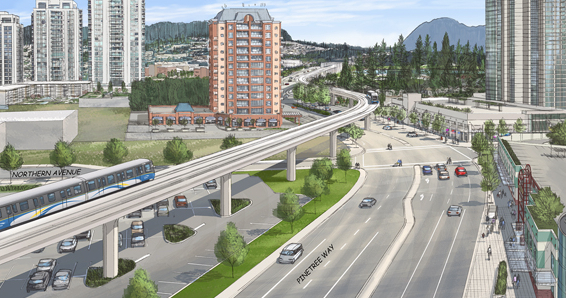
Much longer delay on Evergreen Line start feared
The long-promised Evergreen Line may remain on ice for much of this year because TransLink has so far not even begun to prepare a financial supplement to fund its share.
So says Port Moody Mayor Joe Trasolini, who takes it as a bad sign that more delays are likely on a $1.4-billion SkyTrain extension that was supposed to be under construction by now.
The only missing piece of the puzzle is TransLink's $400-million contribution.
Metro Vancouver mayors are in talks with the provincial government on possible new mechanisms to raise money, potentially including an annual vehicle levy or road pricing.
Trasolini said transportation minister Blair Lekstrom told mayors in a meeting this week the project will not proceed until TransLink's share is delivered.
But he said he's hopeful because Lekstrom recommitted to an accord signed last year by predecessor Shirley Bond and former premier Gordon Campbell pledging to negotiate new sustainable funding sources for regional transportation.
The problem, he said, is that talks are now focused on finding an over-arching solution on long-term funding to pay for a variety of TransLink capital projects, including new rapid transit lines to Surrey and UBC.
That may mean a simpler Evergreen Line-only funding solution will be parked longer, he said.
"It's troubling to me that there is no supplemental plan specific to the Evergreen Line," Trasolini said, referring to TransLink's process of proposing expansion projects with tax or fee increases for the mayors' approval.
"There's no other plan that's been prepared nor is there anything in the works so far as I know."
Federal and provincial funding for the line through Port Moody to Coquitlam is in place, environmental approvals are complete and design work is done.
The transportation ministry is now selecting a contractor and the project website says construction is slated to begin in late 2011, and be finished four years later.
"I object to the northeast sector being the sacrificial lamb when everything is done," Trasolini said. "The only thing missing is the TransLink $400-million and that is not happening."
Coquitlam Mayor Richard Stewart said he, too, doubts TransLink will table a funding solution for the mayors to vote on anytime soon.
But he said the meeting with Lekstrom was "quite fruitful" and he remains upbeat a short-term agreement on the Evergreen Line can be reached soon, followed by a comprehensive long-term funding deal.
"I think the province wants to break this logjam," Stewart said. "I'm fully confident we can find a solution in the course of months. Not weeks, but not years either." It's critical, he said, to solve TransLink's financial impasse before new councils are elected in each city this November.
Stewart said he also believes the provincial government will want to celebrate an agreement securing major transit upgrades for the future – not face continued discord – going into a provincial election some expect could come this fall.
He said the province is already paying its third of the Evergreen Line and Metro cities understand they can't expect Victoria to pay their third as well.
"We have a project here that everyone agrees is our highest priority," he said. "Let's work with the province, identify the tools and move on."
Lekstrom said in an interview Thursday he's also hopeful a deal can be reached with Metro mayors soon. "I'm an optimist here," he said. "The public really wants the service."
He wouldn't discuss what funding sources he favours – many the mayors have talked about would effectively tax motorists – but he said there are only a few that could reasonably work. A long-term answer is important, he said.
"Every time a new project comes forward, I don't think the mayors council or anybody wants to be back in the siutation of saying 'How do we raise the money,'" Lekstrom said "Let's find a long-term solution to this and we're committed to work with them on that."
TransLink recently hired four academics to advise the mayors council on potential new funding sources.
TransLink spokesman Ken Hardie said the TransLink board can't prepare a supplement without a source of extra money the mayors and the province can support. "Right now, one does not exist," he said.
Besides new rapid transit lines, TransLink's expansion wish list also includes running three SeaBuses and adding more buses, SkyTrain and West Coast Express cars.Mayors last fall refused to approve a property tax increase TransLink tabled to cover the Evergreen Line, instead opting to pursue talks on new mechanisms.
http://www.bclocalnews.com/richmond_southdelta/southdeltaleader/news/120394434.html#
Tram projects planned in northern France
Railway Gazette 14 April 2010
France, Artois-Gohelle

A consortium comprising Systra, Inexia, Eccta, Ilex and Urbanica has been appointed to manage two tram projects in northern France. The contract was awarded by the Artois-Gohelle local transport authority, which is responsible for public transport in an area comprising 115 towns and villages with a total population of 600 000.
The first route connecting LiAi??vin, Lens and HAi??nin-Beaumont will be 20Ai??8 km long with 30 stops. The second will be 17Ai??4 km long, running from Bruay-la-BuissiA?re to BAi??thune and Beuvry and will have 24 stops. The tram lines will serve key destinations in 18 towns and villages and are part of an initiative to regenerate the former mining area.

Systra will be responsible for project management and, with Inexia, for engineering and systems. Eccta is in charge of infrastructure, roads and services, while Ilex and Urbanica will handle architecture, landscaping and urban design.
The consortium is due to present its proposals for the two routes by autumn 2010. Construction is expected to start in 2011 with revenue service set for 2014. The project will cost around ai??i??657m.
SMT Artois ai??i?? Gohelle http://www.smt-artois-gohelle.fr/montram/le_projet

LRT and Subway Construction Costs
From the Toronto LRT Information Blog
Discussions on Toronto and GTHA LRT Possibilities
Much of this site is devoted to promoting LRT as a viable alternative to Subway for rapid transit expansion within the GTA where capacity needs exceed or will exceed that of bus operation, but do not warrant a Subway level of capacity. While Subway construction requires a minimum peak requirement of 10,000 people per hour per direction to be justified, LRT operation can easily support up to 12,000 in a roadway median, and even greater than 20,000 in a fully separated right of way.
http://lrt.daxack.ca/LRTvsHRT/CostCompare.html
The major advantage of LRT is that its capacity is high enough for most every outer corridor within the GTA for today and for well beyond the foreseeable future. Furthermore, the capacity of one Subway line can be exceeded with two parallel LRT lines with numerous advantages:
- a single rapid transit line requires funnelling all users to the single line; while feeder bus routes would be ideal, the reality is that many new users will drive to this single line and will require parking; stations must be built with giant parking facilities
- when a service disruption occurs, the entire corridor served by a single line is affected, with little or no alternatives
- single lines involve single point-to-point operation; few, if any, opportunities exist for route interlining that can provide service that provides more convenient travel options for users with a reduced need to transfer in order to reach one's destination

SkyTrain loss is Ansaldo’s gain
Bombardier and their friends on the Skyscraper blog must be weeping a sad song. After many years, carefully cultivating a case for an elevatedAi??SkyTrain light metro in Honolulu, the Ansaldo company of Italy, pipped Bombardier and SkyTrain at the post, by winning the Honolulu light metro contract.
The main difference between SkyTrain and the Ansaldo metros is that the SkyTrain light metro system is powered by Linear Induction Motors, whichAi??need reaction rails which are very expensive toAi??to install and maintain.
Like Vancouver’s Canada Line, Bombardier’s proprietary SkyTrain light metro system proved to be too expensive for the job.
That Honolulu needs an elevated light-metro is another question altogether, yet the smear campaign against modern LRT was so great, by the light metro crowd,Ai??the politicians caved in and only light metro was planned for. This is how TransLink continues with SkyTrain and light metro in Vancouver, an ongoing smear campaign, abetted by the mainstream media has made the mode almost unbuildable here, but now with Surrey demanding LRT, there is going to be a lot of red faces at TransLink.
The Ansaldo light metro inAi??Thessalonika Greece, which will be similar to the Honolulu metro.




Recent Comments