From The Local News………………
From the Vancouver Sun and the Vancouver Province
 Opinion: TransLink's math on U-Pass fraud is questionable
One in six students would have to resell their transit pass each year to cause $15 million in losses
By Stephen Hume, Vancouver Sun –
Forgive my doubting nature, but I'm not ready to buy the claim that students reselling transit passes forced upon them as a condition of enrolling at many universities and colleges is really costing TransLink $15 million a year.
To begin with, by my arithmetic -admittedly imprecise, but then so is the evidence supporting claims of significant student transit fraud -one in six students would have to resell his or her non-transferable U-Pass each academic year for TransLink to lose that much.
Secondly, extrapolating lost revenue on the basis of passes that have simply disappeared -lost in the mail, left in a jeans pocket at the laundry, buried at the bottom of a handbag, used as a bookmark and forgotten, mishandled by institutions -is really an imaginary cost that may not even be occurring.
TransLink says investigators found 29 U-Passes either listed for sale or sought by prospective buyers on Craigslist, up from two postings on the website several weeks earlier. This may represent a trend -or it may not. Whatever it is, it's a tiny sample.
While even a small black market in discounted transit passes certainly deserves concern, 29 U-Passes amounts to about two per cent of the more than 1,500 a month that would have to be sold during the academic year for TransLink to lose what it claims.
One of TransLink's complaints is students who "receive" a U-Pass "provided" by their college or university but then use it after they've dropped studies. But students must pay up to $200 per term in non-refundable U-Pass fees under levies from which they can't opt out, whether they need the pass or not.
Forcing students to pay for the pass, refusing a refund when their enrolment status changes and complaining that they use what they've paid for while it's still valid seems more than a tad unjust.
TransLink was quoted Thursday as saying it might have to cancel the student pass program if the problem persists but was soon distancing itself from what seems to be an overthe-top response. A spokesman later said that "in the fullness of time," TransLink might have to reconsider should the U-Pass program prove unsustainable due to student fraud.
Talk about getting out the elephant gun to hunt fleas.
TransLink itself says there are solutions to this. Meetings are already scheduled to discuss a universal electronic fare card that could replace transit passes and permit TransLink to cancel any U-Pass it believes misused. And how about a lowtech solution like asking students to present their college ID along with the U-Pass?
Some anti-fraud organizations estimate that up to 15 per cent of insurance claims are either exaggerated or fraudulent.
So, anybody in favour of ending auto insurance and shutting down ICBC because clients are seven times more likely to precipitate a fraudulent act than the evidence indicates is the incidence of buying or selling non-refundable student transit passes on Craigslist?
U-Pass woes
 hours.
I spent five years working on courses not even taught on campus. Through it all, I was deducted the $120 three times a year for the U-Pass in my fees. I had no need for it and I was subsidizing the program so full-time students could benefit.
When adults are charged $360 per year for a service they can't use, some will turn to selling the pass on Craigslist to recover some of the money. If U-Pass was a voluntary program, this would not happen.
Renata Hyrman, Richmond
Read more: http://www.theprovince.com/Pass+woes/4858425/story.html#ixzz1NrK0w6CQ
 Forest Grove residents don't benefit from gondola project
As a resident of the Forest Grove community, I deeply disagree with the Burnaby Mountain gondola project.
TransLink has been completely unethical with the entire consultation process. There have been no open dialogues between residents and TransLink officials. They have concealed the stakeholder's involvement in this project and fast-tracked its approval.
We are not a resort community or tourist attraction. We enjoy our conservation land, hiking trails, salmon-spawning streams, wildlife habitat and elementary school just the way they are.
We'd receive no benefit from having 3,000 people whisked above our heads all day long, but the luxury SFU development of UniverCity can now add another sexy selling feature to its list!
Julie Ponsford, Burnaby
As Predicted – Problems Threatens The U-Pass Program
As predicted some time ago, there are serious problems with the U-Pass program. This news item from the Vancouver Sun is but only a tip of the iceberg. The real problem with the U-Pass is not reselling of the pass, etc. rather U-Pass holders are using it much more than anticipated, causing financial havoc to TransLink.
The problem is that too many U-Pass holders are using it too much, with a major problem that the rush hour buses are full of U-Pass holding students, forcing full fare customers to reconsider using the bus or metro and find other transportation options.
Zwei has long predicted that major problems would arise from the U-Pass program and they have come to pass and Translink blaming it on lost, stolen or resold passes is a mere smokescreen to hide the truth, the massive U-Pass program may be filling the buses, but it is bankrupting the transit system.
The U-Pass is as close as a free lunch one can get and as everyone knows, there is no such thing as a free lunch.
Translink should come clean why the U-pass is such a problem and not blame it on stolen passes or other such nonsense.
Post script:
This post was written on Thursday morning, by Thursday afternoon, TransLink's spin doctors were hard at it claiming that TransLink doesn't want to get rid of the U-Pass and it was over exaggeration on the part of the reporter. Zwei's contacts tell a different story, desperate Liberal politicians forced Translink into make an about face to keep the political hot potato.
TransLink threatens to cancel U-Pass
By Kelly Sinoski, Vancouver Sun –
Tensions rise over proposed Simon Fraser University gondola – TransLink Uses RftV estimates!
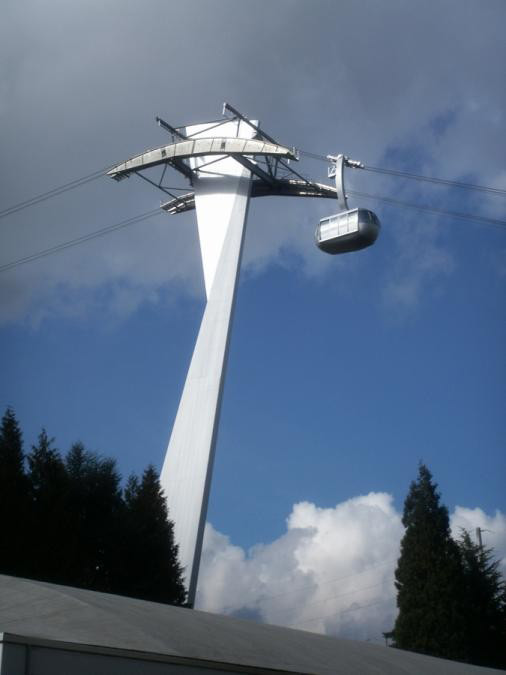
Portland's aerial tramway intermediate 60 metre tower.
If Portland has one, then TransLink wants one too!, this is called the 'neat' factor.
TransLink just doesn't get it, the organization never has.
The 'consultation' process, including community meetings is a sham, with TransLink any sort of consultation process is a sham. It seems now what is happening is TransLink's 'transit geeks' want a neat looking aerial tramway, because, well golly gee whiz other people have them. Listening to TransLink's Ken Hardie on the radio, spinning his tale of wonderment with the aerial tramway and how cost effective it is, makes one wonder shy TransLink doesn't propose aerial tramways for all major bus routes. Here we have another TransLink farce in the making.
TransLink is now lowering capacity on the SFU aerial tramway to 3,000 persons per hour per direction buy planning for 19 aerial tramway cabins (hey didn't that phrase cabin come from the RftV blog?), with a capacity of 35 persons each, traveling at 40 second headways (40 second headways definitely came from the RftV blog!).
Also interesting, is that the costs for the aerial tramway seem to be rising from $70 million to $120 million – shades of the Canada Line fiasco!
Like the Canada line, it seems the main driver behind the SFU gondola is Simon Fraser University itself and not TransLink. With the Canada line it was Vancouver Airport Authority who demanded a $2.5 billion subway!
Is there a cheaper solution. like a $1000.00 solution? Could not TransLink put chains on the buses, like Seattle does, in snowy weather for the climb to SFU?
I guess chaining buses when snow is predicted is just not neat enough for TransLink and SFU, especially when Valley residents will be paying the shot for another TransLink boondoggle.
Tensions rise over proposed Simon Fraser University gondola
By Sam Cooper, The Province –
News From Down-Under
What I like about this article from Australia is that the picture gives a clear indication of what a LRT/streetcar line should look like down Broadway or any other city street in the region.

This is how Broadway could look like with modern Light Rail.
Councils are on line for tram fight
EXCLUSIVE by Vikki Campion
From:The Daily Telegraph
May 25, 2011
Medical emergency halts SkyTrain
Interesting story in the Vancouver Sun electronic edition.
In TransLink’s lexicon, a medical emergency is normally refers to a suicide, which no other news is offered after the initial event.
Suicide or accident isn’t the real story, what Zwei wants to illustrate,Ai??SkyTrain does stop because of a serious accident, which the SkyTrain lobby pretends doesn’t happen.
Ai??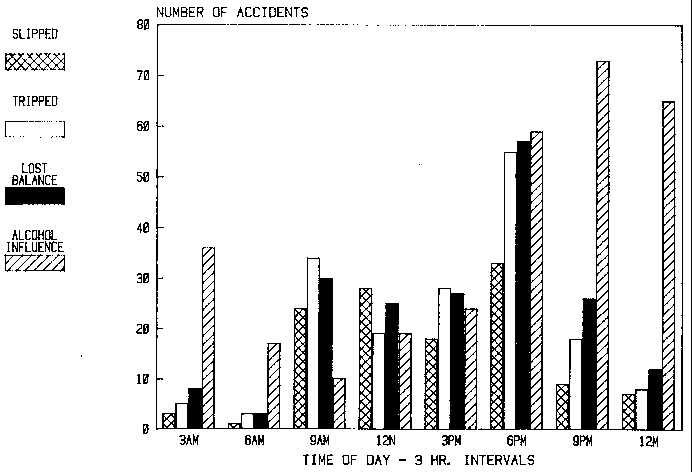
From the US DoT – passenger injuries at transit terminals.
Medical emergency halts SkyTrain
VANCOUVER — SkyTrain service has stopped between Commercial-Broadway and Metrotown stations due to a medical emergency at Joyce-Collingwood station.
There is an unconfirmed emergency services report that a person has been struck.
Vancouver Fire and Rescue Services is now on scene.
SkyTrain is now operating a shuttle train on one track between Metrotown and Broadway, but is not stopping at Joyce.
The bus bridge is still in place, with 15 buses going station-to-station between Commercial-Broadway and Metrotown Stations.
Before & after – TOD French Tramway style
Angers: before and after the coming of the Tram
Taken from http://www.lineoz.net/forum/viewtopic.php?f=16&t=19049&p=317604#p317604
Ai??
The series of images shows the improvements in the urban environment that the introduction of an at-grade tram system can bring.
1. Rue de la RoAi??Ai??Ai??- before

and after

Ai??2. Alsace – before

and after

Finally a link to a `drivers eye’ video
Enjoy!
Solve bus problems: Make TransLink accountable

It takes a #49 bus driver to talk sense on the overcrowding issue, but is anyone listening?
Note to TransLink: Being passed by by your bus makes the transit service seem customer unfriendly and unless one has a ‘cheap‘ bus pass, taking the bus becomes a second or thirdAi??transit option, with the car being the first.
In Europe, transit companies suffer penalties if customers are passed by a full bus.
Will TransLink listen to Mr. Magowan?
Somehow I doubt it, as those six figured salaried transit planners and managers, with their $750 a month car allowances, seldom, if ever take the bus and haven’t a real clue how a transit system works, nor care to learn.
Solve bus problems: Make TransLink accountable
Re: On the buses -or not, May 14
Winning the title of bus route with the most pass-ups must be tough for riders of the 49 bus when they see everyday how easy the solution could be.
Most passengers get on and off at major destinations. Yet each packed bus pulls into every stop, making the trip from Metrotown to UBC and back -a plodding two and a half hours.
Buses make just five round trips from morning through the end of the [afternoon] rush.
Alternate bus routes operating with express buses, as is the case just eight blocks over on the 41 line, could complete seven round-trips in the same time.
More importantly, express buses would complete their loop in time to pick up a second load of commuters during peak periods, when most passups occur. Buses under the current schedule arrive too late to help.
Many might attribute the problem to a paucity of planning. Actually, it’s a product of politics.
Christy Clark’s erstwhile rival for premier, Kevin Falcon, made Trans-Link a cloistered, unaccountable body, with no way for frustrated commuters to appear and ask: “Why [is there] no No. 49 express when it would save me time and you money?” In contrast, Premier Clark ran on a platform of open government.
Reopening TransLink to public scrutiny is the most pressing and obvious opportunity to fulfil that promise.
Next stop, Christyville!
David Magowan, 49 Driver Richmond
Sound Transit to invest $2.1M in rail, bus ridership research

Seattle's LRT is grossly overbuilt for what it does.
Seattle has built a grossly over-engineered light rail line which has more in common with Vancouver's SkyTrain light metro than LRT and ridership is flagging. Having failed to meet forecast ridership comes as no surprise as the hybrid light rail/metro is trying to be all things to all people and in the end pleasing none.
What Seattle transit planners probably do not wish to recognize is that what they planned, was doomed for failure and now ($2 billion too late) hiring market research companies to find what the public really wants and how to grow ridership.
In Vancouver, our three light-metro lines just carry enough ridership to fool the mainstream media which spins the story about our 'successful transit system' to the public. Our transit planners just sit back and let high priced spin doctors feed local TV and radio stations with news release after news release, singing hosannas about how successful our SkyTrain and Canada line light-metros are. What is quietly forgotten is the massive subsidies to pay for our three metro lines have truncated the rest of the transit system.
Funny, no one has copied Vancouver's light metro transit model, except Seattle and the city and its transit system are ignored by the international transit community at large.
Back to Seattle; I could save Sound Transit $2.1 million and simply tell them the truth; "Your $2 billion hybrid light rail/metro system is not customer friendly and thus will not attract much new custom".
"You must completely rethink how and why you build LRT!"
I think fixing the problem will mean that Sound Transit must to get rid of a few sacred cows, starting with that $2 billion, three mile subway to the University District , instead plan for classic on-street/at-grade LRT, with stops every 500 to 600 metres (about 1500 feet) apart, what has proven to attract ridership. Transit authorities must completely rethink how and why they build LRT and how they provide transit and it is not going to be easy, for like Vancouver, they keep doing the same thing over and over again, expecting different and more successful results each time.
I'm afraid the transit clock has run out in Vancouver, with an out of control planning bureaucracy for ever coming up with more expensive subway schemes, but not in Seattle where a usable and customer friendly LRT can be planned for still, instead of politically and bureaucratically prestigious metros and subways. But is there the political will to make change happen?

Sound Transit to invest $2.1M in rail, bus ridership research
Sound Transit will spend as much as $2.1 million for consultants to conduct market research, in hopes of boosting its rail and bus ridership.
http://seattletimes.nwsource.com/html/localnews/2015100696_soundtransit20m1.html
Sound Transit will spend as much as $2.1 million for consultants to conduct market research, in hopes of boosting its rail and bus ridership.
"Finding out what will get people out of their cars and into our services is going to require some deep research and talking to a lot of people in our region," said communications Director Ron Klein.
The board's operating committee voted unanimously Thursday to pay EMC Research up to $1.5 million over five years, and Resource Systems Group up to $630,000 over three years. EMC will analyze public and customer attitudes, while Resource Systems will measure the effects of fares, fuel prices, tolls, congestion and parking on traveler choices.
Meanwhile, neighboring Pierce Transit and Community Transit are cutting buses. King County Metro is considering a $20 car-tab fee to preserve bus service plus the roomier, more frequent RapidRide buses voters approved five years ago.
Sound Transit has announced a long-term $3.9 billion shortfall in its $18 billion, 15-year expansion plan, and the possible scrapping of a future station in Federal Way, but it has ample cash for now.
"If the economy weren't so bad, our partner agencies would want this information as badly as we do," Klein said.
Community Transit Chairman Dave Gossett said there's no way his agency could find $2 million for market research. But it has paid consultants to examine who rides which bus lines — data now being used to make tough decisions, he said.
"Any transit agency is a business, and it's a business that needs to attract customers, just like GM or any other business," Gossett said.
Ridership on Seattle-area Link light rail increased in March to 21,341 average weekday trips, 18 percent above March 2010. That's still below an original goal of more than 26,000 trips. Recession is one factor, and a decision to charge fares downtown likely dissuaded some, a spokesman said.
Sounder commuter trains in March carried an average 8,799 riders a weekday, down more than 4 percent from a year earlier, as mudslides closed the Everett line for a week.
EMC already does annual customer-satisfaction surveys for Sound Transit, but officials say they lack a clear picture of people who don't ride.
That knowledge could help target advertising dollars more effectively, Klein said.
After the Roads and Transit plan lost a regional vote in 2007, an EMC poll indicated a transit-only package might pass. That influenced the agency's decision to try again in 2008 and win.
Sound Transit won't dwell on certain bus lines, such as the 590 from Tacoma to Seattle, that are full, Klein said.
But there's plenty of room on Sounder and Link. "We have trains that are going to run whether they are full or half full," Klein said. "We want them completely full."
Operations-committee members voting yes Thursday were Dave Enslow, mayor of Sumner; Claudia Thomas, of Lakewood; John Marchione, of Redmond; and Paul Roberts, of Everett, who each hold local elected office.
Mike Lindblom:
Aging Pattullo Bridge needs to be replaced – Why Not Build A New Combined Road/Rail Bridge Instead?

Ai??The decrepit Pattullo Bridge, with the rickety Fraser River Rail Bridge under it
There is no surprise over this decision at all, the aged Pattullo Bridge needs to be replaced and so it should as it is literally falling apart. The Pattullo wasAi??originally built as two lane bridge in the 1930’s, like the Lions Gate Bridge and has certainly seen better days.Ai??The Pattullo Bridge needsAi??to be replaced, but this is not the real story.
Under the decrepit Pattullo Bridge is an equally decrepit, if not more soAi??Fraser River Rail Bridge which also is in dire need of replacement. Why not combine two projects into one and design and build a new combined road/rail bridge to cross the Fraser. Not easy to do but it is doable. Even the GVRD considered this in the 1970’s!
The need for a new road bridge is obvious, but not so obvious is the need for a new Fraser river rail bridge and if a new multi track rail ‘lift’Ai??bridge is built, it will go a very long way in solving local transportation issues today and for tomorrow. A multi track rail bridge would provide the necessary pathways for a 20 minute serviceAi??Valley TramTrain service to reach Vancouver as wellAi??encourage TramTrain service to North Delta, Crescent Beach and White Rock and let us not forget increased Amtrak passenger service to Seattle and Portland.
Revenue from the three railways currently using the present rail bridge would also provide a new revenue source to pay for the new combined road/rail bridge.
But this type of forwardAi??thinking isAi??alien to TransLink, who are mired with their dated and extremely expensive subway and light-metro planning andAi??seem completely unable to plan for the future. For less than the cost of extending SkyTrain to Langley , we could build the “full build” Vancouver/Richmond to Rosedale valley TramTrain and a new combined Fraser river Road/Rail Bridge.
The new bridge replacing the Pattullo will be in use for at least the next 100 years and a combined new road/rail bridge would go a long way in providing for transit solutions for the region for the next century. With gas prices ever rising and peak oil now said to be now past, isn’t it time for TransLink to think out of the box and provide a bridge solution that includes rail, especially when the need is so great for affordable transit solutions?
Aging Pattullo Bridge needs to be replaced, not refurbished: report
TransLink pushing ahead with its initial plan to build a new $1-billion six-lane bridge
By Kelly Sinoski, Vancouver Sun
Taxpayers Beware – Seattle’s Newest Subway Is Costing $400 Million A Kilometre
This story should be sounding alarm bells everywhere, Seattle's newest subway, a mere 4.8 km long, is set to cost a massive USD $2 billion or about USD $400 million per km to build, making this insane project one of the worlds more expensive subway projects!
'Zwei' never supported Seattle's so-called LRT line because it is really a very expensive hybrid light rail/metro line with many kilometres of route on elevated viaduct or in deep tunnels. It is not classic light rail and only small portions of the line can be considered true light rail. It's paltry daily ridership supports 'Zwei's' contention that the entire line has been over built and built in the wrong location.
What is being built is not light rail at all, rather a super expensive subway operating light rail vehicles instead of heavy rail subway cars. It is LRT in name only.
This new Seattle subway poses several questions; including; "Is the costs for the completed Canada line accurate?"
More importantly: "Is TransLink's estimates for subway construction under Broadway accurate?"
Seattle's hybrid light metro/rail system makes a mockery out of fiscally sound transit planning and this multi billion dollar 5 km. subway looks more like civic penis envy on steroids than sound transit planning.

Boring to begin Monday on light-rail link to UW
This week, Sound Transit will start drilling a $2 billion, three-mile light-rail tunnel to connect the University of Washington, Capitol Hill and Westlake Center.
This week, Sound Transit will start drilling a $2 billion, three-mile light-rail tunnel to connect the University of Washington, Capitol Hill and Westlake Center.
Boring machines will work around the clock for more than a year. Trucks will carry away dirt, while others will deliver arc-shaped segments to build the tunnel walls. Then rails will be installed, and stations constructed.
The fruit of all that labor and noise is a direct line joining three of the premier transit hubs in Washington state.
The first machine will be christened Monday in a ceremony outside Husky Stadium by Sen. Patty Murray, D-Wash., Federal Transit Administrator Peter Rogoff and other dignitaries.
That machine will bore the southbound tunnel south toward Capitol Hill.
A second machine will start the parallel northbound tube in June. Also in June, a third machine will start at Capitol Hill and go one mile toward Westlake Center, be retracted from a pit next to the Paramount Theatre, then return and dig the parallel tube.
The route is scheduled to open by September 2016. The new First Hill Streetcar, due in 2013, will link Capitol Hill Station to the existing International District/Chinatown Station.
Voters approved a UW line in a 1996 regional plan, but cost estimates were off by more than $1 billion, forcing delays and alignment changes.
The long-awaited route is estimated to attract 70,000 daily passengers by 2030 — even more if the agency completes three suburban lines to Lynnwood, Overlake and Highline Community College.
"As the system is completed, this is going to be a big deal," said Josh Kavanagh, UW transportation director.
Ridership estimates can go awry, as illustrated by the existing downtown-to-airport line, currently drawing 21,000 boardings a day instead of the targeted 26,000.
On the other hand, the UW campus, Seattle University and Seattle Central Community College are proven transit markets with a combined enrollment of 56,000. Two of every five UW students and employees take transit already, another two-fifths carpool, bike or walk, and only a fifth drive alone.



Recent Comments