Baffle-gab from the SkyTrain Lobby.

One just has to shake one’s head at this.
The SkyTrain LobbyAi??is workingAi??hard toAi??haveAi??more of the proprietary mini-metroAi??built in Surrey, now with a glitzy news release claiming that the proposed SkyTrain will only cost a little more to build to Langley than LRT, so let’s build with SkyTrain. We have heard this before.
The following isAi??the SkyTrain for Surrey document.
http://skytrainforsurrey.org/2012/07/08/skytrain-vs-lrt-study/
Let us compare this with the Rail for the Valley and the historic Leewood Study.
In 2009, the Rail for the Valley group engaged Leewood projects of the UK, experts in the field of urban transportationAi??http://leewoodprojects.co.uk/Ai??to do a study on reinstating passenger rail service on the former BC Electric interurban route, now used by the Southern Railway of BC. Rail for the Valley left it up to an independent consultant from outside of the lower mainland to come to a conclusion of the viability of such a service. The result was the historicAi??Leewood Lower Fraser Valley British Columbia, to Surrey Interurban StudyAi??https://docs.google.com/gview?url=http://www.railforthevalley.com/wp-content/uploads/2010/09/chilliwacktosurreyinterurbanfinalreportr.pdf&pli=1&chrome=trueAi?? which not only concluded that an reinstated interurban service would be viable, it could be built quite cheaply when compared to other transit modes.
The Leewood StudyAi??included severalAi??options, from $500 millionAi??98 kilometre,Ai??Chilliwack to Scott Road Station Diesel LRT to an almost $1 billion 138 km Vancouver Central Station to Rosedale electric TramTrain service.
It is interesting that the SkyTrain for Surrey did not use any figures from the Leewood Study, rather the only mention that SfS gave Rail for the Valley was a completelyAi??erroneous SkyTrain extension on interurban right of wayAi??which gave a cost of $100 mil to $140 mil. The aforementioned study had nothing to do with Rail for the Valley and if the SfS study is so badly researched in this instance, one must question SfS method of study. Was it on the back of an envelope?
Which experts did SkyTrain for Surrey (SfS)Ai??engage for their SkyTrain cost analysis.
Here are the main players mentioned Ai??in the SfS news release:
- Daryl Dela Cruz ai??i?? Chief Statistics Analyst. Daryl is the Initiative Chair, Founder, Representative and website manager, in addition to being the Initiativeai??i??s Chief Statistics Analyst.Ai?? As a developed researcher, he is in charge of the collection and interpretation of most statistical data and has contributed heavily toward our studies.Ai?? The Surrey Board of Trade has awarded Daryl with a ai???Top 25 Under 25ai??? award for his contributions to the City of Surrey through the SkyTrain for Surrey Initiative and the Progressive Surrey Transit Coalition.
- Neo Caines ai??i?? Chief Infrastructure Analyst. Neo joined the Initiative in Summer of 2011; he has shared much crucial knowledge regarding the SkyTrain infrastructure and has contributed through writing input.
- Kenneth Chan ai??i?? Analyst, Advocate. Kenneth has lead previous advocacies for SkyTrain in Surrey.Ai?? He made some contributions regarding the study presentation that have been of great assistance.
- Skyscraper Page forum user: ai???nnameai??? ai??i?? Analyst (unaffiliated). ai???nnameai??? is credited because he has provided some relevant statistical information that assisted in confirming the accuracy of this study.Ai?? He is not affiliated with the Initiative.
The Rail for the Valley group sees no experts here, in fact like most SkyTrain initiatives in Metro Vancouver, real transit experts have seldom been consulted with. What really is laughable, they use an unnamed source from a Skyscraper as an analyst.
To quote American Transit Expert, Gerald Fox and his scathing critique on the Evergreen Line business case; “I found several instances where the analysis had made assumptions that were inaccurate, or had been manipulated to make the case for SkyTrain. If the underlying assumptions are inaccurate, the conclusions may be so too.”
The SfS’s assumptions about LRT and LRT’s construction costs are inaccurate, then; “the conclusions may be so too.”
http://www.railforthevalley.com/wp-admin/post.php?post=7553&action=edit
For an historic context on construction costs, the 5th (1995) Edition of On-track, published by the Greater Victoria Electric Railway Society, published a table of Comparable Capital Costs for New-Start Lower Cost Light Rail Systems Updated to 1995 Canadian Dollars.
- Baltimore – $15.4 mil/km
- Denver- $15.4 mil/km
- Portland (Gresham Line)Ai??- $16.2 mil/km
- Sacramento – $10.5 mil/km
- San Diego – $13.8 mil/km
- St. Louis – $17 mil/km
- SkyTrain Millennium Line (SFS StudyAi??2011 estimated cost) $68.3 million/km.
One can see that even by adjusting the 1995 figures to 2011 values, modern LRT can be easily built for one quarter to one third the cost of SkyTrain and gives a good indication why no one buys SkyTrain today.
The SkyTrain lobby is working very hard to discredit modern light rail, which happens to be the first choice for rail transportation by transit planners around the world. SkyTrain has been sold as the panacea transit system and being driverless, silly claims are being made that itAi??costs almost nothing to operate, the problem is that factsAi??get in the way of the SkyTrain rhetoric and modern light rail can be built much cheaper than SkyTrain, carry more customers than SkyTrain; attract more new customers than SkyTrain; be designed to operate faster than SkyTrain; and cost a lot less to operate than SkyTrain. It is easy to see how modern LRT made SkyTrain obsolete over two decades ago and like the Luddites of old, the SkyTrain Lobby persists with dated mini-metro gadgetbahnen-speak, when the rest of the world has moved on.
I leave it up to Gerald Fox to sum up the dilemma now faced by TransLink and the SfS folks; “But, eventually, Vancouver will need to adopt lower-cost LRT in its lesser corridors, or else limit the extent of its rail system. And that seems to make some TransLink people very nervous.“
Over to you, Cardinal Fang…………………
Urgent need for light rail transit in Surrey
The following editorial by Frank Buchholz continues the myth that at-grade light rail is slow and causes accidents at intersections. I am not surprised as the SkyTrain Lobby’s mouthpiece, the SkyTrain for Surrey blog is given prominence in the piece.
From what I have read, SkyTrain for Surrey rehashes the same old myths about LRT, at the same time pretending that the proprietary SkyTrain light metro system is the great panacea for urban transit. What the SkyTrain chaps’ fail to mention is that SkyTrain is only seriously used as an urban transportation system in just two cities, Vancouver and Kuala Lumpor, with the other five SkyTrain type systems being demonstration lines and glorified airport people mover type systems. Even in Kuala Lumpor there is an extensive elevated light rail system, now call just light metro and a proprietary monorail system. Even in Vancouver, the Canada line is not a proprietary SkyTrain, but a conventional heavy rail metro built as a truncated light metro as SkyTrain was too expensive to build.
As mentioned in previous posts, not only modern light rail has proven to carry far more customers in revenue service than SkyTrain, it can travel at higher speed if it designed to.
If we cut through the fog of pseudoscienceAi??that surroundsAi??SkyTrain, we find that the proprietary railway cost far more to build than modern LRT, can carryAi??less transit customers than modern LRT, and that SkyTrain only appears to be faster than LRT because it has about one half the stations per route km. than modern light rail. Sadly, very few media types ever report that and the great SkyTrain myth continues on and on. “A lie repeated often enough becomes a fact in the public’s mind.”
Surrey needs a viable public transit plan, but not a plan that indentures modern LRT as a poorman’s SkyTrain, with LRT radiating outwards from SkyTrain stations in central Surrey, instead, the City of Surrey and TransLink must plan LRT to cater where customers needs and where transit customersAi??want to go, not whereAi??politicians want to cut ribbons. From what I have seen to date, I do not think TransLink and Surrey planners are up to the task.

Urgent need for rapid transit in Surrey
By Surrey Leader
Published: July 05, 2012The City of Surrey sent out a provocative press release on Sunday, saying
that ai???LRT arrives in Surrey.ai???The city arranged with Bombardier Transportation to exhibit
a 60-foot-long, full-scale model of a light rail vehicle at the popular
Canada Day event at the Millennium Amphitheatre in Cloverdale.The model being exhibited was the Bombardier Flexity Freedom vehicle. The
city says it is designed with the latest technology, emits no emissions and
reduces visual and noise pollution.Mayor Dianne Watts is on record as wanting LRT in Surrey, as opposed to
extensions of SkyTrain. She would like to see LRT lines on at least three busy
corridors ai??i?? 104 Avenue from Whalley to Guildford; King George Boulevard from
Whalley to Newton with a possible extension to South Surrey and from Whalley to
Langley on Fraser Highway, passing through Fleetwood and Clayton.The cost of LRT extensions is considerably less than SkyTrain, which has been
very expensive to construct. However, SkyTrain is separated from road traffic
and as such can offer quicker trips and not get tied up by intersection crashes.
One only has to travel on SkyTrain from King George station to New Westminster
at a time when the Pattullo Bridge is backed up to understand that.For more on the cityai??i??s perspective, see www.surrey.ca/RapidTransitNow.
However, not everyone agrees with Watts. Daryl Dela Cruz, chairman of the
SkyTrain for Surrey Initiative, says SkyTrain costs in other areas have been
inflated by specific conditions, and he says a study his organization is working
on will provide the true costs of SkyTrain versus LRT. His organizationai??i??s
position is detailed at http://skytrainforsurrey.org.The real issue to consider in the debate is this: will any money be
forthcoming from the senior levels of government to pay for most if not all of
the capital costs of extending rapid transit in Surrey? Surrey canai??i??t come up
with the money itself, and TransLink has been reluctant to put money towards
adding transit service in Surrey.TransLinkai??i??s own money woes seem to indicate that it will not be taking the
lead in bringing more rapid transit service in Surrey anytime soon.Discussions between South of the Fraser mayors on transportation have been
going on for some time, and it may well make sense to set up a separate South
Fraser transit authority. It could still cooperate with TransLink and pay part
of the costs of buses that go from south to north of the Fraser, but chances are
it could provide better service here ai??i?? if it had enough taxing authority.Thatai??i??s been TransLinkai??i??s problem from day one ai??i?? it has proven very difficult
to expand transit service with its limited taxing authority. While it keeps
saying a car tax would solve many of its problems, that is a non-starter in
areas like Surrey where bus service is so poor.For now, the LRT model provides something to dream of ai??i?? frequent and fast
rapid transit in Surrey, service that could move a lot of people quickly. That
service could be a SkyTrain extension, or it could be at-grade LRT. No matter
what, it is needed now, because Surrey transit service is far from what it
should be in a city with this many residents.
British Politicans Get It, While Canadian & BC Politicans Don’t

Britian’s politicans get it about TramTrain, while in BC, our politicians haven’t a clue.
Money for transportation projects or even maintaining an affordable public transit system is finite. All to often, people support horrendously expensive transportation projects without an inkling as how toAi??pay for it. The clarion call for new or higher taxes to fund government sponsored projects only meets increased resistance from tax maxed out residents, yet our transit planners ignore economic transit solutions because they are foreign, or they never studied ‘that‘, in university.
Our regional transit planners and politicians are ever so quick to force European style taxes on the local taxpayer, such as carbon taxes or congestion fees, but they never apply European style transit solutions, which are mostly funded by the European style taxes. Oh yes, the European solution for reducing traffic (carbon emissions) is modern light rail transit is and not the hugely expensive SkyTrain light-metro system, but we can’t have that can we, because it will well illustrate over 30 years of bad transit planning.
TramTrain or the reincarnated interurban an get construction costs for LRTAi??can be as low asAi??$5 mil/km. to $7 mil./km. and for the $2.2 billion cost to extend SkyTrain to Langley, we could construct the ‘full build’ RftV/Leewood, Vancouver/Richmond to Rosedale (138 km.) TramTrain, the RftV WKW Line and a third LRT line in either Surrey or Langley.
It is time our regional transit planners & politiciansAi??in TransLink and Metro Vancouver think out of the box and apply proven 21st century transit solutions to solve 21st century transit problems. TramTrain is part of the solution.
PRESS RELEASE FROM the All Party Parliamentary Light Rail Group
24 June 2012
Chairman of UKTram calls for government funding for TramTrain
At a recent meeting at the House of Commons, organised by the All Party Parliamentary Group for Light Rail, Geoff Inskip, Chairman of UKTram and Chief Executive of Centro the West Midlands Passenger Transport Executive and Authority, called upon the government, through the Department for Transport, to set aside A?100 million per annum from the A?3 billion savings they will be making from implementing the McNulty report and ring-fence that money to fund TramTrain schemes. This would be a way of ensuring that DfT can achieve its agenda of delivering a better value-for-money railway and a greener, more sustainable economy.
Mr Inskip said that while the DfT’s TramTrain trial in Sheffield is welcome, TramTrain is a proven concept and it is desirable that viable projects elsewhere proceed as soon as possible as not to miss the full benefits.
TramTrains can be more economical than heavy rail by reducing track maintenance and signalling costs. Lighter vehicles can serve more frequent stops without unduly extending overall running time. Street running in city centres can provide greater connectivity for passengers while reducing congestion at central stations.
NOTES FOR EDITORS
The All Party Parliamentary Light Rail Group is an independent forum for MPs and peers from all political parties and industry to come together and raise awareness of matters concerning light rail and tramways; their best practice and sustainable development.
The All Party Parliamentary Light Rail Group holds regular inquiry sessions in order to provide a holistic package of policy proposals that will drive forward best practice, leading to affordable light rail and tramways with resultant physical and economic regeneration, carbon reduction, improved air quality, congestion relief and affordable transport to the UK and its citizens.
Secretariat support is provided by Jim Harkins FCILT, Light Rail (UK) and various supporting organisations and individuals.
For press enquiries – please contact:
Mr Jim Harkins FCILT
Surrey pitches light rail transit line – British Columbia – CBC News
Click on the link to see the CBC video.
Surrey pitches light rail transit line
CBC News Posted: Jul 2, 2012 12:37 PM PT Last Updated: Jul 2, 2012 1:49 PM PT
The City of Surrey’s rapid transit plan
(Note:CBC does not endorse and is not responsible for the content of external links.)
The City of Surrey is eyeing light rail transit when it comes to expanding south of the Fraser.
Over the weekend, officials showcased their proposal to bring an LRT line to the area.
“We commit $164 million a year to TransLink, so it’s important those dollars flow south of the Fraser now,” said Surrey Mayor Dianne Watts.
Surrey wants to build three lines that connect to Surrey Central Station ai??i?? one would travel down to Newton City Centre, the second would link to Langley along the Fraser Highway and the third train would go towards Guildford along 104th Avenue.
“Well, TransLink has identified a skytrain from [Surrey] City Centre to Langley at a cost of about $2.2 billion,” Watts said.
“What we are saying is, if that’s what you are going to spend, give us the money and we’ll put all three lines in.”
Before a Surrey LRT line can become a reality, the city would need the province and TransLink to commit to the plan.
via Surrey pitches light rail transit line – British Columbia – CBC News.
Surrey to display light rail model during Canada Day celebrations
The City of Surrey wants modern light rail and planning is now ongoing for several LRT lines in Surrey.
The mistake I feel that is being made is that TransLink, who are unfortunately involved with the planning process, are planning Surrey’s proposed LRT as a poorman’s SkyTrain, forcing it to act solely as a feeder to the SkyTrain light-metro line and not as an independent transit mode.
The Siemen’s Combino and a Alstolm Citadis modular trams would also make fine companions to the Bombardier Flexity being displayed. Let the public compare three modern trams, which are defining how people travel in large urban areas in the 21st century.
The City of Surrey is years ahead of Vancouver in transit planning and while Vancouver is pretending to be green, the City of Surrey is planning for sustainable transit for today and tomorrow by planning for modern light rail.
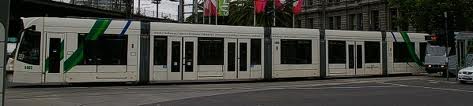
A Siemens Combino tram or streetcar in Melbourne
 An Alstolm Citadis tram in France
Surrey to display light rail model during Canada Day celebrations
By ELAINE O’CONNOR, The Province June 29, 2012
The sleek Bombardier Flexity Freedom Light Rail Vehicle model will be on display at the cityai??i??s Canada Day celebrations this Sunday.The city is pushing for three light rail lines in the community: one along 104 Avenue from City Centre to Highway 1, one along King George Boulevard to Newton,and one on Fraser Highway connecting Surreyai??i??s downtown to Langley.Photograph by: Handout Photo, City of Surrey
Surrey has succeeded in bringing light rail transit to the city.
Well, sort of.
Mayor Dianne Wattai??i??s quest to have TransLink help fund the service in her municipality has been well-publicized. Sheai??i??s adamant itai??i??s the best option for the sprawling suburb, rather than costlier SkyTrain service.
And this weekend, residents will be able to get on board ai??i?? literally with her vision ai??i?? touring a state-of-the-art light rail car.
Too bad itai??i??s not going anywhere just yet.
The sleek Bombardier Flexity Freedom Light Rail Vehicle model will be on display at the cityai??i??s Canada Day celebrations this Sunday. The 60-foot long model is a marvel of green energy, another of the cityai??i??s priorities. It makes no noxious emissions and creates virtually no noise.
ai???Surreyai??i??s population is expected to increase by 50 per cent over the next 30 years, so we need efficient transit service now in order to help shape and connect our growing communities,ai??? Watts said in a statement.
ai???Light rail is cost-effective and will allow us to create billions of dollars in new economic activity.ai???
The city is pushing for three light rail lines in the community: one along 104 Avenue from City Centre to Highway 1, one along King George Boulevard to Newton, and one on Fraser Highway connecting Surreyai??i??s downtown to Langley.
To learn more about Surreyai??i??s light rail proposal visit: www.surrey.ca/RapidTransitNow.

The SkyTrain Lobby – And The fine Art of Deception

The deliriously pro SkyTrain blog, SkyTrain for Surrey (SfS), continues its campaign of deception and misinformation in an attack against American transit expert Gerald Fox. I don’t normally follow the nonsenseAi??spouted byAi??the SkyTrain lobby because they live in a world of their own, where the rules are simple; SkyTrain good, light rail bad.
The recent post; “RE: Gerald Fox ai??i?? Evergreen Line business case underestimated SkyTrain“……
http://skytrainforsurrey.org/2012/06/23/skytrain-underestimated/
……completely underscores the deliberate attempt to misinform the public. Why should I not be surprised?
American transit expert, Gerald Fox, knows SkyTrain very well as he used the SkyTrain as one of hisAi??examples in hisAi??1980’s study comparing automatic transit systems (AGT) with light rail, using hard data, came to the conclusion that operatingAi??AGT and LRTAi??on the same quality of rights-of-ways with equal station stops,Ai??found that LRT was cheaper to operate than AGT.
The SkyTrain for Surrey blog takes Mr. Fox to task and offers a ‘man of straw’ argument that Mr. Fox has got it all wrong because the maximum speed for SkyTrain is 90 kph and not 80 kph.
Such nonsense! The real issue is looking a SfS right in the face, as TransLink’s study compares a longer SkyTrain train operating at 3 minute headways with a maximum speed of 80 kph, with a small LRT train at 5 minute headways, with a maximum speed of 60 kph. No wonder that TransLink can claim a peak hour ridership of 10,400 persons for SkyTrain versus a mere 4,080 persons for LRT by using LRT operating at longer headways. The TransLink comparison is totally dishonest and in other countries, those producing such a study would have been censured and could have faced criminal prosecution.
A honest comparison, because modern light rail vehicles have a slightly larger capacity than SkyTrain, wouldAi??see LRT havingAi??slightly higher capacity at equal headways; theAi??maximum speedAi??which a transitAi??vehicle can operate at has very little to do with capacity! Today, one can buy a LRV which can operate in excess of 110 kph.
Libeling transit expert Gerald Fox only highlights the desperation of the SkyTrain Lobby.
But the SkyTrain Lobby’s nonsense continues.
We are directed to another SfS post…………
http://skytrainforsurrey.org/2012/05/30/misconceptions-skytrain-is-proprietary/
………where the SkyTrain Lobby once again embarrasses itself, claiming that the SkyTrain is not a proprietary transit system.
It seems the great authority on transit, XERX (I am not making this up!), claims that an email from Bombardier told him so. More rubbish from armchair experts who really do not know what they are talking about.
Here is a lesson boys and girls, SkyTrain is considered a proprietary transit system because it uses Linear Induction Motors (LIM’s) for propulsion and not standard (squirrel cage) electric as used motors used on other rail systems; the third or fourth rail power pick-up has nothing to do with it. This means only Bombardier stock can operate on proprietaryAi??ART lines.
As ART is propelled by magnetic force and not adhesion, the cars are lighter andAi??active steerable axle trucks (bogies) can be used as the axles are not hampered by power drives, etc.Ai??The use of LIMsAi??is the reason why SkyTrain can’t operate on the Canada Line and why the ROTEM EMU’s can’t operate on the SkyTrain lines.
SkyTrain has always been seen as a proprietary railway and those buying with ART, will be forced to use the same product for the lifespan of their transit line. Of course another company can design a SkyTrain type vehicle, but the development costs ($70 million+) would prohibitAi??any profit when bidding against Bombardier for replacement vehicles.
The claim that Osaka’s metro can operate on our SkyTrain tracks is another display of ignorance as the Osaka cars are longer, heavier and slower, would be impossible to operate on the SkyTrain guideway.
A good indication of a proprietary transit system is, can another company’s ‘off the shelf’ transit vehicle operate on the line, if the answer is no, it is a good chance that the said transit line is proprietary.
Portland’s LRT is a good example as it operatesAi??vehicles manufactured byAi??Siemens, Gomaco, and Bombardier stock and evenAi??the Skoda streetcars can operate on the light rail lines if need be. Vancouver’s SkyTrain can only operate Bombardier built Mk.1 and MK. 2 cars and if they are not coupled together.
The preceding posts from the SfS web site are a goodAi??indication at what lengths the SkyTrain Lobby will go to distort the truth and should be treated as nothing more than bumf; bumf from those who haven’t a clue what they are talking about.
Transit Planning in the Vancouver Region – The Years The Locusts Have Eaten
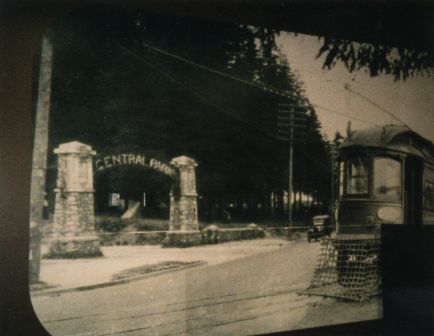 In the beginning, Vancouver was serviced by a sizable streetcar network and several interurban lines, but by 1960 the streetcars were long gone and the last interurban route saw its final service. There was a last ditch attempt to operate a New Westminster to Vancouver interurban service on the Central Park Line using coupled pairs of PCC cars but it failedAi??due toAi??unionAi??demands forAi?? two man staffing (one driver per car) of the car trains.
In the 1960’s and 70’s many new regional highways and bridges were built to contend with the growing population and greatly increased car use.Ai??In the late 1960’s aAi??line is the sand was drawn in Vancouver preventing a US style 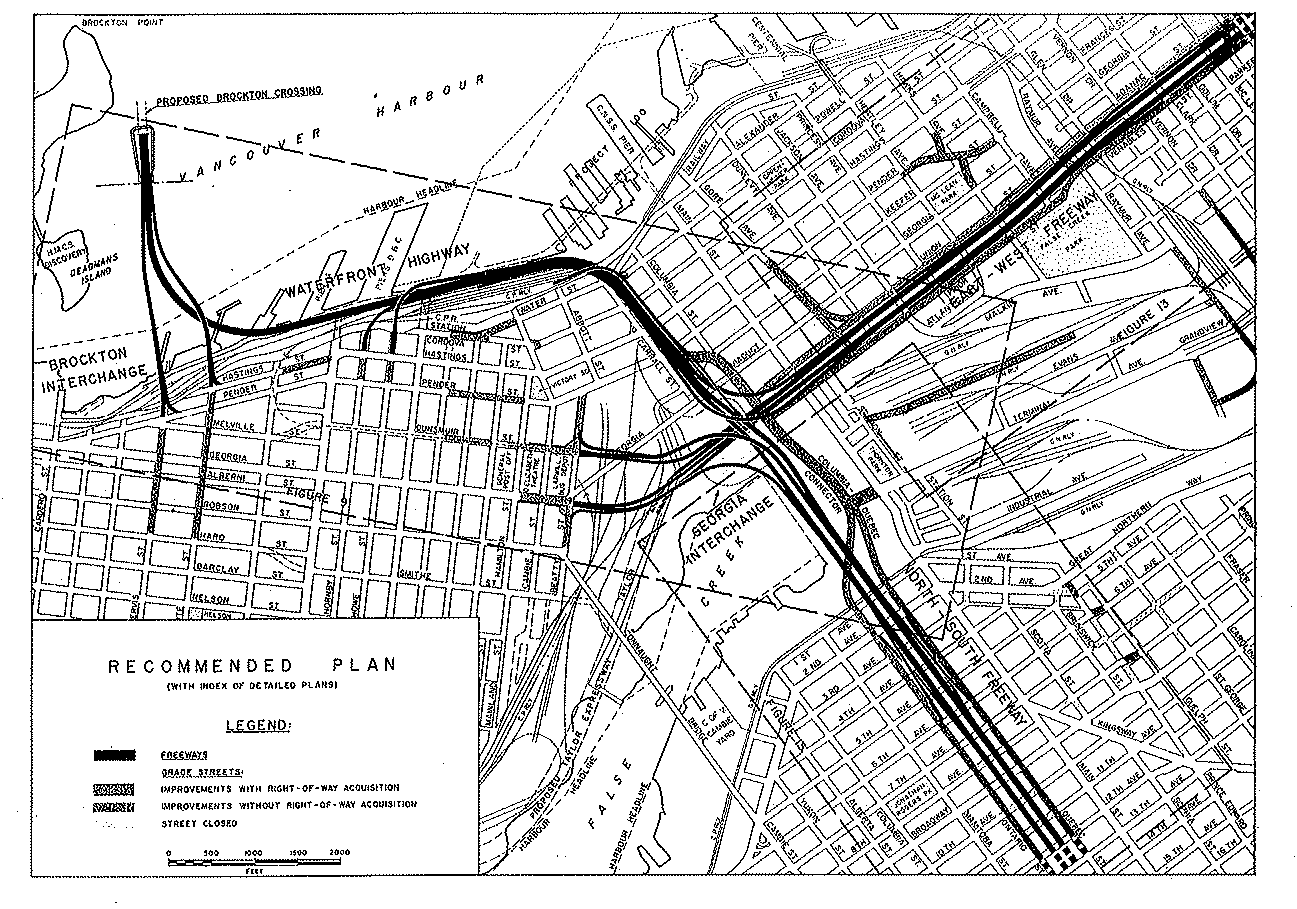 freeway bisecting China Town in Vancouver’s growing seedier East side, and the provincial penchant for new highway construction went elsewhere in the province to build new infrastructure.
Without a highway to cater to increased traffic flows, the Vancouver region started planning for ‘light rail’ and in the late 1970’s a three pronged light rail scheme was almost approved connecting Vancouver to Richmond, Surrey and Lougheed area on the Burnaby/Coquitlam boarder. The LRT plans were to utilize as much of the old interurban rights-of-ways as possible as the ridership potential was very high along these routes.
In a crass political dea,l the then Social Credit Government purchased a proprietary light metro or Advanced Light Rail TransitAi?? (ALRT) from the Ontario government’s crown corporation, the Urban Transportation Development Corporation or UTDC. The automatic (driverless) ALRT light metro system was renamed from the UTDC’s unsuccessfulAi??ICTS or Intermediate CapacityAi??Transportation System, which failed to find  a market in North America. ICTS, being elevated, was to have a greater capacity than a Toronto PCC streetcar, built at a much cheaper cost than a Toronto subway, or in short, a transit system with the benefits of a heavy-rail subway at a fraction of the cost. It wasn’t to be. The Toronto Transit Commission found that ICTS could cost as much as ten times more to built yet have the same capacity as modern LRT or cost about the same as a Toronto subway which had four times the capacity! ICTS was quickly renamed to ALRT and only one system was sold – too Vancouver.
Later Bombardier purchased the rights to ICTS/ALRT and now sell the package as ART or Advanced Rapid Transit.
With ALRT, now renamed SkyTrain for the local market, came all the sales rhetoric for the light-metro and thus began the massive anti-LRT campaign the reverberates still today.
In the 90’s, againAi??saw light rail on the drawing board again for the region, but the then NDP flip-flopped on transit mode, again forcing the SkyTrain light metro system on what was to be the Broadway-Lougheed transit project, now renamed the Millennium Line.
Light Rail for the Canada Line was given the toss, by former City manager and close confident of then Premier Campbell, by Ken Dobell, for reasons of political prestige. The Liberal supporter along the former BC Electric Richmond Interurban Line, raised such a fuss that the public were conned by the BC Liberal government and TransLink that LRT was not viable and only a SkyTrain light metro could be built.
The Canada Line, planned for in the early 2000’s, saw its costs rise dramatically, from $1.3 billion to an estimated cost that now may exceed $2.5 billion. The result, a drastically scaled back mini-metro that, as  designed, has less capacity than if LRT had been built on any route from Vancouver to Richmond. The result of this scaled down design was devastated businesses along Cambie Street, who suffered a design change from bored tunnel toAi??cut-and-cover construction. Even Skytrain was too expensive for the Canada Line and a generic heavy-rail metro was built to a light-metro standard. SkyTrain and the Canada Line are incompatible.
Predicted 30 years ago by the experts of the day, TransLink, the operating authority has run out of funds and needs new extra taxes to build the long waited Evergreen SkyTrain Line. TransLink wanted andAi??received aAi??gas surchargeAi??and still wants further extra taxesAi??to complete the funding for the locally called (N)Evergreen Line. The problem is the regional taxpayer is maxed out and is digging in its heels with ever increasing gas taxes.
Zwei predicted thisAi??over a decade ago in a presentation to the then new TransLink board, but predictions of a funding crunch for a metro system that costs three to four times more to build than a light rail alternative fell on deaf ears, as it still does today.Ai??The taxpayer will always has enough money to fund a new metro line, or does he or she?
Still the SkyTrain Lobby peddle their diatribes as they were fact, yet ignoring the that no one else wants to build with the proprietary SkyTrain system. With this in mind, the slogan todayAi??is SkyTrain is for Vancouver and light rail is OK for Surrey, but of course all of Metro Vancouver’s taxpayers pay for SkyTrain and if it was Vancouver ratepayers fronting the bill for SkyTrain want to pay fo expansion in their city, so be it, butAi??they do not and still want valley taxpayers to subsidize an obsolete metro system in their city.
 It has been now 33 years since SkyTrain was forced upon the regional taxpayer and the bureaucratic, political, and academic prestige that has been invested in SkyTrain and the Canada Line light metros, will ensure that SkyTrain will be built for future transit expansion, but with SkyTrain expansion comes higher and higher taxes and user fees to pay for light metro. 33 years of extremely bad transit planning by both BC Transit and TransLink, to ensure the continuation of SkyTrain expansion has left TransLink on a financial precipice, yet no one will admit to it.
Rail for the Valley has offered TransLink a life-belt with the RftV/Leewood Report a major transit study done by a bona fide transit expert, but it has been rejected by TransLink with excuse they can think of. TransLink is planning, sort of, for light rail in Surrey, but it is the old story, design light rail as a poorman’s SkyTrain and design it to fail. Simply, TransLink does not want a light rail solution for our transit woes in the region and instead plan for pie in the sky SkyTrain expansion such as the $1.4 billion Evergreen Line; an up yo $4.5 billion SkyTrain subway to UBC and another up to $4 billion SkyTrain to Langley.
The $1 billion, 138 km. RftV Vancouver/Richmond to Rosedale tramtrain service certainly looks a better deal than TransLink’s proposed SkyTrain lines,Ai??as there would be nearly $9 billion left over to fund a BCIT to UBC LRT; a Marpole to downtown Vancouver streetcar; a White Rock to Surrey Centre LRT; a Hastings St. to Coquitlam LRT, LRT to SFU, a new Fraser River Rail Bridge; LRT for Langley on 200th; and several other LRT/streetcar lines in the region. Again, TransLink is so blinkered, the bureaucracy would rather bankrupt itself planning for prestigious mini-metro, rather than a consumer driven, user friendly regional light rail network.
When the time comes that TransLink is forced kicking and screaming to plan for modern LRT instead of light metro, future transit and transportation planners will call the SkyTrain years; “The Years The Locusts Have Eaten.“

TransLink looks at higher prices for park-and-ride lots……..When idiots run the show, don’t be surprized………..
Didn’t take long for TransLink to make another cash grab from transit customers. Forgetting that ParkAi??& Rides are supposed to attract customers that would otherwise not take a bus or live to far from convenient transit, TransLink’s bureaucrats continue to blunder on and on with ideas that will only deter ridership.
Tis a very small world TransLink lives in and until TransLink’s bureaucrats are willing to give up their very generous monthly car allowances and other perks and told they must use the transit system as part of their employment contract, little should be heard from them. In fact, we could rid ourselves of TransLink all together and not hinder the transit service one iota. How’s that for saving money!
Just a note, the TransLink Park and ride at the South Delta Exchange is just the parking lot at the South Delta Recreation Centre and it would be very hard indeed to charge for Park & Ride parking.

TransLink looks at higher prices for park-and-ride lots
By Kelly Sinoski, Vancouver SunJune 21, 2012
TransLink is considering charging parking fees at some of its free park-and-ride lots ai??i?? or raising the price at others ai??i??to encourage people to take transit to SkyTrain stations or bus loops instead of driving to them.
The idea, part of a study to determine how the regionai??i??s 19 park-and-ride lots can more efficiently feed into the transit network, could see prices at some lots jump substantially.
TransLink spokesman Jason Martin said no decisions on pricing have yet been made, but acknowledged TransLink could potentially partner with more parking companies, such as Impark, which now charges commuters $6 per day to park at Surreyai??i??s King George SkyTrain station.
By comparison, the South Surrey park-and-ride lot is free, while the Scott Road park-and-ride charges commuters $3 per day. Richmondai??i??s Bridgeport station, which has a partnership with the River Rock Casino, charges $2.50 per day.
ai???Weai??i??re going to look at our strategy overall for park-and-rides,ai??? Martin said, adding there will likely continue to be a range of pricing and partnerships across the regionai??i??s park-and-ride lots.
Charging more at the lots may encourage people to take buses to SkyTrain stations or connecting bus loops, instead of driving to them, he said.
ai???Pricing may be the most efficient way to control demand. If a park-and-ride lot is free we might not be creating the right incentives for people to consider using transit in those areas.ai???
Meanwhile, TransLink is cracking down on illegal parking at the South Surrey park-and-ride, where overcrowding has prompted some drivers to park at curbs, double park, block other cars or park in such a way that prevents buses being able to manoeuvre.
TransLink has had a tow truck on the lot during this weekai??i??s morning rush hours to warn drivers that it will begin towing cars next week.
Martin said the overflow is happening even though the lot was reconfigured recently to increase the parking spaces from 425 to 481.
Surrey Mayor Dianne Watts said the South Surrey park-and-ride has been over-capacity for the past five years, with little being done to improve the problem.
And while she supports getting people out of their cars and onto transit, she doesnai??i??t believe commuters south of the Fraser should be penalized with higher fees because they donai??i??t have the same transit infrastructure as some cities like Vancouver and Burnaby.
ai???All the park-and-rides are busy. When you have a car-dependent community because of lack of transit, you want to do everything you can to encourage people getting out of their cars and taking transit when they can,ai??? Watts said. ai???Until you have an integrated transportation system you can rely on, I donai??i??t think fees should be in place.ai???
Martin said the study, which is expected to be completed within the next six months, will look at where commuters are coming from and where they are parking to develop a strategy that complements the existing transit service.
It may be that some underserved areas need cheaper access to park-and-ride lots, he said, while the prices could increase at lots in transit-dense areas where people live closer to SkyTrain. Martin would not confirm whether TransLink is considering closing certain lots.
He said the increase in traffic at park- and-ride lots is a result of more people taking transit, including those who are catching buses from South Surrey or Ladner and connecting with the Canada Line at Bridgeport.
But he noted it costs TransLink $3,000 to create each parking space and $200 per year to operate it.
ai???Itai??i??s positive people are taking transit but we have to look at what are the value or the cost of park-and-rides,ai??? he said. ai???We understand park-and-rides offer a convenience for customers but it comes at a price.
ai???Itai??i??s a matter of balancing how transit can support park- and-rides but park-and-rides themselves are not an overall solution.ai???
Coquitlam Mayor Richard Stewart said that if transit is made ai???inconvenient enough,ai??? people will continue to drive.
Fees are charged at all West Coast Express station park-and-rides. But park-and-rides at Gleneagles, Westmount, Park Royal mall, Phibbs exchange, Sexsmith, Walnut Grove, Ladner exchange and south Delta exchange are all free.
ksinoski@vancouversun.com
It is interesting how TransLink has used this cunning method of manipulating analysis to justify SkyTrain in corridor after corridor, and has thus succeeded in keeping its proprietary rail system expanding.
The Great transit philosopher’s stone, the Evergreen Line saga continues and it is once again time for Rail for the Valley how suspect TransLink’s business case for the (N)Evergreen Line was.
In, 2008 Gerald Fox, a well known American transit and transportation expert shredded TransLink’s Evergreen Line business case and found it grossly biased in favour for SkyTrain.
It is interesting how TransLink has used this cunning method of manipulating analysis to justify SkyTrain in corridor after corridor, and has thus succeeded in keeping its proprietary rail system expanding.
In other jurisdictions such comments would lead to legal action or an inquiry, but not in BC, where TransLink’s deliberate manipulating of certain facts may have lead to a police investigation of TransLink and its bureaucrats!
I would like to remind Surrey mayor, Dianne Watts, that the very same TransLink bureaucrats are now planning for LRT in Surrey are the very same anti-LRTAi??~ pro-SkyTrain bureaucrats that worked on the Evergreen Line and it is for certain the very same pro-SkyTrain arguments are being made for Surrey!
Nothing less than an audit of TransLink, West coast Mountain Bus and SkyTrain including the Canada line, by BC’s Auditor General, will clear the air. Both the provincial government and TransLink are deathly afraid of this happening as they continue to steamroll one SkyTrain or light-metro project after another on the BC taxpayer.
The following is the Gerald Fox letter of 2008……………..
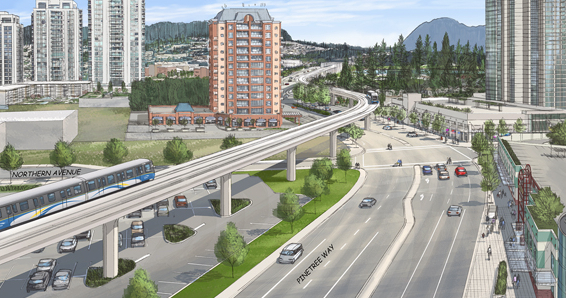
From: A North-American Rail Expert
Subject: Comments on the Evergreen Line “Business Case”
Date: February 6, 2008
Greetings:
The Evergreen Line Report made me curious as to how TransLink could justify continuing to expand SkyTrain, when the rest of the world is building LRT. So I went back and read the alleged “Business Case” (BC) report in a little more detail. I found several instances where the analysis had made assumptions that were inaccurate, or had been manipulated to make the case for SkyTrain. If the underlying assumptions are inaccurate, the conclusions may be so too. Specifically:
Capacity. A combination of train size and headway. For instance, TriMet’s new “Type 4” Low floor LRVs, arriving later this year, have a rated capacity of 232 per car, or 464 for a 2- car train. (Of course one must also be sure to use the same standee density when comparing car capacity. I don’t know if that was done here). In Portland we operate a frequency of 3 minutes downtown in the peak hour, giving a one way peak hour capacity of 9,280. By next year we will have two routes through downtown, which will eventually load both ways, giving a theoretical peak hour rail capacity of 37,000 into or out of downtown. Of course we also run a lot of buses.
The new Seattle LRT system which opens next year, is designed for 4-car trains, and thus have a peak hour capacity of 18,560. (but doesn’t need this yet, and so shares the tunnel with buses). The Business Case analysis assumes a capacity of 4,080 for LRT, on the Evergreen Line which it states is not enough, and compares it to SkyTrain capacity of 10400.!
Speed. The analysis states the maximum LRT speed is 60 kph. (which would be correct for the street sections) But most LRVs are actually designed for 90 kph. On the Evergreen Line, LRT could operate at up to 90 where conditions permit, such as in the tunnels, and on protected ROW. Most LRT systems pre-empt most intersections, and so experience little delay at grade crossings. (Our policy is that the trains stop only at stations, and seldom experience traffic delays. It seems to work fine, and has little effect on traffic.) There is another element of speed, which is station access time. At-grade stations have less access time. This was overlooked in the analysis.
Also, on the NW alignment, the SkyTrain proposal uses a different, faster, less-costly alignment to LRT proposal. And has 8 rather than 12 stations. If LRT was compared on the alignment now proposed for SkyTrain, it would go faster, and cost less than the Business Case report states!
Cost. Here again, there seems to be some hidden biases. As mentioned above, on the NW Corridor, LRT is costed on a different alignment, with more stations. The cost difference between LRT and SkyTrain presented in the Business Case report is therefore misleading. If they were compared on identical alignments, with the same number of stations, and designed to optimize each mode, the cost advantage of LRT would be far greater. I also suspect that the basic LRT design has been rendered more costly by requirements for tunnels and general design that would not be found on more cost-sensitive LRT projects.
Then there are the car costs. Last time I looked, the cost per unit of capacity was far higher for SkyTrain. Also,it takes about 2 SkyTrain cars to match the capacity of one LRV. And the grade-separated SkyTrain stations are far most costly and complex than LRT stations. Comparing 8 SkyTrain stations with 12 LRT stations also helps blur the distinction.
Ridership. Is a function of many factors. The Business Case report would have you believe that type of rail mode alone, makes a difference (It does in the bus vs rail comparison, according to the latest US federal guidelines). But, on the Evergreen Line, I doubt it. What makes a difference is speed, frequency (but not so much when headways get to 5 minutes), station spacing and amenity etc. Since the speed, frequency and capacity assumptions used in the Business Case are clearly inaccurate, the ridership estimates cannot be correct either. There would be some advantage if SkyTrain could avoid a transfer. If the connecting system has capacity for the extra trains. But the case is way overstated.
And nowhere is it addressed whether the Evergreen Line, at the extremity of the system, has the demand for so much capacity and, if it does, what that would mean on the rest of the system if feeds into?
Innuedos about safety, and traffic impacts, seem to be a big issue for SkyTrain proponents, but are solved by the numerous systems that operate new LRT systems (i.e., they can’t be as bad as the SkyTrain folk would like you to believe).
I’ve no desire to get drawn into the Vancouver transit wars, and, anyway, most of the rest of the world has moved on. To be fair, there are clear advantages in keeping with one kind of rail technology, and in through-routing service at Lougheed. But, eventually, Vancouver will need to adopt lower-cost LRT in its lesser corridors, or else limit the extent of its rail system. And that seems to make some TransLink people very nervous.
It is interesting how TransLink has used this cunning method of manipulating analysis to justify SkyTrain in corridor after corridor, and has thus succeeded in keeping its proprietary rail system expanding. In the US, all new transit projects that seek federal support are now subjected to scrutiny by a panel of transit peers, selected and monitored by the federal government, to ensure that projects are analysed honestly, and the taxpayers’ interests are protected. No SkyTrain project has ever passed this scrutiny in the US.
Victoria
But the BIG DEAL for Victoria is: If the Business Case analysis were corrected to fix at least some of the errors outlined above, the COST INCREASE from using SkyTrain on the Evergreen Line will be comparable to the TOTALCOST of a modest starter line in Victoria. This needs to come to the attention of the Province. Victoria really does deserve better. Please share these thoughts as you feel appropriate.
A Tale of Two Bridges: Pattullo survey in New West opposes six lane replacement
It seems the good burghers in New Westminster do not want a mega bridge dumping traffic into their city.
In the 1970’s, the GVRD (pre-METRO Vancouver days) proposed a new six lane bridge, with two lift spans for railways,Ai?? plus two light rail lines to replace replacing the decrepit Fraser River Rail bridge and the Pattullo Bridge. Today, we still have the now decrepit Pattullo Bridge, the even more decrepit Fraser river Rail Bridge and the now twenty year old SkyBridge for the SkyTrain light metro for its short run into Surrey.
The problem with the SkyTrain Skybridge is that Surrey doesn’t want SkyTrain, rather Surrey wants LRT, thus making the SkyTrain Skybridge somewhat a white elephant as it can’t be used for anything but SkyTrain!
Zweisystem has a solution; TransLink should design and buildAi??aAi?? combined road/rail bridge to replace both the aged Fraser River Rail and the Pattullo road bridges. The design could be a modified GVRD 1970’s bridge with a modern 4 trafficAi??lanes, generousAi??pedestrian/bicycle lanes and a three track lift span for the railways.
Such a bridge would allow modern LRT to directly access downtown Vancouver at least 20 minutes faster than taking SkyTrain from Scott Road Station. Allowing light rail, operating as TramTrain,Ai??to trackshare with the mainline railways would mean faster travelling times for transit customers and according to TransLink, the faster one can travel via transit, the more people will use the service!
A three track lift spanAi??would allow many trains to use the bridge at the same time, without conflict and with modern technology, a modern lift span can be raised and lowered in about 90 seconds, minimising disruption of rail traffic, while keeping the waterway open for ever less shipping traffic on the Fraser River.
The problem is that TransLink is not interested,Ai??instead planners spend their times planning for ever more expensive light metro construction or road only bridges. The fear Zwei has, that in 20 years, we will have the aged white elephant, the SkyTrainAi??Skybridge, a white elephant six lane car bridge replacing the Pattullo Bridge and an even more decrepit Fraser River Rail Bridge or a single track lashup if the bridge falls into the river, all being a monument to TransLink’s myopic planners of today.

From radio News 1130
Pattullo survey in New West opposes six lane replacement
Andrew Hopkins Jun 19, 2012
NEW WESTMINSTER (NEWS1130) –
The mayor of New Westminster says TransLinkAi??is offering his city more input on what a new Pattullo Bridge might look like. New Westminster council has a problem with the current focus on building a six lane replacement to help you get across the Fraser River.
Mayor Wayne Wright says at city-run open houses earlier this year they collected feedback from the public. He says almost everyone they heard from was against jumping from four lanes to six. He believes roads through his city won’t be able to handle the increase in traffic that could result.
“We are at capacity as we speak, anything that we add to it now will just cause more congestion everywhere, so that came out very strong from everyone that was on this side, and I think people who realistically look at it from any point of view, will see it,” says Wright.
He adds a letter to council from TransLink now suggests the authority is willing to review all the options with the city.
Councillor Jonathan Cote says that has him feeling a little more positive about the project’s future. He believes the letter shows TransLink may be willing to reconsider the six lane proposal.
“Indicating that they’re open to have dialogue with both New Westminster and Surrey, and that they’re willing to put back on the table the location of the bridge and also the lane capacity,” says Cote.
He hopes discussions will lead to a solution that can handle the region’s needs, without hurting New Westminster.
Wright says he’s anxious to see how TransLink plans to get six lanes of bridge traffic through New West.
The city says it won’t be able to handle the increase in traffic



Recent Comments