Bogota’s Vaunted Bus Rapid Transit System ai??i?? in Distress
This comes as no surprise as the shine of bus rapid transit is beginning to wane.
In South America, the rise of BRT was mainly due to the World Bank’s aversion to fund any type of rail project, but would shovel piles of money off the back of a truck to fund new highway construction. BRT also echoed an era of major highway expansion and everyone knows, new highways can accommodate a lot more cars and in a very short while congestion reigns.
Today, those who champion BRT, are also championing new highway construction andAi?? TransLink, whichAi?? puppet strings reach as farAi??as the provincial government in Victoria, whichAi??puppet stringsAi??are directly linked toAi??the BC Road builders Association, will promote anything the provincial government and its political friends want.
In simple terms, BRT = new highway construction.
BRT, in North America has been abysmalAi??in revenue operation, failing to meet its promoters expectations and where BRT is built, LRT is soon to follow, only at a far grater cost than if modern LRT had been built in the first place.

Bogota’s Vaunted Transit System ai??i?? Model for Transjakarta ai??i?? in Distress
March 14, 2012
Bogota, Colombia. Bogota’s eco-friendly mass transit system has been widely emulated around the globe, so urban planners were dismayed when a protest by frustrated commuters turned into a free-for-all that nearly paralyzed Colombia’s capital.
Anger over the TransMilenio system’s overcrowded, deteriorated state was behind last week’s protest, which began at five of the bus rapid transit system’s 114 stations before spinning out of control and devolving into battles between protesters and riot police.
Vandals in ski masks looted and broke windows. Bus drivers abandoned their shiny, double-length vehicles and fled. Earlier protests over the system’s decline had been isolated. This one seemed coordinated.
“The stations are like rivers of people and there’s no control,” complained German Augusto Guarumo, a 52-year-old lawyer and commuter who says the system has become unmanageable during peak travel hours.
Friday’s rioting was a shock to an 11-year-old system that urban planners have lauded, along with a similar network in Curitiba, Brazil, as a promising alternative to rail systems. Its low-emission buses briskly ply dedicated lanes that typically border traffic-choked avenues.
Prized for their efficiency, low cost and smog- and congestion-fighting prowess, such systems have sprung up in cities from Jakarta, Indonesia to Mexico City to Los Angeles and Cleveland, Ohio.
But the TransMilenio has become a victim both of its own success and of official neglect. It became overloaded as the capital’s motor pool grew by about 100,000 automobiles annually over a decade and two consecutive city administrations did almost nothing to expand it. It was built to handle half of the 1.7 million passengers it now carries daily.
And it’s not as if Bogota residents have an alternative. There are rickety old belching buses on some avenues. But most main thoroughfares belong to TransMilenio alone.
Other Latin American cities with bus rapid transit systems tend to have alternatives. Santiago, Chile, has an underground metro. So do Mexico City and Buenos Aires, Argentina, where the variety of options include a bus rapid transit system launched last year.
The success of bus rapid transit is not measured in easing vehicular traffic alone. Economists like it for its affordability. Environmentalists like it for its climate- and public-health friendliness.
The TransMilenio has reduced particulate emissions by 1,000 metric tons a year, saved Bogota $60-70 million in health care costs from decreased respiratory and other ailments and reduced carbon emissions by more than 1.7 million tons between 2006-2009 alone, according to a 2010 study by Manuel Olivera, Colombia’s director for the Clinton Climate Initiative. It has also already earned Bogota $3 million in direct carbon reduction payments under the Kyoto Protocol.
For commuters, the benefit has come primarily in relief from the congestion caused by the 1.4 million automobiles that bloat Bogota’s roads, sometimes producing near-gridlock conditions.
That congestion worsened during the previous administration of Samuel Moreno. The former mayor is on trial for allegedly soliciting and receiving payoffs in granting major construction contracts including one to expand the TransMilenio.
Enrique Penalosa, who as Bogota’s mayor from 1998-2001 launched the TransMilenio, says at least 18 percent of the TransMilenio’s users have cars but leave them at home at least two days a week to comply with vehicle restrictions based on license plate numbers.
One complaint of riders is that the fare is expensive at $1 per trip because the overcrowding makes their commute longer.
Police say they don’t yet know who organized Friday’s protest. About 60 participants were arrested but later released. Authorities put the damage at a half million dollars and 11 injuries were reported.
The violence came as Bogota’s new mayor, former M-19 leftist rebel Gustavo Petro, seeks to renegotiate contracts with some of the system’s 26 concessionaires that expire in 2014.
He claims the city, which does not subsidize the system, deserves more than 5 percent of the TransMilenio’s profits because it provides the infrastructure and security. The concessionaires have not yet agreed to open negotiations.
Petro contends his political opponents were behind Friday’s protest. But Penalosa blamed Petro, claiming the mayor promoted the protests as part of his campaign to renegotiate contracts.
System users, meanwhile, say they’re tired of finger-pointing. “It’s going to take a tragedy until these people realize that we are human beings and not merchandise,” said Carmenza Contreras, a 38-year-old architect.
Associated Press
April 15 Friends of Rail For the Valley AGM
Mark your calendars,
Announcing…
Annual General Meeting of
Friends of Rail For the Valley, inc
Sunday April 15, 2PM
University of the Fraser Valley, Abbotsford
Room B 121
Details are To Be Announced. We hope to have a guest speaker and/or a video presentation.
YouAi??can help speed up the coming of light rail
Share your ideas. Get involved!
(membership fee of $10)
Austin LRT plan criticized … by rail advocates
Light rail advocates not only promote light rail, they also promote good public transport and if a light rail project does not meet the criteria for good public transit, light-rail advocates must criticize the project.
What is happening in Austin has happened elsewhere. In Seattle, the light-rail group supporting the then proposed Seattle LRT projects withdrew their support when bureaucrats morphed the project into an expensive hybrid light-rail/metro line and in Vancouver, those supporting LRT for the Broadway-Lougheed rapid transit project (latter known as the Millennium SkyTrain Line) abandoned the NDP government who forced a SkyTrain solution onto the taxpayer.
There is no shame for light rail advocates criticizing a transit project, if it is a bad transit project, it just increases their credibility.
Austin LRT plan criticized … by rail advocates
Written by Lyndon Henry
Customarily, in almost any urban area, you’d expect your strongest rail transit advocates to be rallying around an official rail plan as it heads toward a possible ballot initiative. But in Austin, Tex., today, that’s definitely not the case.
A group of avid transit activists has been questioning the official City of Austin plan for 16.5 miles of “Urban Rail” (actually, a full-performance light rail transit, or LRT, plan that has mutated from an original streetcar plan). They argue that it’s literally off the track, ignoring where the biggest need is, and investing about 1.4 billion bucks to go where it isn’t.
This group of pro-rail nitpickers is currently small, but it comprises some of the most venerable and influential transit advocates in the city ai??i?? including yours truly and a longtime colleague, Dave Dobbs, publisher of the well-respected Light Rail Now website. I’m the guy that originally proposed LRT for Austin, way back in the 1970s (whew), and, following the ballot failure of that plan in 2000 (by a very narrow margin of less than 2,000 votes), Dave and I concocted the scheme for running DMUs on the railway owned by Capital Metro, the transit authority. You know … the scheme that today runs as the MetroRail Red Line.
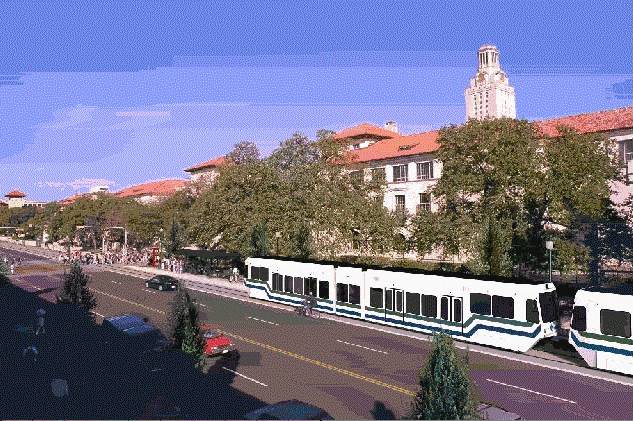
Basically, the city’s neediest travel corridor runs along a couple of major central-city thoroughfares called Lamar and Guadalupe, which channel a huge travel flow from the north and northwest down southward through the heart of the city and into the Core Areaai??i??including the University of Texas (plus the fourth-densest residential neighborhood in the state), the Capitol Complex (state Capitol plus a cluster of state offices), and Austin’s downtown. (A depiction of the proposed service, envisioned as LRT, is at left.)
MetroRail, originally envisioned as a “demonstration” starter line, and built at very low cost (about $4 million a mile), has gained public respect for attracting just under 2,000 rider-trips a day out of cars, SUVs, and pickup trucks. Why such relatively low ridership for a rail transit line? By following a former Southern Pacific branch line, MetroRail bypasses the central corridor and the Core Area in a leisurely dogleg through the east side of the city, ending up in the lower southeastern corner of downtown. Now the new Urban Rail plan (promoted by the City, not Capital Metro) also fails to serve this crucial travel corridor, thus likewise missing the target.
For about the past six years, we’ve been raising concerns about these route weaknesses. The official response has consistently been that the route plan isn’t “set in stone” … but, well, it’s set in stone. There’s talk of a possible bond election next November to fund the first phase.
All this should become clearer in an article I’ve just published, with more details, maps, and other graphics, on the Light Rail Now website: Austin, Texas: City’s Urban Rail Plan Needs Major Overhaul
The official Urban Rail site, with full information on the plan, is here:
You’d think that, in today’s contentious political atmosphere (with some GOP politicians trying to scuttle dedicated fuel-tax funding for transit), local planners would realize a major rail project like this needs all the help it can get. But instead, the attitude seems to be, “Damn the critics’ torpedoes ai??i?? full speed ahead!”
But if some of the most knowledgeable and enthusiastic rail supporters in the city think it’s flawed, what about voters at large? Doesn’t seem to bode so well.
Lyndon Henry
Lyndon Henry is a writer, editor, investigative journalist, and transportation consultant currently based in Central Texas. He holds a Master of Science in Community & Regional Planning, with a focus in Transportation, from the University of Texas at Austin, 1981. From 1973 to 1989 he was executive director of the Texas Association for Public Transportation, and presented the original proposals and feasibility studies for light rail that led to the inclusion of rail transit in the Austin-area planning process.. From 1981 to 1985 he served as a transportation consultant to the Hajj Research Centre at
King Abdul Aziz University, in the Kingdom of Saudi Arabia. He has also served as a transportation planning consultant on several other transit projects in the USA. In 1983-84 he was a member of the Austin-Travis County Transit Task Force which recommended a transit authority for the Austin area. That agency, eventually named Capital Metro, was created in 1985. From 1989 to 1993, Mr. Henry served as a board member and vice-chairman of Capital Metro. From 1990 to 1992 he was an Adjunct Faculty member at St. Edwards University, teaching a course in public policy. Since 2000 he has served as a technical consultant to the Light Rail Now Project, and from 2002 to late 2011 he served as a Data Analyst for Capital Metro in Austin. He is also a member of APTAai??i??s Streetcar and Heritage Trolley Subcommittee and Light Rail Transit Technical Subcommittee.
Cleaning a subway – Does TransLink get it?
 A London Underground Vacuum train
Subways are an expensive proposition, not only are they expensive to build and operate, they are expensive to maintain.
A little known fact is that subways needAi??regular cleaning as the dust and debris from daily operation is very corrosive to important signaling installations. The constant piston like action of trains in the tube, propel the debris of operation like a miniature sandblaster and over time, great and expensive damage occurs. This debris must be cleaned and a subway vacuum, many custom made, is used to clean the subway tubes.
Subway cleaning is just another subway expense that has been quietly ignored by TransLink and the subway lobby in Vancouver, especially when they expect the valley taxpayer to ante up to pay for Vancouver’s expensive transit demands.
From the Railway Gazzette
London Underground vacuum train to cut tunnel cleaning time
12 March 2012UK: London Underground aims to slash the time taken to remove dust and litter from underground sections of its network from two years to two months using a new tunnel cleaning train which is expected to enter service by the end of this year.
Much fine dust in the tunnels is metal from wheel-rail contact or braking, which LU says can ’cause signal failures and interfere with other electrical systems’. At present a contractor is employed to clean tunnels manually overnight, but it takes two years for six gangs of six workers to cover all the tunnels which at 181 km form 45% of the 402 km LU network.
The new train will consist of seven cars. At each end will be a pair of driving motor cars built for the Victoria Line in 1967 and recently withdrawn. These are being remodelled to provide traction and to supply the power for the vacuum and dust disposal plant, which is being supplied by Hannover-based metro cleaning vehicles specialist SchAi??rling Kommunal. A hydraulic drive will allow low-speed running at 1 km/h during cleaning, while the motor cars will enable the train to reach work sites at line speed.
Dust and litter will be sucked in by a 360Ai?? ring of nozzles on the central vacuum car. On each side of the vacuum car will be vehicles with containers to store the fine dust or larger items of litter. It is estimated that manual cleaning removes about 150 kg of dust per km of tunnel. The vacuum train is expected to quadruple this to 600 kg/km.
The train is suitable for use on the small-profile single-bore deep level tube tunnels, and also the mainly double-track sub-surface tunnels on the older parts of the LU network.

A New York subway vacuum train
Surrey’s mayor renews call for light rail
Surrey mayor, Dianne Watts is renewing her call for LRT and well she should as the province is now leaning towards a SkyTrain subway under Broadway. Surrey and the south Fraser region is grossly shortchanged by TransLink and public transit is just a few steps up the ladder from dismal.
The real problem is TransLink’s fetish with SkyTrain, light-metro and subways and all transit planning is based on the outdated bus/light-metro philosophy, where all bus routes feed a light-metro spine. Inflexible and mostly customer unfriendly, TransLink persists with this nonsense to the detriment of prospective transit customers.
The SkyTrain, anti-LRTAi??lobbies areAi??very strong and very vocal and they no shrinking violets at spreading untruths, questionable studies, and pure invention to discredit modern LRT. The ongoing debate with “rico” shows that utter lack of knowledge of modern LRT and the ability to carry large numbers of passengers, yet at the same time, absolutely no scrutiny isAi??done at all with the spurious claims aboutAi??SkyTrain ridership.
Mayor Watts should step up the calls for LRT and at the same time demand an independent consultant for proposed light rail in Surrey as TransLink is just not up to the task. Rail for the ValleyAi??would like to suggest Leewood Projects of the UK to undertake an independent study for LRT in Surrey, just like the historic study Leewood Projects didAi??in conjunction withAi??Rail for the Valley for the return of the Valley interurban.
TransLink is far to anti-LRT to have any credibility with any transit study, either with LRT or SkyTrain light-metro, as the Broadway transit studies have shown. Surrey needs a fresh approach to “rail” transit and surrey mayor, Dianne Watts, renewed call for light rail is on the right track!
Surrey’s mayor renews call for light rail
Ai??Dianne Watts delivers her annual state of addressBy Kelly Sinoski, Vancouver SunMarch 13, 2012
METRO VANCOUVER — Surrey Mayor Dianne Watts is once again renewing her call for light rail transit south of the Fraser, arguing rapid buses or a costly SkyTrain line to Langley won’t reduce the increasing gridlock on city streets.
Watts noted her city pays $160 million every year to TransLink but is not getting the transit service it needs to meet a growing population that is set to reach 750,000 people by 2040. The city’s population has grown 18.5 per cent in the past five years ai??i?? more than three times the national average of 5.9 per cent growth. About one-third of the population is under the age of 19.
“Do we want to become Los Angeles?” she asked the attendees at her annual state of address of the Sheraton Guildford Hotel.
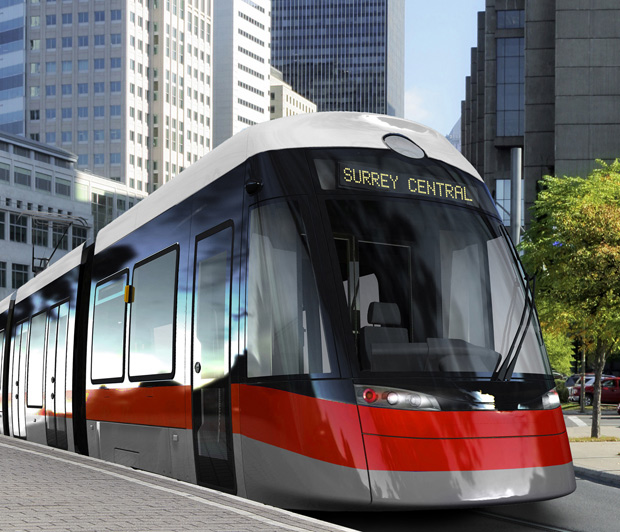
Using the same stage backdrop of an LRT as last year, Watts said light rail is not a “request of the month” and she won’t give up, noting three light rail trains could be built for less than the cost of a $2 billion SkyTrain to Langley. More buses aren’t efficient enough, she argued, while rapid buses are “not 21st century” and do not meet the city’s goal to have 80 per cent of trips within Surrey on transit by providing denser town centres.
The city is in line for a B-Line bus service along King George Highway from White Rock to Guildford, buses from White Rock to Langley and a rapid bus along Highway 1 over the new Port Mann Bridge. A new Pattullo Bridge is also included in the TransLink plan, while a study on a rapid transit line linking to the King George station is underway.
But Watts said light rail will help shape and connect communities across Surrey’s vast land base, while increasing economic development. Watts noted Portland, Oregon has seen $8 billion in new development around its rail stations.
The city is already exploring three routes: 104th Avenue between the City Centre and 152nd Street; Fraser Highway between City Centre and Langley; and King George Boulevard, between City Centre and South Surrey.
She also called for a regional tolling strategy to help defray the costs of a new Pattullo Bridge, noting residents south of the Fraser are being unfairly taxed with tolls on the new Port Mann Bridge.
Transportation was just one prong of Watts’ speech, which noted Surrey has a strategic advantage in becoming the economic powerhouse for the region because it holds 46 per cent of the region’s available industrial land, and has the second largest border crossing in Canada, the Fraser Surrey Docks and is the gateway to Asia Pacific.
But the city is feeling a financial pinch related to growth. The city’s major source of revenue is property taxes yet cities only get eight cents of every one tax dollar, are consistently facing downloading costs from the provincial and federal governments for expanded services such as sewer and water and are trying to address the growing issues of affordable housing and homelessness.
The city has already instituted new zoning bylaws to allow for more multi-family dwelling and smaller lots as well as mixed-used ton centres with higher density around transit, fee simple row houses and manor houses. The plan to move forward, she said, includes improving social infrastructure, generating social economic activity and creating thriving communities.
The Karlsruhe model of a dual-mode railway system
Karlsruhe:
|
| Country: | Germany |
| Type: | Policies |
| Area: | Entire City, Region |
| Actors: | Local Gov. |
| Funding: | Local Gov., Regional Gov., National Gov., Private |
| Topics: | Built environment |
| Consultancy | |
| Mobility | |
| Objectives: | Increase non-motorised mobility |
| Increase use of public transport | |
| Reduce car mobility | |
| Reduce energy consumption | |
| Instruments: |

A coupled set of GT-8’s in Karlsruhe operatin on the main tramway
Abstract:
The dual-mode railway system of Karlsruhe is widely regarded as the model of a high-quality and well patronised local public transport system. The successful track-sharing experience of the Karlsruhe Stadtbahn, the Citynew tram system, revolutionise the urban and regional public transport system as this Karlsruhe tram is running on the urban light rail system and on the heavy rail tracks of the German Railways. The Karlsruhe model of a dual-mode railway system is an outstanding example of best practice in urban development for the following reasons:
- continuous extension of an environmentally compatible transport system from
the urban area to the region; - introduction of innovative technology;
- dissemination of know-how;
- facilitation of commuter movement between railway and tramway by through
connection; - revitalisation of urban life in the city centre by serving pedestrian
precincts.
Concept and aims
Transferability is the key to the creation of an effective public transport system that can serve the urban area as well as the conurbation as a whole. The linking of different modes is essential in the public transport sector in order to attract new passengers by offering travelling standards that can compete with the car. In Karlsruhe the peripheral location of the railway station initially required that a large number of commuters have to change from the railway to the tramway connection. This has two major disadvantages. Firstly, the trips become lengthy and, secondly, the passengers have to pay an extra ticket due to non-integrated fares. It is obvious that the philosophy of the Karlsruhe public transport system started with the target of establishing intermodality between
tramway and railway.
The concept of track-sharing between light rail and heavy rail vehicles had been investigated in an initial study by the Federal German Ministry for Research in 1984/85. The results triggered off the development of the so-called Karlsruhe Model. Three fundamental preconditions characterise the new approach:
- The transport system has to use vehicles which can use the light rail tracks
of the city area as well as the heavy rail tracks of the German Rail (Deutsche
Bundesbahn AG) on the regional level. - The different railway networks have to be connected;
- The new network has to incorporate the building of new stops along the
existing heavy railway lines in order to cut the travelling time.
The origins of the Karlsruhe model of a dual-mode transport system can be traced back to the 1950s. In 1957 the metre gauge Albtalbahn merged with the city tramway. The Albtalbahn is running south from its own station near the German Rail main station to the spa of Bad Herrenalb and Ittersbach in the Black Forest. At the time the railway was converted to a standard gauge and could be
operated by city trams providing a through service to the city centre. The experience was exploited again in the period of 1979 to 1989 when the Albtalbahn
service was progressively extended to the north of Karlsruhe by using the German Rail branch line. With the new connection to Neureut the basic innovation has been introduced. On the new line the railway leaves the separate railway line at special points and runs through village streets.
This development laid the foundation for a new concept of far-reaching operations on a mixed light rail and heavy rail network. So far it had been possible to install tramway overhead electrification at 750 V DC on the shared track sections but extensions should need to operate with the 15 KV AC electrification of DB lines. Experiments were undertaken with prototype battery and dual system tram. The dual system was found more efficient as the equipment allows voltage change with the tram in motion. The dual system vehicle type is supplied by the Duewag rail vehicle company which is part of the Siemens rail vehicle group. An important factor of the new type of vehicle is that it uses the safety standards of ordinary heavy rail vehicles (low passive safety) and, thus, allows travel at higher speeds in the region.
Implementation
The area served by the integrated transport system has 1,200,000 inhabitants, including 270,000 from the Greater Karlsruhe area. Most of the served suburbs have between 25,000 and 30,000 inhabitants.
The practice of intermodality started in 1992 when the Karlsruhe Model, the so-called Stadtbahn (the city tram system), started its service between Karlsruhe and Bretten (30.2 km). This was the first route which is run on the heavy rail tracks (21 km) and which also includes a twin ack section of 2.8 km due to the busy schedule on the German Rail line. This service has provided some
significant changes:
- shorter timetable intervals (every hour during off-peak hours and every 30
minutes during peak hours) - more stops,
- single fare structure,
- integration of the local bus network (at Bretten),
- provision of park and ride facilities for bicycles and cars.
In the meantime the Stadtbahn is running on its own network of approximately 400 km. In 1996 the total network of the new corporate structure serves approximately 600 km as some of the routes are rented from the German Rail. The service has been continuously extended in all directions. Since 1994 the region on the other side of the river Rhine is served to the City of Worth in the Land
of Rhineland Palatinate. To the north the Verkehrsbetriebe Karlsruhe und Albtal-Verkehrs-Gesellschaft (VBK/AVG) has added the line to Eppingen to its corporate network as they bought the line from German Rail. In the south the famous spa of Baden-Baden can be reached by Stadtbahn since May 1994. However, the link to the Baden-Baden centre still has to be completed as the once
existing railway network had been removed. The northern part of the Black Forest has also become part of the co-operative structure of Karlsruhe in June 1996.
However, the route to Baden-Baden and to Forbach in the Black Forest are both rented from the German Rail. In contrast the VBK/AVGown track to Eppingen will be extended to the City of Heilbronn within the next two years.
Results and Impacts
The first dual-mode line between Karlsruhe and Bretten proved to be highly successful. Since the opening in September 1992, there has been a 479% increase in passengers. 40% of the customers have previously used their private car. The number of passenger has also gone up at weekends. The number of public transport passengers before the opening of the Stadtbahn was 533,660 in total (488,400 on workdays, 39,000 on Saturdays, and 6,200 on Sundays) where
as the figures after six months of operation of the Stadtbahn have increased to a total of 2,554,976 (2,064,378 on workdays, 263,120 on Saturdays, and 227,478 on Sundays). The percentage increase is 423% on workdays, 675% on Saturdays, and 3,660% on Sundays!
32% of the passengers used monthy environmental tickets, 21% use city or regional cards, 20% use apprentice or student tickets, 12% use tickets of the German Rail, 6% use four-trips tickets, 4% use single tickets and the remaining 5% have some other special ticket. Since the setting up of a co-operative structure for the travelling area in 1994 the former German Rail tickets are sold by the VBK/AKB. Surveys into the purpose of travelling with the Stadtbahn showed that 38% of the passengers travel to work, 23% are on their way to training, 15% of the travel share is during leisure time, 12% of the travel is for shopping, and the remaining 12% are related to various reasons.
The success of the Stadtbahn is mainly due to the shorter travelling intervals, the increase in number of stops and the higher comfort of the light rail. Thanks to faster acceleration and braking the VBK/AKB only requires three light rail vehicles for a comparable service previously operated by the German Rail with four diesel trains. The ecological benefit is an extra bonus. The difference in energy costs is about 18,000 DM per year / per train.
In 1994 the total number of passenger of the Verkehrsbetriebe Karlsruhe und Albtal-Verkehrs- Gesellschaft amounted 93.9 million.
The Karlsruhe Model can be regarded as an optimal solution of a public transport system that should serve medium-sized cities and regions with a population of 200,000 to 500,000. At times of financial pressure the revitalisation of existing and under-used tracks is preferable to the construction of new and often parallel lines. In this context the Karlsruhe experience is a valuable asset in order to generate transferability of a successful system. Currently, the Verkehrs-Consult Karlsruhe GmbH (VCK), the consultancy subsidiary of the VBK/AKB, is helping to build several follow-up
projects:
- The City of SaarbrA?cken (190,000 inhabitants in the city and 280,000 in the
region) is the most advanced scheme. The implementation started in 1995, and the
operation of the first route will start in 1997. The project includes 15 km of
newly constructed inner city tracks and the total investment is 540 million DM. - In Heilbronn (122,000 inhabitants in the city and 415,000 in the region)
there will be only 9 km of new tracks but the light rail system will gain access
to approximately 220 km of regional heavy rail tracks. As the city is only 80 km
from Karlsruhe the plan is to connect both networks in order to set up a direct
connection from Karlsruhe to Heilbronn via Bretten by 1998. - The City of Aachen (280,000 inhabitants in the city and 630,000 in the
region) decided in July 1995 to build a system which is re-using the tracks that
had been closed in the 1970s. Parallel planning incorporates a linkage with the
lines to Herzogenrath (MAi??nchengladbach) and Stolberg (KAi??ln-DA?ren) as well as a
line across the border to the Dutch city of Heerlen. The electrification in the
City of Aachen will be 1500 V DC which is the Dutch voltage standard. Priority
is given to the connection to the DA?ren area as the upgrading of this network is
making fast progress. In 1995 the investment for the modernisation and
standardisation of access points, the building of additional stops, and the
purchase of 16 new rail vehicles totalled approximately 53 million DM. - The City of Kassel (195,000 inhabitants in the city and 550,000 in the
region) has started to operate a 3.5 km light rail track in the district of
Baunatal which is also using the heavy rail track of the regional rail, the
Kassel-Naumburger Eisenbahn. In Kassel a special solution is the use of
four-rail tracks at stops to allow low-floor platforms outside heavy rail
clearances. - The City of Chemnitz (270,000 inhabitants and 600,000 in the region) will
also use low-floor light rail vehicles with a power-pack for use on five
non-electrified regional German Rail lines. The power pack system is a test case
which could become a model for cities with a non- electrified regional rail
network.
Other German cities like Dresden, Kiel, Ulm, OsnabrA?ck, Paderborn, and Rostock are currently investigating the possibilities of an adoption of the Karlsruhe Model. In most cases these cities already had a light rail system which had been abandoned in the 1960s or 1970s.
In addition, the Karlsruhe Model has also had some impact in other European cities. In Austria the cities of Graz and St. PAi??lten are in the process of assessment with the Austria Rail (Ai??BB). Feasibility studies should be completed in 1996. In Great Britain there is growing interest. Nottingham, Karlsruhetwin town, has completed the first planning phase of a new track-sharing system, the
so- called Robin Hood line. Newcastle upon Tyne, the towns in the Medway valley in Kent, and Cardiff are further candidates for a system. The introduction depends on a change in financing on the local level. In Great Britain private funding of public transport is the normal case whereas in Germany the financing is via Land and municipality funding. Currently, the thinking is mainly directed
towards the possible use of existing infrastructure. In France the Karlsruhe Model has been discussed for the region of Ile de France (8,120,000 inhabitants) and the cities of Marseille and Valenciennes. In the Netherlands studies are being carried out in the Rijn and Bolenstreek region which includes the cities of Alphen aan Rjin, Gouda, Leiden, and Nordwijk. Similar planning has been
initiated in Maastricht, Heerelen, and Kerkade. The City and Region of Luxembourg is also interested and the City of Ljubljana in Slovenia (260,000 inhabitants in the city and 360,000 in the region) is the first East European municipality which has commissioned a feasibility study for 1995/96.
Actors and Structures
The co-operative structure of Karlsruhepublic transport (Verkehrsverbund) was
founded in 1994 by five public transport companies which operate different
networks. The Verkehrsbetriebe Karlsruhe und Albtal-Verkehrs-Gesellschaft
(VBK/AVG) are the main operators. The company has a total staff of 1,400 (722
drivers).
Finance
The total investment in the basic infrastructure and the first generation of
vehicles amounted to 80 million DM. The new route to Bretten alone cost some 45
million DM in 1989 (excluding the ten dual-voltage vehicles). Other technical
infrastructure investment is directed to the building of connection points, the
building of depots, and the purchase of new rolling stock. The price of a dual-
voltage light rail vehicle of the first generation was 4.5 million DM. 15% of
the costs are taken by the dual-voltage equipment. The second generation of
vehicles is expected to be less expensive.
Due to the German financing method of co-funding
(Gemeinde-Verkehrs-Finanzierungsgesetz) the financing of vehicles is split
between the national government (50%), the City of Karlsruhe (25%) and the
municipalities and districts (Landkreise) in the region cover the remaining
quarter.
The investment costs for infrastructure (e.g. electrification, twin tracks,
park & ride facilities) are shared between the national government (60%),
regional government of the Land of Baden- WA?rttemberg (20 to 25%), and the local
communities (10 to 15%).
It is interesting that Karlsruhe, like other cities with a well patronised
public transport system, has one of the highest percentage of costs covered.
Revenue from fares covers 66% of the costs in the area of Karlsruhe and 85% of
the costs within the region.
In June 1996 the new zone network has been introduced. Prices for a monthly
environmental ticket are 54 DM (two zones), 72.50 DM (three zones), 90.50 DM
(four zones), 109 DM (five zones), 127.50 DM (six zones), and 165 DM for the
network as a whole. Special prices for apprentices are 45 DM for the Karlsruhe
or Baden-Baden area, 55 DM for three zones, or 85 DM for the complete network.
Students also have special tariffs as the term tickets for five months cost 180
DM inside Karlsruhe, 220 DM for three zones, or 340 DM for the complete network.
A single ticket costs 2 DM (one zone), 3 DM (two zones), 4 DM (three zones), 5
DM (four zones), 6 DM (five zones), 7 DM (six zones), or 8 DM (network as a
whole). Special offers are a city card or the three-zones ticket for 8 DM each
or the regional card for the complete network. These ticket are valid for two
persons and 24 hours. Other services include the so-called combination tickets
for special events (e.g. fairs and exhibitions, concerts and music festivals,
sport events in Karlsruhe or a special 150 km one-day trip to the Bundesliga
football game in Freiburg) and the school childrens ticket for the six-weeks
summer holiday (30 DM). Company tickets are also available with a 5% reduction
for over 50 cards or 10% reduction for over 300 cards. In 1994 5,000 company
tickets have been sold and another 4,000 company tickets for five big employers
have special price arrangements. All tickets are valid on the Stadtbahn, the
light rail transit, and the buses.
Evaluation and Statements
At the time of the opening of the Stadtbahn between Karlsruhe and Bretten in
September the VBK/AKB commissioned an evaluation study on the change in mobility
pattern. The researchers selected the districts of GrAi??tzingen (9,500
inhabitants) and JAi??hlingen (4,500 inhabitants) as case studies. The two surveys
have been completed as a pre-survey in April 1992 before the service went into
operation and a second round questionnaire a year later. Approximately 2,000
people participated by filling out of the questionnaires or by giving
interactive interviews.
The results underline that the new Stadtbahn has made an impact:
- mobility as a whole remained on the same level;
- use of the Stadtbahn led to an increase of the total public transport from
20% to 25% in GrAi??tzingen; - use of the Stadtbahn led to an increase of the total public transport to 75%
in JAi??hlingen; - change from private car to the Stadtbahn does not result in a secondary use
of the car by other members of the household; - total increase of trips by Stadtbahn is due to an increase in first-time
travellers; - there are still potentials of increase which can be scooped out by soft
policies like information campaign and special events.
Source of Information
Drechsler, Georg 1987: Beispiel Karlsruhe: Aufbau des Strassenbahn- /
Stadtbahnnetzes in der Stadt und Region Karlsruhe, in: Reinhardt KAi??stlin /
Hellmut Wollmann, (Hg.), Die Renaissance der Strassenbahn, S. 297-334
Ludwig, Dieter / Emmerich, Horst / in der Beek, Martin, 1994: Erfahrungen mit
der ersten Stadtbahn auf Bundesgleisen. Ein Jahr Gemeinschaftsbetrieb Karlsruhe
Bretten, in: Der Nahverkehr, Nr. 1-2, S. 42-50
Verkehrsbetriebe Karlsruhe und Albtal-Verkehrs-Gesellschaft mbh 1994:
Potentiale fA?r den Ai??ffentlichen Personennahverkehr, Karlsruhe
Verkehrsbetriebe Karlsruhe und Albtal-Verkehrs-Gesellschaft mbh 1995: report
Karlsruhe
Verkehrsbetriebe Karlsruhe und Albtal-Verkehrs-Gesellschaft mbh 1995:
Stadtbahn Karlsruhe- Bretten. Untersuchung A?ber das MobilitAi??tsverhalten,
Karlsruhe
Ludwig, Dieter / KA?hn, Axel 1995: Das Karlsruher Modell und seine
A?bertragbarkeit, in: Der Nahverkehr, 13. Jg., Nr. 10, S. 12-22
Griffin, Trevor 1995: Trams on heavy rail tracks: The Karlsruhe experience,
in: European Railway Review, November, pp. 55-57
Ludwig, Dieter 1995: Der regionale Schienenverkehr – am Beispiel des
Karlsruher Modells, in: Hartmut H. Topp, (Hg.), Verkehr aktuell: Renaissance der
StraAYenbahn, Kaiserslautern, S. 61-67
Contact:
| Name | : | Ludwig |
| Firstname | : | Dieter |
| Telefon | : | ++49 / 721 / 599 59 02 |
| Telefax | : | ++49 / 721 / 599 59 09 |
| Address | : | Managing Director |
| Verkehrsbetriebe Karlsruhe | ||
| Albtal-Verkehrs-Gesellschaft | ||
| mbH | ||
| Tullastr. 71 | ||
| D – 76131 Karlsruhe | ||
Cities:
Karlsruhe :
The City of Karlsruhe has a population of approximately 270,000 and the
region accounts for some 1.2 million people. The region covers an area of 2,700
square kilometres. The City of Karlsruhe is a centre of administrative
authorities as well as the Federal Court (Bundesverfassungsgericht). Karlsruhe
has a Technical University and a nuclear test laboratory
(Kernforschungszentrum). The City is near the River Rhine and it has an
important port in the Karlsruhe-Rheinhafen district.
Population:
270000
Project was added at 27.06.96
Project was changed at
27.06.96
Extract from the database ‘SURBAN – Good
practice in urban development’, sponsored by: European Commission, DG XI and
Land of Berlin
European Academy of the Urban Environment Ai?? Bismarckallee
46-48 Ai?? D-14193 Berlin Ai?? fax: ++49-30-8959 9919 Ai?? e-mail:
husch@eaue.de
The 1986 LRTA Study: Bus ai??i?? LRT ai??i?? Metro Comparison – Reprinted

I thought I would reprint this post from May 20, 2010 as it may clear up some major misconceptions about LRT capacity.
There is an ongoing debate today that LRTAi??can only carry a limited number of riders and that the magic number for a subway is about 100,000 riders a day on a transit line. This may have been true in the 1970’s, but not the 21st century, where modern multi-articulated low-floor light rail vehicles (tram is much easier to say!) are able to easily carry three or four times this number, thus negating the need for expensive subway construction, except on the most heavily used routes. If the LRTA found that modern LRT could carry over 20,000 pphpd in 1986, it is no stretch of the imagination that LRT can carry 30,000 to 40,000 pphpd if demands warrant, such as Karlsruhe Germany, where 45 second headways with coupled sets of trams are doing just that.
The 1986 LRTA Study: Bus ai??i?? LRT ai??i?? Metro Comparison
Posted by zweisystem on Thursday, May 20, 2010 Ai??

The following is from the Light Rail Transit Associations hand book Light Rail Transit Today, comparing the operating parameters of bus, light rail, and metro on an unimpeded 8 kilometre route with stations every 450 metres. Using real data based on acceleration, deceleration, dwell time, etc., the study gives real time information for the three transit modes.
Please note: This study has been abridged for brevity and clarity.
The study assumes a vehicle capacity for a bus at 90 persons; LRT 240 persons (running in multiple unit doubles capacity); and metro at 1000 persons.
The time to over the 8 km. route would be:
- Bus ai??i?? 22.4 minutes
- LRT ai??i?? 18 .6 minutes
- Metro ai??i?? 16.3 minutes
The Round trip time, including a 5 minute layover:
- Bus ai??i?? 54.8 minutes
- LRT – 47.2 minutes
- Metro ai??i?? 42.6 minutes
The comparative frequency of service in relation to passenger flows would be:
At 2,000 persons per hour per direction:
- Bus ai??i?? 2.7 minute headways, with 22 trips.
- LRT – 7.5Ai?? minute headways, with 8 trips.
- LRT (2-car) ai??i?? 15 minute headways, with 4 trips.
- Metro ai??i?? 30 minute headways, with 2 trips.
At 6,000 pphpd:
- 1 Bus ai??i?? 0.9 minute headways, with 67 trips.
- LRT ai??i?? 2.4 minute headways, with 17 trips.
- LRT (2-car) ai??i?? 4.8 minutes, with 13 trips.
- Metro ai??i?? 10 minute headways with 6 trips.
At 10,000 pphpd:
- Bus ai??i?? 30 second headways, with 111 trips (traffic flows above 10,000 pphpd impractical).
- LRT ai??i?? 1.4 minute headways, with 42 trips.
- LRT (2 car) ai??i?? 2.8 minute headways, 21 trips
- Metro ai??i?? 6 minute headways, 10 trips.
At 20,000 pphpd:
- LRT ai??i?? 0.7 minute headways, with 83 trips.
- LRT (2 car) ai??i?? 1.4 minute headways, with 42 trips.
- Metro ai??i?? 3 minute headways, with 20 trips.
Comparative Staff Requirements on vehicles in relation to passenger flows. Station staff in brackets ().
At 2,000 pphpd:
- Bus ai??i?? 21 (0)
- LRT ai??i?? 7 (0)
- LRT (2 car) ai??i?? 4 (0)
- metro ai??i?? 2 (up to 38)
At 6,000 pphpd:
- Bus ai??i?? 61 (0)
- LRT ai??i?? 20 (0)
- LRT (2 car) ai??i?? 10 (0)
- Metro ai??i?? 5 (up to 38)
At 10,000 pphpd:
- Bus ai??i?? 110 (traffic flows above 10,000 pphpd impractical) (0).
- LRT ai??i?? 34 (0)
- LRT (2 car) ai??i?? 17 (0)
- Metro ai??i?? 8 (up to 38)
At 20,000 pphpd:
- LRT ai??i?? 69 (0)
- LRT (2 car) ai??i?? 34 (0)
- Metro ai??i?? 15 (up to 38)
Though the study is 24 years old and completed before the advent of low-floor trams (which decreased dwell times), it still give a good comparison of employee needs for each mode. Metroai??i??s, especially automatic metro systems do require a much larger maintenance staff than for bus or LRT and when one factors in the added high cost of subway or viaduct construction plus higher operational costs, Metro only become a viable proposition when traffic flows exceed 16,000 pphpd to 20,000 pphpd on a transit route.
Claims from other blogs that automatic metros can operate more frequent headways than LRT are untrue; automatic metros can not operate at higher frequencies than LRT, but if Metro is operated at close headways in times of low traffic flows, they do so with a penalty in higher maintenance costs and operational costs.
Taking into account the almost universal use of low-floor trams, operating in reserved rights-of-ways, combined with advances in safe signal priority at intersections; given an identical transit route with equal stations or stops, LRT operating on the surface (on-street) would be just as fast as a metro operating either elevated or in a subway at a fraction of the overall cost grade separated RoWai??i??s. Also, automatic (driverless) metros, though not having drivers have attendants and station staff, which negate any claim that automatic metros use less staff than light rail.
The LRTA study does give good evidence why LRT has made light-metros such a as SkyTrain and VAL obsolete.
http://www.railforthevalley.com/latest-news/zweisystem/the-1986-lrta-study-bus-lrt-metro-comparison/
Subways dreams for dreamers
Interesting article from Toronto.
I doAi??take issue with is the claim “that subways attract more riders than any other form of transit.”whichAi??is not supported by studies elsewhere, instead it isAi??modern LRT actually attracts more new ridership than other modes. That Toronto doesn’t have modern LRT and instead operates with the light rail variant streetcars (mostly non-articulated), whichAi??has probablyAi??clouded the opinions of transit officials in the city.
As well, if LRT is operating on a reserved rights of ways, commercial speedsAi??are determined by the distance between stations or stops, not adjacent traffic. St. Louis’s LRT line has a higher average commercial speed than the SkyTrain Expo Line.
The estimated construction Ai??costs of $85 million/km also include long lengths of subways for the LRT, which in fact makes LRT a subway and not LRT!
What is interesting is the realistic view taken by the author, a subway supporter, that subways cost a lot of money and that modern light rail is a viable alternative, unlike the SkyTrain Lobby in Vancouver, wear they think money grows on trees and the taxpayer always welcomes new taxes and fees to pay for more light-metro.
In Vancouver, our transit planners have rejected light rail out of hand, using dated studies and anti-light rail rhetoric, to keep SkyTrain planning on track. Too bad that TransLink and the SkyTrain Lobby where rose coloured glasses, while taking the taxpayer for a very long and expensive ride.

Thu Mar 8, 2012
PoliticsTunnel of dreams
Why the numbers donai??i??t add up for the Sheppard subway extension.BY: Edward KeenanPeople prefer subways. Mayor Rob Ford says it, over and over, and few disagree: Before he was unceremoniously sacked for his alleged anti-subway bias, former TTC general manager Gary Webster told city council that subways attract more riders than any other form of transit. Polls this year have shown support for subways winning by margins as high as 20 per cent when the question is put as a simple, context-free subway vs. LRT choice.
I am among those who prefer subways. I have been a vocal supporter of the Transit City LRT plans, but my heart belongs to the underground. There have even been times of weakness when I have secretly hoped Rob Ford or some other bull-headed politician would steamroll his opponents in the debate about transitai??i??including my own voiceai??i??because then at least we would have the new subway lines.
ai???Dream big dreams, Toronto,ai??? I think. ai???Just build the effinai??i?? things and damn the consequences!ai???
But I donai??i??t entertain that voice for long. Itai??i??s a childish voice that would also tell me to bet half a yearai??i??s salary on a single spin of the roulette wheel or to empty the kidsai??i?? education accounts to take a cool vacation. Itai??i??s the part of me that wants to believe there are no factors involved in making a good decision beyond my own desires. That is the mayor of Torontoai??i??s voice.
There are costs involved. There are considerations of what is appropriate and practical. These are factors that adults weigh when making decisions, and factors that a grown-up city weighs when deciding how to build.
Letai??i??s consider those costs: Subways move about 25 per cent faster and are capable of carrying about one-third more people, but they cost three or four times as much to build. Tunnelling underground and building and maintaining stations are radically more expensive than just putting tracks and platforms on the street, as the illustration below shows.
Accurate operating cost differences arenai??i??t available, but subways are far more expensive to run due to the stations, which need to be staffed, lit and (in some cases) heated, and served by escalators and elevators. And the construction expenditure differences alone are astronomical. We have $8.4 billion from the province in hand, which will cover all of the costs of the proposed LRT lines. The total price tag of building subway lines to run the entire length of the same proposed Transit City phase-one plan would be in the neighbourhood of $20 billion. To cover the differenceai??i??over, say, 10 yearsai??i??weai??i??d need to raise money equivalent to a 75 per cent property tax hike. Then to cover the operating losses of these lines, weai??i??d likely need between half a billion to a billion dollars a year in new revenue, permanentlyai??i??an amount equivalent to a 50-per-cent property tax increase or a one to two-per-cent Toronto sales tax.
Thatai??i??s a problem for subway advocates. A recent Angus Reid poll, for example, showed that 57 per cent of Torontonians are opposed to any new taxes to fund subway construction. The mayor has suggested developers will pay higher fees to build on subway lines; developers have said they would not.
What are the differences between subways and LRT?
Click here for a close-up view of the infographic below
Those higher costs would be justified, of course (and the required operating subsidy would be lower) if we expected those subways to be filled with riders every day once they were up and running. Most advocates of Transit City are not anti-subway on principle: most, in fact, support the construction of a downtown relief line that would take pressure off the Yonge subway line and serve passengers on the crowded King and Queen streetcar lines (which currently carry more than 100,000 passengers per day).
But on Sheppard, the current five-station subway line operates at one-sixth of its capacity during peak times, and the projected expansion might bring peak ridership a generation from now to between 6,000 and 10,000 passengersai??i??one-fifth to one-third capacity. The TTCai??i??s projections up to 2050 show projected ridership on all the routes under discussion still easily handled by LRT lines. A subway is just way more vehicle than the number of riders who would use those lines need.
Which brings us, of course, to the prospect of ai???building for the future,ai??? as advocates of the subway say. Scarborough will get more densely populated if we build a subway, they argue. But to justify a subway, planning experts figure density along the Sheppard corridor would need to roughly double. Thatai??i??s a staggering number. You cannot simply double the number of people in Scarborough by approving a bunch of high-rise towers on the main streets near the subway lines. Weai??i??re talking about razing entire subdivisions of ranch-style bungalows and replacing them with rows of townhouses.
The people who live along Sheppard may want a subway line, but itai??i??s doubtful they want to see their neighbourhoods transformed into downtown-style urban grids to justify it. Those same residents have consistently opposed construction of highrises in their neighbourhoods, and routinely opposeai??i??and ii???ght at the Ontario Municipal Boardai??i??the severing of lots to build smaller homes.
So weai??i??re left with the one argument Rob Ford and his allies keep making: Those residents of neglected areas like Scarborough and Finch West deserve subways. Wealthier downtown residents have subway stations at their doorsteps and yet they want to tell the residents of Malvern and Rexdale that they only rate a ai???lesserai??? vehicle.
And while suburban-urban resentments can be overblown for political purposes, these arguments have emotional resonance. If the voting patterns in the last election mean anything, they mean that the residents farthest away from the city core, who include some of our poorest citizens and our most recent immigrants, feel left out of the city as it has developed over the past decade.
The physical manifestation of that alienation is the subway map: Those neighbourhoods on the edge are the worst served by rapid transit. Bringing those communities into the physical subway network that speeds us around the city would be a giant leap to connecting Toronto psychologically.
Perhaps, oddly, that is the biggest reason I prefer LRT lines over subways to serve the suburbs. Even if we had $20 billion instead of $8.4 billion, I would suggest spending it on extending the network of LRT lines further. If theyai??i??re built right, LRT lines are fast and reliable. And we can build them more quicklyai??i??and in greater numbersai??i??than we can build subway lines. Estimates show that the Transit City LRT project will attract about 125 million rides per year, while Fordai??i??s subway plan would attract only 60 million. That is, for less money, we can serve about twice as many residents of the inner suburbs, and have the lines up and running a decade sooner. We donai??i??t need to blow the bank giving people along one stretch of Scarborough oversized vehicles that will run half-empty for generations while people in Rexdale make do with overcrowded buses. We can connect the residents of all of our most underserved neighbourhoods into the rapid transit network within a few years.
So, yeah, thereai??i??s a place in my gut that dreams about subways. But simple math says we can only provide them to a very few people, and even then it would cost us all dearly. The part of my gut that says all Torontoai??i??s residents deserve to have access to fast, reliable transit service that will connect us together as a city, as soon as possible, tells me we can do it with LRTs. And thatai??i??s not a dream, itai??i??s a fantastic reality well within our grasp.
MORE SUBWAY STATS


Liberal government caves in on road pricing
Ha, ha, ha, it seems the Liberal government hasAi??caved-in at introducing road pricing or road tolls on the region, when they realized that the introduction of road tolls/pricing, would ensure a one way trip to political oblivion.
To make road pricing or road tolls work, would mean the region would have to have a viable public transit alternative and the region doesn’t and with present SkyTrain/light-metro only planning, will not have, ever. The road toll/pricing lobby live in a tax and spend world, wearing rose coloured glasses and only saw the issue as a massive tax generator for general revenue. The prospect of a massive public backlash that would make the HST recall seem like nonevent, never seemed to dawn on the promoters of the road pricing/tolls scheme.
If Vancouver regionAi??had the rail transit network (at least 300 km. to 400 km.) and customer oriented bus routes, maybe then road pricing/tolls could be accepted by the maxed out taxpayers, but the region doesn’t and under the leadership ofAi?? an incompetent TransLink, will never have.
It seemsAi??the road pricing/tollAi??trial balloon was flown and shot down in record time.
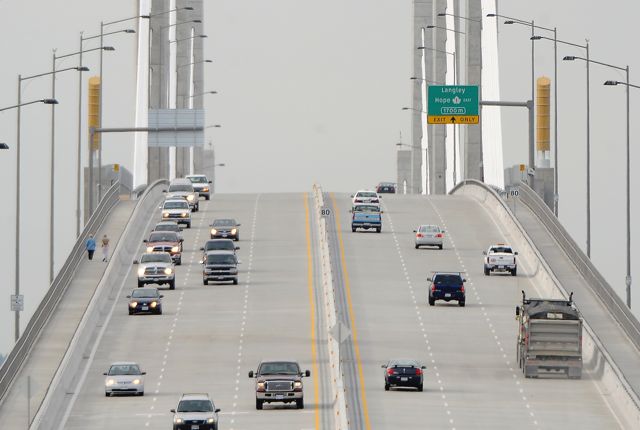 More tolls, like the charge for using the Golden EarsAi?? Bridge, is the method favoured by bureaucrats to raise money for TransLink.
Photograph by: Vancouver Sun
B.C. unlikely to support tolls on all Metro Vancouver roads, bridges
By KELLY SINOSKI, Vancouver Sun March 7, 2012B.C. Transportation Minister Blair Lekstrom said Wednesday it’s unlikely theAi?? province will support tolls on all of Metro Vancouver’s roads and bridges toAi?? raise funds for transportation.
The move, which has been raised by mayors as a potential way to generateAi?? funds, “is not something the government has been pursuing,” he said.
While the idea of tolls are used around the world, Lekstrom said, the mayorsAi?? will first have to engage the public on the issue.
“I don’t know whether the government would say we’d be prepared to say we’dAi?? change the toll policy,” he said. “At this point we’re not.”
Lekstrom’s comments followed a meeting with the regional mayors’ council onAi?? transportation, which discussed everything from short-term funding options forAi?? transit to a new governance model and auditor for TransLink.
Metro Vancouver mayors had suggested road pricing – which could include tollsAi?? on roads, bridges and tunnels as well as charging drivers for the distanceAi?? travelled – as a potential way to raise money for future transportationAi?? infrastructure.
The mayors are also working with the province to introduce new legislationAi?? this spring for short-term funding options such as a vehicle levy or a regionalAi?? carbon tax to generate $30 million next year.
If a new funding option can’t be found, property owners will face an averageAi?? $23 increase in 2013-14.
Ai?? Copyright (c) The Vancouver Sun
Who is driving TransLink?
Who is driving TransLink, you ask?
The real answer, if a Mr. Ferry cared to investigate, is the provincial government and the Premier’s office.
What is making TransLink so expensive, demanding all sorts of taxes and levies?
The provincial demand for light-metro, mostly in the guise of SkyTrain, has increased the the cost of a regional rail system by at least three times! So the taxpayer has paid well over $8 billion for three light-metro lines (the Canada Line is in reality a heavy-rail metro, but built as a light-metro), instead of just under $3 billion, if the province built with light-rail instead.Ai??The taxpayer’sAi??cost for light-metroAi??increases on an annual basisAi??because of provincial subsidy of over $250 million for light-metro, which will only increase with the construction of the Evergreen Line.
SkyTrain and the province’s desire to build politically prestigious light-metro instead of more efficient and cost effective light rail is driving TransLink – driving TransLink right into a financial iceberg!
 The province’s desire for SkyTrain light-metro, is driving TransLink into a financial iceberg!
Who’s driving TransLink?
By Jon Ferry, The Province March 7, 2012
Greater Vancouver mayors meet today with Transportation Minister BlairAi?? Lekstrom to lobby, among other things, for an overhaul of TransLink, ourAi?? region’s perpetually cash-strapped transportation agency.
Now, you don’t need an MBA to know that, to be effective, organizations needAi?? solid governance structures with clear reporting lines. TransLink, however, hasAi?? one only a mother could love.
The mother in this case was hard-driving Kevin Falcon who, whenAi?? transportation minister, was so ticked off with the regional mayors’ squabblingAi?? over the planned Canada Line he set up a new governing structure. The onlyAi?? problem was it was worse.
It consists of a somewhat powerless mayors’ council on regionalAi?? transportation, a rather secretive board of directors, a separate regionalAi?? transportation commissioner and a chief executive officer, all supposedlyAi?? operating in tandem with Metro Vancouver and Victoria (which really controls theAi?? purse strings for capital spending).
It’s as flawed as the B.C. teachers’ bargaining structure. And it’s theAi?? reason why Lower Mainland residents remain baffled by TransLink and all theAi?? various taxes, levies and fees it keeps proposing to fund the new Evergreen LineAi?? and other costly transportation projects.
I mean, if you want to complain, who do you call? Well, you don’t. And thatAi?? probably was the governance structure’s purpose when it was set up.
So, all these TransLink entities are doing something . . . but what? And toAi?? what effect? It’s hard to figure out.
TransLink commissioner Martin Crilly is reviewing planned transit-fare hikesAi?? averaging 12.5 per cent that are due to take place next January. He says heAi?? could reduce these increases if TransLink could find offsetting cutsAi?? elsewhere.
But don’t hold your breath, there’s no net-zero mandate here. Crilly, whoAi?? does have an MBA, is supposed to rule on the hikes by the end of the month.
The mayors’ transportation council, meanwhile, is meeting Lekstrom to pressAi?? their case for a new source of funding to help TransLink cover a $30-millionAi?? shortfall for various capital improvements.
The mayors also are seeking regular, official performance reviews ofAi?? TransLink ai??i?? plus, of course, the aforementioned new governance structure.
Mayors’ council chairman Richard Walton agrees with me that the current setupAi?? is strange, and TransLink should revert to having a single board of directorsAi?? consisting wholly or in part of regional mayors.
“It’s always been an issue for us that the TransLink board is not accountableAi?? to the public for how the dollars are spent, in a direct public way,” saidAi?? Walton, the mayor of North Vancouver District. “And we are as mayors andAi?? councillors.”
Yes, if TransLink is going to squeeze us like lemons, there should beAi?? responsible people to whom we can squawk. And who better than those we elect toAi?? head our region’s 24 local authorities?
However, I think we need direct input to the board from a standing committeeAi?? composed of regular folks for whom the system is more than just a politicalAi?? football. It should include both motorists and transit and bike riders.
We need a transportation agency that’s more in touch with those it’s supposedAi?? to serve.
Read more: http://www.theprovince.com/news/driving+TransLink/6263192/story.html#ixzz1oRYrNLzI



Recent Comments