Wrong Again – How Long will it Take Them To Get It Right?
They have got it wrong, but in Vancouver we have have always got transit wrong.
Speed of a transit system is not the prime factor in attracting ridership, it is part of the mix. The main reasons for successful transit, according to the internationally acclaimed study ' Bus or light rail, making the right choice', by Professor of Urban Transport, Carmen Hass-Klau, it is the ease of use, ambiance, ease of ticketing and the seamless (no transfer journey) that were the main reasons for a successful public transit service.
Translink still plans for small metro lines and compel bus riders to transfer onto the metro, even if it increases their commute times, such as the Canada line, pretending recycled bus passengers make the metro successful.
Modern LRT, operating on-street/at-grade has commercial speeds comparable to metro, with metro having fewer stations (about half) making the mode seem faster, but fewer stations along a transit route means fewer transit customers as the the car seems the better transit mode.
Vancouver is the only city in North America and Europe that fails to seriously plan for modern LRT and continues to trundle out expensive plans for more metro lines, based on questionable ridership figures and spurious transit claims. Fewer few people actually believe Translink's claims.
Added into our transit planning nonsense, which is akin of alchemists of old trying to turn lead into gold, is the cottage industry of combing transit with density or growth, while at the same time ignoring current transit chaos. Transit planning has turned into a developers dream, by allowing naive city councils to upgrade property zoning along metro lines into higher density (read high-rise) buildings, ultimately making the transit corridor a canyon amid high-rise construction. All would work only if the people moving into the new high-rise apartment and condos work along the metro line, but in most cases they don't and work where transit service is poor and they drive instead.
Modern light rail, on the other hand, is built to provide an economic service on transit routes when buses become uneconomic to operate, thus from the start, economy is the by-word with LRT construction, something that is completely ignored by those advocating metro or light-metro like the Canada Line and SkyTrain.
In the end, what makes public transit attractive is that it is designed with the transit customer in mind taking the customer where he/she wants to go. Until we design affordable public transit in the region, catering to the transit customer's needs, TransLink will continue to scream poverty every year and demand new and higher taxes to fund their inept transit planning.
Driving trumps transit in Vancouver
By KELLY SINOSKI, Vancouver SunRead more: http://www.vancouversun.com/news/Driving+trumps+transit+Vancouver/5302581/story.html#ixzz1W1G7mtee
Lower mainland roadways are snarled with traffic as more than 80 percent of commuters choose to drive, according to StatsCan.
Photograph by: Jason Reed, REUTERS
The vast majority of Canadian commuters continue to drive to work rather than take transit despite a push to get people out of their cars and on to buses and trains, Statistics Canada reported Wednesday.
The reason? It’s faster to drive.
The federal agency’s 2010 General Social Survey, which sampled 6,650 respondents, found that the average Vancouver car commute was 25 minutes, 23 minutes shorter than the average transit commute of 48 minutes.
“Since the use of public transit involves walking, waiting and sometimes traffic congestion, it is not surprising that commuting times are generally longer for public transit users,” the report said.
Congestion, sharing the road with cars, transfers, low-density transit hubs and out-of-sync schedules all contribute to the lag times for public transit.
Rapid-bus lanes and underground tunnels could speed up the transit commute, the report said, but on average car commutes are faster.
Zweisystem's note: The preceding sentence underscores the ignorance about modern light rail in the region. Modern LRT operates on what is called a 'reserved-rights-of-way' or a right of way that is reserved for the exclusive use of the tram or streetcar. Traffic doesn't block LRT as it is able to travel free of traffic on the R-R-O-W, which translates with modern LRT having almost the same commercial speeds of a metro at a fraction of a metros cost. Until Translink embraces modern LRT, transit funding will be problematic and traffic gridlock will continue unabated.
And, it seems, drivers are reluctant to test the system. About 82 per cent of Canadians travelled to work by car last year, while 12 per cent took transit and six per cent walked or cycled.
Of the 10.6 million workers who commuted by car nationally last year, about nine million have never used public transit to get to work, according to the survey. And of the 1.6 million who did, about 53 per cent said they found it inconvenient.
Then there’s the stress that accompanies long commutes, especially if workers are stuck in daily traffic jams.
About 39 per cent of full-time workers who took less than 15 minutes to get to the office said they felt pressed for time every day, the report said. Among those whose commuting time was 45 minutes or more, the percentage rose to 49 per cent.
Others blamed the long commute for messing with their life-work balance. “The feeling of being trapped in a routine and the impression that there is no time for fun also increased with commuting time,” the report said.
The average commute across Canada, including all modes of transportation, was about 26 minutes. The average commute in the Toronto metropolitan area is the longest in the country, at 33 minutes, followed by Montreal at 31 and Vancouver at 30 minutes.
Meanwhile, workers who walk or cycle to work have shorter trips, about 14 minutes on average.
TransLink spokesman Ken Hardie said the stats aren’t surprising, noting that depending on where you go in Metro Vancouver, the transit story changes.
In downtown Vancouver, for instance, about 40 per cent of commuter trips are by transit; in Surrey, the number is less than five per cent.
But, he noted, while transit may take longer, it’s generally more reliable, partly because of bus-only and queue-jumper lanes. “There’s a time reliability,” he said. “It may be that it’s not faster than a car but it’s as close to the same time each day as possible.”
Hardie said TransLink’s push for more transit services such as the Evergreen Line and rapid transit in Surrey are aimed at creating a better balance between cars and transit across the region so people who don’t drive have other transport options.
In some cases, he said, people are willing to swap time for money: As it gets more expensive to drive a car, they are more willing to try transit. “Cars have a place on the network; [you] can’t do without them,” he said.
The StatsCan figures were released just days after TransLink announced that it expects to post a record year for transit ridership — surpassing last year when the city hosted the Winter Olympics.
There have already been 114.4 million transit trips in the first six months of the year, four per cent more than last year.
Electric Hybrid Streetcars coming to Austin?
Austin Cars ExaminerAi?? August 12, 2011
http://www.examiner.com/cars-in-austin/eclectric-hybrid-streetcars-coming-to-austin
A glimpse of the possible future of mass transit in the City of Austin was shown to the public on August 11. Kinkisharyo, a global provider of high speed and mass transit rail vehicles, set up a version of their new low floor hybrid electric street car (the ameritramai??? 300) downtown and invited to public to tour and ask questions.
The continued growth of the Austin metropolitan area as a highly desirable place to live and work is going to depend, among other things, on a very dependable and efficient mass transit system linking the various communities, businesses, entertainment venues, recreation facilities, government and educational institutions. Not only must it move people in and out of the city, it must also provide effective transportation within the city that is environmentally clean and efficient.
http://www.examiner.com/cars-in-austin/austin-electric-hybrid-streetcars-picture

TransLink’s Finacial Woes
The Vancouver Province's editorial has got it partially wrong. a good part of TransLink's financial woes is that they have tied themselves to the extremely dated light-metro/SkyTrain rapid transit model which can cost over fifteen times more to build than light rail, without any operational or financial benefit! Light-metro, especially the automated (driverless) product not only costs much more to build, it costs more to operate, giving the transportation authority a financial double whammy.
It is not social engineers that are the problem, rather the adherence to a now discredited transportation policy that was designed to compete against old fashioned PCC style non-articulated streetcars and not modern modern light rail operating trains of articulated trams on reserved rights-of-ways.
SkyTrain is an operating museum piece and the taxpayer must bear the brunt of increased taxes to pay for it.
Editorial: Social engineers are behind transit woes
The ProvinceThe Canada Line.
Photograph by: Gerry Kahrmann, PNG file
As much as many people would sympathize with the idea of Province letter writer Laura Lynn to hold an inquiry into TransLink spending, it's unlikely much would be learned not revealed in the 2009 audit by thencomptroller-general Cheryl Wenezenki-Yolland.
She found that the much-despised transportation authority had a structural deficit because its constant expansion of services was outstripping its ability to pay. Certainly nothing has changed since, with TransLink promoting its Evergreen Line despite having enough cash without imposing new, totally unpopular tax hikes on a tapped-out and angry public, particularly drivers.
The overpaid social engineers at TransLink, on various municipal councils, and various taxpayer funded institutions such as Simon Fraser University have created the mess.
TransLink's recent breathless announcement that ridership is again at an all-time high can be largely blamed on the organization and its backers' constant attack on drivers. North America-high fuel taxes, criminal parking tax rates and a failure to upgrade the road system leading to congestion has forced people who otherwise would look after their own transportation needs on to public transit.
TransLink needs to stop expanding, take a breath, and work within its budget and not, as its officials constantly whine, demand higher taxes. As well, private transportation should be encouraged much more than is currently the fashion.
TransLink’s Propaganda Machine In Full Force
Wait for it, TransLink wants more tax revenue to fund their questionable transit planning, so the propaganda campaign has started. We have seen this all before with the Canada Line, higher ridership claims, jammed buses due to lack of service, etc. The question what needs to be asked is; "Are TransLink's ridership claims valid?"
With no independent audit of ridership, TransLink's mandarins, abetted by the hopeless, but highly paid TransLink Board of "Experts" are echoing claims of high ridership and the need for more tax monies to fund new services, pitch half truths and inventions to the media.
Problem with this is that TransLink has quietly forgotten that it greatly reduced the increased bus services to the Canada Line, from South of the Fraser as projected Canada Line customers just did no appear. Many buses run almost empty, on routes that really do not service an transit need at all and TransLink deliberately causes overcrowding on routes, such as Broadway, by not providing the bus service needed to cater to demand.
All this, of course, is to impress our rather naive politicians and news media that we need new and higher taxes to fund new transit initiatives, but no one is asking the real questions such as:
- How does TransLink calculate ridership?
- What percentage of transit use is by U-Pass customers?
- What percentage of U-Pass customers make multiple trips (3 or more) a day?
- How many bus services operate with little or no patronage?
- How many YVR employees use the Canada Line for free?
- What was the modal shift from car to transit on the A) Canada Line, B) Millennium Line, C) Expo Line.
- How much is the annual provincial subsidy, including debt servicing costs. are paid to TransLink and/or SkyTrain and West Coast Mountain Bus?
- Is TransLink's planning peered reviewed? if so, by who?
Until the public are told the exact truth about TransLink operations and finances, the taxpayer should demand that no new tax money be spent on TransLink.
Record number of riders use TransLink in 2011
A record number of riders opted to take transit during the first six months of 2011, according to TransLink.
Photograph by: ian Lindsay, Vancouver Sun Vancouver Sun
A record number of riders opted to take transit during the first six months of 2011, according to TransLink.
Ian Jarvis, the chief executive officer of TransLink, called the figures “amazing,” but said there’s little room in the system for more riders unless services are expanded. He is asking the public to support plans that include a significant tax increase with revenue earmarked for the transportation authority.
“I’m very concerned that we’re seeing this substantial rise in demand by more people for more transit at a time when TransLink has no ability to meaningfully increase capacity,” said Jarvis in a news release.
“This rate of growth is a clear signal that we need to start expanding the network again.”
TransLink’s figures over the first six months of the year suggest 2011 ridership will outpace 2010’s tally of 211.3 million riders by a large margin. To date this year, the company has logged 114.4 million passengers.
Year-over-year increases in ridership is nothing new to the transportation authority, with TransLink reporting nine straight record breaking years.
It is now pushing the public to support a plan to expand bus routes, increase SeaBus sailings, upgrade SkyTrain stations, and build a rapid transit line to the University of B.C.
But with all that work comes a hefty price tag, and TransLink is hoping the public will give the nod to two new sources of tax revenue to help fund the work.
“At the request of the Mayors’ Council [on Regional Transportation], TransLink will hold another series of public meetings in September, plus other sessions for city councillors across Metro Vancouver, to see if the support is there for an additional $70 million per year in revenue to fund the next round of expansion,” said Nancy Olewiler, a TransLink chair.
The additional revenue would come from two sources:
— a two-cent per litre fuel tax increase starting in April 2012
— a property tax increase averaging $23 per year; or an undetermined alternative
TransLink will be holding a series of open houses in September to hear what you think of its plans.
© Copyright (c) The Vancouver Sun
European latest – Croydon, Reims & Bordeaux
Stadler wins London Tramlink tram order
Railway Gazette http://www.railwaygazette.com/nc/news/single-view/view/stadler-wins-london-tramlink-tram-order.html
18 August 2011

UK: Stadler Rail has won a contract to supply six Variobahn trams to increase capacity on the Tramlink light rail system in south London, Mayor of London Boris Johnson announced on August 18.
The first of the new trams is scheduled to be delivered ‘this winter’ and all will enter service in spring 2012, allowing a more frequent service to be operated on the busiest part of the network through central Croydon between Therapia Lane and Elmers End.
Three of the trams will be taken from a batch of five which were ordered for the Bybanen light rail line in Bergen but not yet delivered to Norway; Stadler built these earlier than the 2012 contractual delivery date to make use of free capacity at its Pankow plant in Berlin. Stadler will also build three trams directly for Croydon, plus three replacements for Bergen.
At 32 m the five-section air-conditioned Varobahn trams will be 2Ai??5 m longer than Tramlink’s existing fleet of 24 Bombardier CR4000 vehicles, requiring modifications to the stops and the depot.
The contract is worth A?16Ai??3m to Stadler, including spare parts and related equipment. The London Borough of Croydon is contributing A?3m to the purchase cost.
‘Perception is important, and the perception today is that things are really beginning to move again in Croydon’, said council leader Mike Fisher. ‘By spending heavily on extra trams we’re backing what we’re saying with hard cash. The tram network has proved to be a huge hit with the many thousands who use it on a daily basis. It’s fair to say that, at peak times during the day, the network has become a victim of its success. These new trams will ease that burden’.
The Bordeaux Tramway & APS
http://en.wikipedia.org/wiki/Bordeaux_tramway
Although Bordeauxai??i??s tramway was not opened earlier but in late 2003, it is already one of the biggest tramway systems in France. Currently, there are three lines, which operate separate from each other. Every line has just one intersection with the two other lines. In this way the lines form a triangle in the city centre. Line A is the only line which crosses the river Garonne to serve the eastern neighbourhoods. It is as well the only line which has a branch. All three lines possess longer sections with Alimentation par Sol (APS), a ground-level power supply system. Bordeaux was the first city in the world that adopted this technology. The motivation was to avoid negative visual influence of aerial contact lines in sensitive ambience. APS can be found on all three central sections, but as well in MAi??rignac at the western end of line A. Various extensions should bring the network to approximately 80 km until 2017.
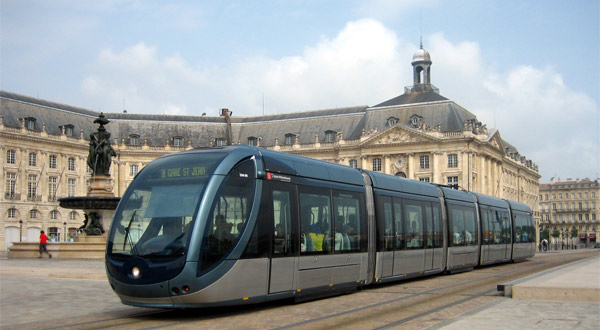
from http://www.trams-in-france.net/reload.htm?bordeaux.htmAi??andAi??Ai?? http://citytransport.info/Bod.htm
Ai??Reims Tramway
from Urbanrail.net http://www.urbanrail.net/eu/fr/reims/reims.htm
and Tramways Monthly http://www.tramways-monthly.com/latest-news/450-new-tramway-opens-in-reims

France has seen another of its cities open a brand new tramway, following the inauguration of services on the new network in Reims. With services beginning on April 18th, this tramway becomes the 22nd new system to open in France, which has embraced the new generation of tramways on a larger scale than any other European country. Having seen almost total abandonment of its original system in the 1930s and 1940s, the tram in France is now seen as the future, with most cities and many towns now boasting a tramway of their own.
The system in Reims took two and a half years to construct, a period which would be the envy of most tramway promoters in Britain. Built to replace three bus routes, two lines are currently in existence, a north-south route from Neufchatel to the Robert Debre hospital, with another, shorter line branching off to serve the main railway station.
Eighteen Alston Citadis trams, numbered 101-118, have been delivered to serve the new tramway, a type which is particularly favoured in France, also seeing extensive use on the Paris tramway. Uniquely however, the decision has been made not to introduce a corporate identity through having a single fleet livery. Instead a local artist was commissioned to choose nine different, complimentary colours and each tram has been given one of these. Thus, the tramway boasts vehicles in fuchsia, lavender, grey, mandarin, pistachio, azure, turquoise, lemon or scarlet, adding a splash of colour to the local transport scene.
Another significant feature of the new tramway is the dual use of both conventional overhead wires and a surface contact system in the city centre area. This has been designed to appease critics of unsightly overhead being erected in areas of historical interest, and mirrors arguments held in towns and cities such as Torquay and London over a century ago.
Amtrak to continue running two trains a day into Vancouver.
Common sense at last.
Amtrak will continue to rumble Seattle to Vancouver route twice daily
The Amtrak Cascades train from Vancouver to Seattle.
Photograph by: Vancouver Sun files, .
The second daily Amtrak Cascades train between Seattle and Vancouver, which was scheduled to end in October, has been given a reprieve and made permanent.
Public Safety Minister Vic Toews made the announcement this week at a media briefing after a meeting with U.S. Homeland Security Secretary Janet Napolitano.
“Despite some significant financial constraints, the Canada Border Services Agency has decided that it will continue to provide publicly funded border-clearance service to Amtrak’s second daily train,” Toews said.
During the 2010 Winter Olympics the second train carried 1,872 passengers during the two-week event, and 16 trains were sold out.
“This was an issue that was raised in British Columbia and by Washington state and … a matter of very great importance to the business and other travellers there,” Toews said.
Can’t TransLink Count? Evidently Not.
Interesting stuff this, but really, TransLink just can’t seem to stay on the page, with ridership figures, or any other figuresAi??they release.Ai??The claim of 310,000 passengers a day is really 310,000 boardings a dayAi??and there is no mechanism to count actual passengers or customersAi??on the SkyTrain light metro system. The Canada Line has infrared sensors that count boardings, but that is all and transit customers boarding multiple times per day (the $1 a day U-pass) are recounted andAi??no one really knows how many people actually use the SkyTrain light metro system.
Still, TransLink has been claiming 381,000 passengers a day on the two SkyTrain Lines andAi??the Canada Line which isn’t really SlyTrain at all,Ai??on Wikipedia and other on-line transit sites, yet today they claim today 310,000 people use SkyTrain.
Like most of TransLink figures, they seem to be pulled from a hat.

Happy Birthday SkyTrain!
Vancouver CKNW AM980
Janet Brown
8/17/2011
Skytrain is celebrating its silver anniversary with a few notable politicians from the past on hand. Former Minister of Transit, Grace Mccarthy, whose government, under then-Premier Bill Bennett, who was responsible for launching skytrain 25 years ago, rode in to the skytrain operation centre at burnaby on one of the newer cars.
“……Well, we need the skytrain and it was an instant success….It truly was…I know that we expected the second generation of cars would come along and maybe in ten or 15 years we wouldn’t have to expand…well we passed that mark long ago”
Skytrain carries 310, 000 passengers a day.
August Doldrums

With the HST debate behind us and most politicians away for the summer, the transit debate in the region is in summer mode.
Posts will be done as local news and issues arise.
Do Buses Actually Ease Gridlock?
So some people think that adding more buses will solve our endemic transit gridlock, yet buses themselves contribute to traffic congestion.
There is a strong bus lobby that continually advocates buying more buses, yet when more buses are operated, congestion and gridlock just continues.
In Portland, transit official reckon that one tram or LRV, is as efficient ad six buses. Let us put this another way; one tram/LRV (one driver) is as efficient as six buses (six bus drivers) and for every tram/LRV or bus operated one needs to hire at least four people to drive, maintain and manage them.
Given a theoretical route that operates 15 trams and employsAi??60Ai??people, the same route would require 90 standard (non-articulated) buses and 360 people to operate the route.
Beside a vast savings in wages, 90 buses on a transit route would certainly cause a lot more congestion, leading to traffic gridlock, thanAi??15 trams.
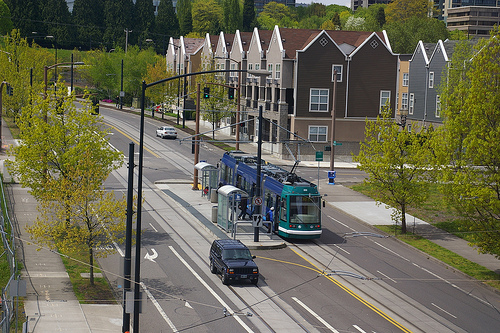
A simple Portland Streetcar is as efficient as 6 buses.
Years more gridlock to come, bus study warns
Jacob Saulwick
August 8, 2011
BUS congestion between the Harbour Bridge and the city is costing commuters and the state about $13 million a year in lost revenue and wasted time, according to a report obtained by the Herald.
The report – commissioned but not released by the previous state government – shows the York Street bus stops near Wynyard, used by thousands of commuters from the north shore, northern beaches and north-west suburbs every day, were already operating at capacity by late 2008.
And, although planners have made several traffic changes in the area since, commuters will still have to wait years for any large-scale attempt to tackle the morning and afternoon gridlock.Ai??
Jammed … buses line up York St, Sydney CBD to drop of morning commuters. Photo: James Brickwood
The 67-page Wynyard Bus Study by Booz and Co., released to the Herald under freedom of information, put the cost to commuters of the extra time spent waiting in clogged bus lanes about Wynyard at $9.2 million in September 2008.
The report found that the congestion also cost bus operators $2.5 million in lost ticket revenue and $1.2 million in extra operating costs.
If the problem was not addressed it would ”clearly result in some excessive queuing and delays,” the report said.
It said the bus precinct at Wynyard was already at 99 per cent capacity.
But commuters may draw little comfort from the fact that most of the quick-fix options suggested for improving congestion around Wynyard have since been taken.
If anything, bus congestion in the area has worsened because of the growing number of services to the city. The report predicted that 273 bus trips in the corridor between 8am and 9am would rise to 350 by 2016. That figure has already been hit.
One of the report’s main suggestions was to turn York Street at Wynyard into a drop-off only section in the morning peak. The measure, estimated to produce a 30 per cent improvement in traffic flow, was adopted late last year.
Another recommendation was to increase the number of three-door ”bendy” buses in the State Transit fleet. The third door makes it faster for passengers to alight and for the bus to keep moving.
State Transit has since bought 150 new bendy buses.
The report also offered several more ambitious suggestions which ”would have significant benefits for bus throughput” but at more cost or that would potentially hinder traffic in other parts of the city.
These included making use of old tram tunnels under Wynyard; building a ”set down island” on York Street to provide more space for drop-offs; and setting a Wynyard-style run of bus stops on Grosvenor Street.
None of these suggestions has been adopted.
The Transport Minister, Gladys Berejiklian, said of the Wynyard crush: “This issue will be addressed as part of the transport masterplan to be developed by Transport for NSW.”
She has said the masterplan would not be ready this year.
A spokeswoman for the City of Sydney said improvements had been made since 2008.
”Clearing intersections so that buses are not blocked, having shorter signal times and clearing pedestrian build-up on surrounding roads are issues that still need to be addressed,” the spokeswoman said.

Non News From TransLink – Canada Line to Operate Two More Trains
What would not be considered a news story elsewhere, the Vancouver Sun makes much hoopla that the Canada Line will operate two extra trains during peak hours as per the operating contract.
Adding two more trains will slightly ease congestion but unless Translink operates the bus services to feed the Canada line, the $2.5 million metro will never be an attractive alternative to the car.
I would like the Vancouver Sun report that the Canada line metro, because of the reduced scope of construction to address cost overruns, means that the metro has less capacity than even the simplest of streetcar or tram operations, costing up to one tenth as much to build.. Now that would be a story worthy of being printed.
TransLink to expand Canada Line service
Vancouver SunTrain service from downtown Vancouver to Richmond and the Vancouver International Airport is about to increase.
Photograph by: Jenelle Schneider, Vancouver Sun files
Train service from downtown Vancouver to Richmond and the Vancouver International Airport is about to increase.
Starting Wednesday, the popular Canada Line will run 16 trains during weekday peak hours, up from 14, and will extend peak service by half an hour in the morning (to start at 6:30 a.m.) and one hour in the evening (until 7 p.m.).
On Saturdays, Sundays and holidays, peak service will continue to start at 9 a.m. but will run an hour later each day until 7 p.m., TransLink says in a news release.
All Canada Line train departures and arrival times during peak periods will change as of Wednesday and, for the rest of the month, the times shown on TransLink's trip planner may not correspond exactly with the new schedule, the release says.
"Everyone with time-sensitive connections should plan to arrive at their Canada Line station a bit earlier than usual beginning Aug. 10," TransLink advises, adding that transit schedules will be updated on Labour Day.
The expanded service was part of the operating contract between TransLink and the company that built the Canada Line. The average daily ridership on the Canada Line is approximately 107,000, the release says.
© Copyright (c) The Vancouver Sun



Recent Comments