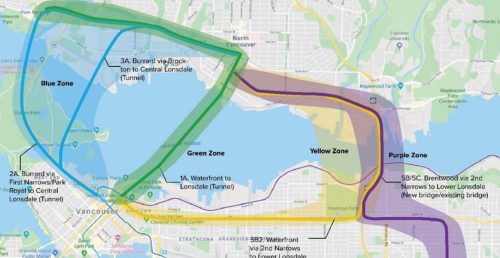
For all those who have deluded themselves that SkyTrain will be extended via tunnel, under Burrard Inlet, think again.
TransLink has been spinning a lot of stories about transit expansion, but every story ignores a fundamental fact – funding.
TransLink’s well oiled propaganda machine, which includes the mainstream media and “Hive”, all talk the big talk but ignore funding.
So, the next time someone claims that SkyTrain will be built here or built there, ask about “funding” and the silence following will be self explanatory.
Quebec City tunnel beneath St. Lawrence River to cost $7B, take 10 years to build
by The Canadian Press
Posted May 17, 2021
Quebec Premier Francois Legault says a tunnel to be built under the St. Lawrence River connecting Quebec City and Lévis, Que., will cost $7 billion and take 10 years to complete.
The tunnel was a major campaign promise for Legault’s Coalition Avenir Quebec, which enjoys strong support in the provincial capital and promised to begin the project within its first mandate.
Legault told reporters today the final price tag could rise by as much as 35 per cent when borrowing and other unexpected construction-related costs are factored in.
The 8.3-kilometre tunnel will have a lane dedicated for electric buses and will become the third road link connecting Quebec City to the south shore.
Legault says construction is expected to begin in 2022, the same year as the next provincial election.
The tunnel is the second major project announced this year by Legault for the provincial capital, following a $3.3-billion, 20-kilometre tramway system that is expected to be completed in 2027.
This report by The Canadian Press was first published May 17, 2021.
It has all been said before the many issues that plague the Broadway subway but never keep a politician from a grand photo-op to show the public how politicians squander money.
Liberal and NDP cabinet members, with the federal Liberals election ready, will attend, eager for the public too see how they squander taxpayer’s money and they are well taught in the issues of shoveling money off the back of a truck.
The following politicians may attend, most virtually.
Hey say what you want but make sure they spell my name right:
* The Honourable Catherine McKenna, federal Minister of Infrastructure and Communities
* Rob Fleming, B.C.’s Minister of Transportation and Infrastructure
* George Heyman, B.C.’s Minister of Environment and Climate Change Strategy
* Bowinn Ma, B.C.’s Minister of State for Infrastructure
And of course, from TransLink the mastermind of this scam.
* Gigi Chen-Kuo, interim CEO of TransLink
Regional mayors may also be there, desperate for a chance of a photo-op, plus assorted bureaucrats and other spin doctors that always follow the politcal train.
The media will attend as this sod turning is to be a pure photo-op with with only “puff” questions asked. Of course, the provincial government, the City of Vancouver, Metro Vancouver, the Mayor’s Council on Transit made sure the subway would be a reality by eliminating any hint of public involvement in the planning process.
You are getting a subway, whether you damn well want it on or not!
The city empowered goons to shout down people at what few meeting there were and scaring the elderly into submission. This how things are done in Metro Vancouver and British Columbia today. The bicycle lobby, latter day Quislings, sung hosannas about the subway, waiting for their promised bike lanes.
Prime Minster Trudeau’s new Spanish friend, Acciona, finding jobs for his former SNC-Lavalin friends, is the engineering firm of choice. Acconia has a lot of experience with costly BC mega projects including Site C (with a $9.4 billion cost overrun), the North Shore Wastewater Treatment Plant ($500 million+ cost overrun), the Pattullo Bridge (construction yet to begin, but cost overruns expected) and now for the Broadway Subway (estimated cost, $2.83 billion, for 5.8 km of line. Actual cost expected to increase past $3 billion).
A cost overrun here, a cost overrun there, politicians don’t care, just make sure it is a good photo-op.
Here are the questions the mainstream media have not or will not ask.
How many “new to transit” customers are estimated will use the subway?
The 99 B-Line bus has a maximum capacity of 2,000 pphpd, yet in North America, subways are only built when ridership exceeds 15,000 pphpd on a transit route, why an almost $3 billion subway?
As it turns out that Broadway isn’t the busiest transit route in Canada and TransLink only claims it is “our most congested bus route“, isn’t the congestion on Broadway a management issue and not an almost $3 billion engineering issue?
Transit customers using the Expo line, must now transfer twice, if they are going past Arbutus (Expo Line transfer to Millennium Line and Millennium Line transfer to the B-Line), most times savings claimed by the new subway, in fact will not exist because of the new transfer. How many transit customers will stop using transit because of this new transfer?
What bus routes will be changed, forcing customers onto the subway? Like the Canada Line’s P-3 concessionaires (SNC Lavalin & the Caisse De Depot) inked a secret agreement with TransLink not allowing direct bus service from South of the Fraser (Richmond, South Delta & Surrey) to continue to downtown Vancouver and forcing Vancouver bound customers to transfer to the Canada line at Bridgeport Station.
As the new density added, including high rent towers and high rise condo’s along Broadway, demolishing much present affordable housing, will this only add to the renoviction housing crisis in metro Vancouver?
It is estimated that the subway will add about $40 million more annually to TransLink’s operating costs and on a route mainly used by UBC students, faculty and workers using their dollar a day U-Pass, ride at will transit pass, will not this added annual operating cost be funded in the form of new taxes, fares and reduced services elsewhere?
Photo-ops and puff questions will be the order of the day, business as usual in British Columbia.
This is a new one, thin wheels and wide track causing problems with Honolulu’s light metro horror show.
What was a $5.3 billion project in 2010 has now turned into a $12.4 billion project in 2021; that is $15 billion Canadian dollars! Put another way, the HART light metro in Honolulu costs as much as the total cost for Metro Vancouver’s SkyTrain light-metro!
Just gotta love politicians and their gadgetbahnen.
The same is true in metro Vancouver and the beloved SkyTrain light-metro system where the system costs three times more than if LRT were to be used.
The only difference between metro Vancouver and Honolulu is that the American media do investigative reporting on transit and Metro Vancouver’s mainstream media do not.
HI: Honolulu’s rail project plagued with wheels too thin and tracks too wide
The trains built for Honolulu’s troubled rail project have wheels that are too narrow for the track, and solving the problem will lead to more issues or more delays.
Dan Nakaso
The Honolulu Star-Advertiser (TNS)
May 10th, 2021
May 7—The trains built for Honolulu’s troubled rail project have wheels that are too narrow for the track, and solving the problem will lead to more issues or more delays.
Replacing the wheels will add too much weight to the trains. Replacing the tracks would push the timeline back a year.
Like many aspects of the rail project, there is no easy solution ahead.
Lori Kahikina, interim CEO and executive director of the Honolulu Authority for Rapid Transportation, told HART’s Project Oversight Committee on Thursday that the wheels are about a half-inch too narrow at the “frogs, ” the places where rail tracks cross.
One option would be to replace the wheels with wider ones. But Kahikina said thicker wheels would make the trains overweight.
Replacing the tracks with narrower ones would set the project back at least a year, Kahikina told HART board member Kika Bukoski.
“One solution that is being contemplated right now is maybe changing the wheels on all of the cars, ” Kahikina said. “It’s a faster solution and a cheaper solution, but one drawback to changing the wheels is that you’re adding weight to the cars, and so they’re going to go over the threshold. So you have to subtract weight somewhere. … If you have to change the track, that’s estimated to be maybe one year just to manufacture the new track and ship it over here, whereas the wheels could be much quicker. I’m sorry. I don’t have a good answer, Kika, just because the solution hasn’t been determined yet.”
Asked whether the wheel problem will delay turning rail operations over to the city, Kahikina told Bukoksi, “This solution will delay that.”
The too-thin wheels are in addition to other problems at the frogs, including subpar welding and sandblasting that created cracks.
The 20-mile, 21-station project is now budgeted to cost $12.449 billion, is not scheduled for completion until March 2031 and has no easy away to plug a $3.577 billion shortfall.
Kahikina said rail officials and Mayor Rick Blangiardi are expecting to present federal officials with a plan in the next few months outlining how to build rail all the way to Ala Moana Center and make up for the budget shortfall.
But Kahikina did not rule out the possibility of halting construction “somewhere in downtown.”
Bukoski asked Kahikina whether the issue of stopping rail at Middle Street—4 miles shy of its Ala Moana Center final destination—came up during a quarterly meeting with the Federal Transit Administration this week that included Blangiardi.
Kahikina responded that Blangiardi is aware of the funding gap, but made no mention to the FTA about stopping short of Ala Moana Center, the state’s busiest transit hub.
Sometime around July or August, the city expects to return to the FTA “with a plan on how we’re going to get there, ” Kahikina said. “Mayor is committed to getting all the way to Ala Moana Shopping Center.”
In the meantime there is hope that general excise and transit accommodation taxes, which were crippled during the COVID-19 pandemic and the shutdown of tourism, will return “higher than expected ” and provide needed revenue, Kahikina said.
“Middle Street is not going to work, ” she said. “If we could get somewhere in downtown, I don’t know, we’d have to look at that. We’d have to look at the different scenarios, and then HART is trying to put together a plan in conjunction with the mayor and then talk about this. And once we have a plan going forward, myself and mayor will go to FTA and speak to them about it.”
The question of stopping construction at Middle Street continued to hover over HART on Thursday.
Board member Roger Morton, who used to oversee the city’s TheBus system, said, “After spending billions of dollars to get where we’re at … Middle Street is not as good. … We still have that tremendous traffic congestion. … There’s no good way to get into town.”
Board member Joe Uno, who has been urging the board to discuss an unspecified “Plan C ” for the future of rail, pushed back.
“I don’t feel it’s (stopping at Middle Street ) been studied as a stand-alone alternative, ” Uno said. “Certain options probably have not been discussed or even thrown up on the table—things like having express buses run in express lanes and that type of thing.
“I think we should be prepared … and keep an open mind if it does come down that we’re requested to study those a little bit more in depth, ” Uno said.
Calls for a return of an interurban style rail passenger service from Vancouver to Chilliwack; the restoration of passenger service on the E&N; the reinstatement of a passenger service from Vancouver to Prince George; for a Vernon to Kelowna passenger rail service and now folks in the Kootenay’s want a passenger rail service as well, shows a growing demand for a regional passenger rail system in the province.
*
Why not?
*
If government is truly “Green”, then rail is the only alternative to attract the motorist from the car.
*
So let’s compare the following.
The current provincial and federal government is spending $4.6 billion to extend the Expo and Millennium light-metro lines a mere 12.8 km, yet the investment will not take a car off the road.
The Rail for the Valley plan in 2021, costing about $1.5 billion for about 130 km route, providing a maximum of three trains peer hour per direction from Vancouver to Chilliwack. Such a service would attract ridership because of the congested Number 1 highway and the proximity of post secondary institutions and industrial hubs along the route.
The RftV/Leewood Study would make an excellent test bed for TramTrain and the possibility of making it a template for a Canadian version of tramtrain.
Realistically, the E&N needs a $1 billion rehab to provide a viable passenger service (maximum two trains per hour on some sections of track) linking Victoria to Nanaimo, Courtney and Port Alberni. Again, like the RftV Interurban, congestion on Island highways would make a passenger service a viable alternative to the car.
The E&N Railway is also an excellent candidate for a tramtrain service.
Rebuilding the railway from Salmon Arm to Kelowna for passenger service would cost around $1 billion but with the Kelowna International Airport and UBC Okanagan literally at the doorstep of the railway, would guarantee a healthy ridership.
Another excellent candidate for a TramTrain service.
Reinstating a the Vancouver to Prince George passenger service would return a vital tourist and transportation link in the province, which disappeared after the BC Liberal government of the day sold off BC rail on the cheap.
*
A Cranbrook to Creston railway, may sound good on paper, but has a major flaw, who will use it?
*
Unlike the three above examples, which connect population centres with destinations a stand alone Cranbrook to Creston railway is a non starter; but what about a 450 km passenger service from Golden to Nelson, via Cranbrook and Creston?
*
Here we have a regional railway connecting the Golden with major tourist areas, including Radium and Fairmont hot springs; with Cranbrook to the University town of Nelson. The line, properly marketed would be a major tourist attraction, traveling through BC’s almost unspoiled Kootenay’s.
*
The schedule would see two through trains per day, with more services in areas with demand. Using modern diesel multiple unit (DMU) rail cars, complete with full amenities, would be standard and in the future could provide such tourist pleasing features as steam operation or a modern version of “car-go-rail” where cars travel with the passenger’s, on the train service, an important feature for limited distance electric cars.
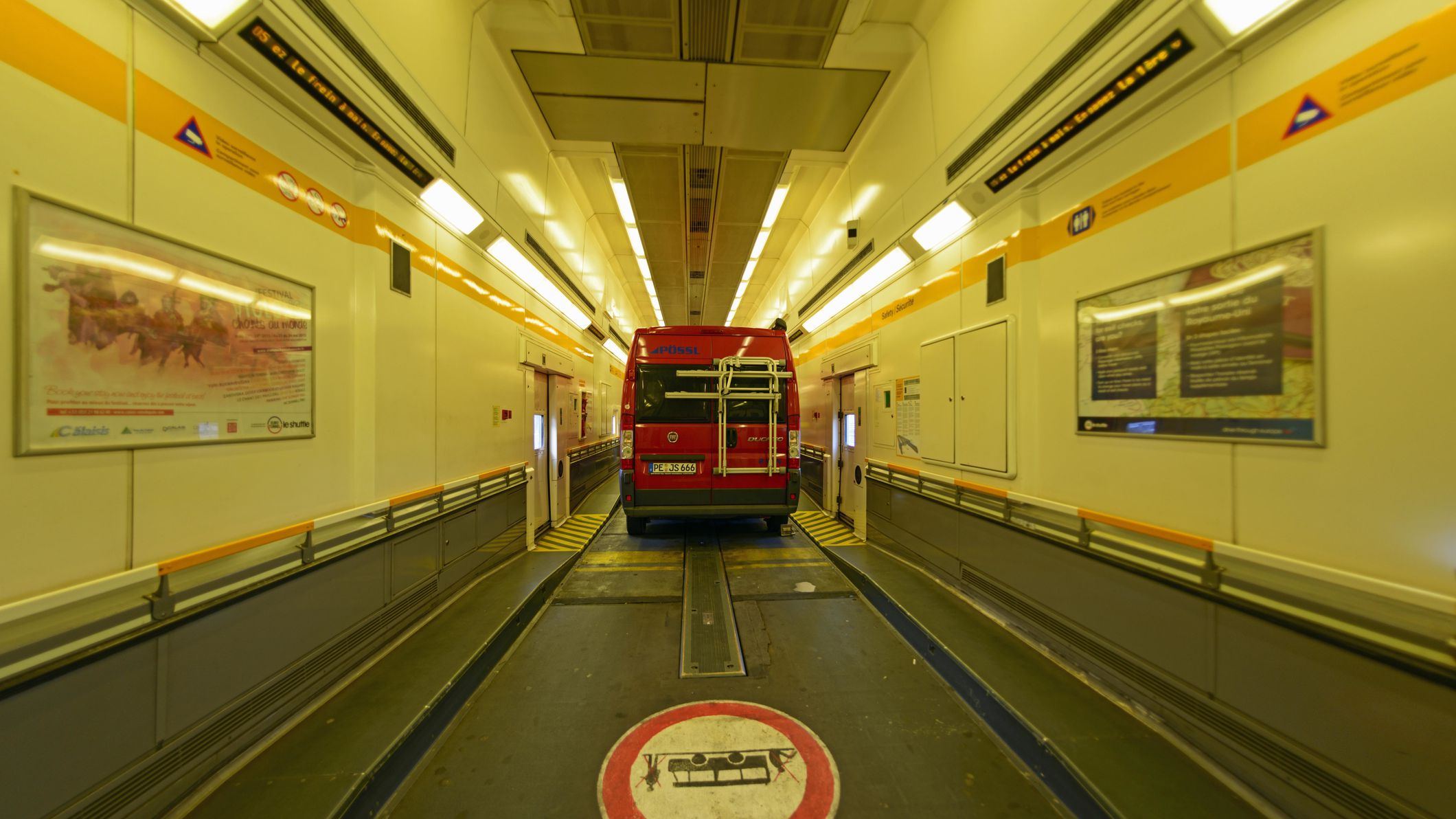
Inside of the Channel Shuttle train, car carrier, providing a ro/ro service.
*
The cost? Track and signalling upgrades for the line would push the budget past $1.5 billion. As there is not the traffic to justify electrification, the trains would be modern DMU’s to start and the service could evolve to hydrogen powered electric train, now in their infancy.
*
Certainly the naysayers will poke holes with such a plan, but if BC really wants to be “Green” a stark choice will have to be made, either invest in rail to move local freight and passengers like rail once did, using today’s continuing evolving rail technology or invest in an unproven, high-tech gadget methods, using existing or new highways or even more expensive new build infrastructure.
BC desperately needs to connect tourist oriented destinations in the province, post Covid and a modern passenger rail service would provide the impetus for “Green” tourism, without the need to build more highways and associated infrastructure.
British Columbian politicians face a Hobson’s Choice with provincial transportation infrastructure, either spend a lot of money on “Green” rail, or spend a lot of money on “not very Green” new highways.
The question is “can we wean BC politicians off of classic blacktop politics?”
Norwegian DMU's
A passenger train in Switzerland. Kootenay-Columbia MP Rob Morrison wants to bring a similar, but much smaller in scale, electric service to the region. Photo: Andi Graf/Pixabay
Kootenay-Columbia MP exploring electric passenger train service
Rob Morrison says a train from Cranbrook to Creston makes sense
May. 4, 2021
Kootenay-Columbia MP Rob Morrison says he’s working on a pitch to bring an electric passenger train service to the region.
Morrison said there is a clear need for more transportation options in the Kootenays, as well as ones that use clean energy. A small train, with perhaps 24 passengers he says, that runs on CP Rail lines is realistic.
“To me, I think it’s manageable,” said Morrison. “We can use existing tracks, we can use existing technology for electric.”
Travel throughout the Kootenays is currently limited to personal vehicles, BC Transit routes and limited flights out of airports such as those in Castlegar, Trail and Cranbrook.
Morrison said constituents have told him a Cranbrook-Creston route that travels through Yahk makes sense, especially in the winter when highway conditions make driving difficult and tend to cancel flights out of Castlegar.
Eventually, he said, other routes such as Nelson-Castlegar would be added as well.
“I think it would be great if I could come to a meeting in Nelson by just jumping on the train in Creston, spend a day and night or whatever and move on,” he said. “I think it’d be awesome.”
Morrison said the idea isn’t just a politician’s daydream either.
He’s had a meeting with Tesla to discuss the concept — no, it would not be a Hyperloop — and is putting together a feasibility study that would make an environmental and business case for small-scale passenger service that can be presented to the federal government.
“I’m not trying to start a multi-billion dollar enterprise,” he said.
Speed limits on CP Rail lines, as well as the Kootenays’ mountainous geography, rule out a high-speed train concept. But Morrison, a Conservative MP, said a regional electric train service works as a non-partisan solution that he thinks will appeal to the Liberal government, which has pledged to cut greenhouse gas emissions by 40 to 45 per cent by 2030.
“This is very good for our environment. It’s good for our communities,” said Morrison.
Passenger train service in the Kootenays ended in the 1960s, but Morrison isn’t the first person to consider bringing it back in some form.
A group of residents pitched CP Rail on a passenger service that would run between Procter and Nelson, but that plan went nowhere after CPR said in 2011 it wasn’t interested in operating the service.
In 2019, Castlegar and District Economic Development put a call out for consultants to research a train service that could be used by either commuters or tourists. Nothing came of it.
In light of former MP Denise Savoei’s grossly ill-informed letter in the Victoria’s Times Colonist about the E&N railway and public transport in general, the following maybe of some help for those advocating for affordable and user friendly transit in BC.
Advocating public transport improvements is often an exercise in long term frustration. Decades can go by with only poorer service and line closures. But there is a way to work through these feelings. A lot of it has to do with understanding human nature.
This is a guide to the different ways the general public, and advocates, perceive public transport improvements, and the potential to increase their knowledge of what’s involved in getting public transport projects support, funding, and approval.
Herein we describe a method to avoid falling into the well of bitterness, keeping sanity and hopefully serenity, and making a difference. It can actually become a spiritual journey, accepting the things we cannot change, the courage to change the things we can, and the wisdom to know the difference. You can be the change you want to see in others.
The Spectrum of Public Transport Advocacy
Let’s start by identifying some of the stages in public transport awareness:
0 Neutral on public transport (may not use it or know anyone who does).
1 Likes trains, trams, or buses, and/or understands that they are important for towns and cities, allowing people who can’t or don’t want to drive to get around.
2 Wonders why there aren’t way more public transport, trams, and/or buses. If angry, blames the transport authority.
3 Starts thinking of ideas for new lines or services.
4 Actively participates in discussions about appropriate public transport mode, vehicles, lines, and/or priorities.
5 Reads rail and transport articles, news regularly, and starts to realise the cost, funding, political priorities, or underlying culture limitations to expanding transport.
6 Joins a public transport advocacy organisation to actually push for improving public transport.
7 Understands competing points of view on public and road transport, and that transport authorities are beholden to elected leaders’ goals and funding.
8 Understands transport authority and political realities, and not blaming them outright (each has good and bad points).
9 Zen state of accepting limits of what one can reasonably do to move sustainable transport forward.
10 Actively works to educate others, communicate with elected officials, write a blog or YouTube channel, joins with others to constructively communicate positive ideas.
Not all transport enthusiasts and advocates necessarily follow this progression, nor necessarily experience all these stages. It’s a spectrum of attitudes and behaviours we have observed, with individuals fitting in to some and not others.
Avoiding the Depths of Despair
There are also those who are against public transport, for a number of reasons:
-1 New mass transport will get the car and bus in front of me off the road.
-2 NIMBYs – Not In My Back Yard (transport improvement is fine, but not near me).
-3 BANANAs – Build Absolutely Nothing Anywhere Near Anyone.
-4 Invest nothing in transport networks – it’s a waste of money (the CAVE Brigade – Citizens Against Virtually Everything).
-5 Completely shut down public transport networks, and give over the infrastructure to cars and expressways.
Many on the negative side of the spectrum believe the private sector is better able to fulfill transport need, but this has lead to street and chaos with jitney buses, unregulated taxi services, and greatly increased congestion and pollution in third world cities. And increasingly in first and second world cities thanks to the likes of Uber and Lyft clogging street and sharply reducing bus reliability.
Some of these levels are particularly susceptible to bitterness and anger. This is understandable, but these behaviours just put others off. They also work to tar fellow advocates working to foster communication and goodwill with public transport authorities and allies. Perception is reality for most people.
By all means have a healthy debate, but overly simplistic monochrome ‘authority X is bad’, ‘authority Y sucks’ positions are misleading, as there are many competing factors that are in play for public transport authorities – the politicians they report to, the multiple levels of government funding promised and available, environmental review laws, etc. Similarly, ‘LRT is bad’, ‘BRT is better than LRT’, ‘cut and cover is bad’ blanket statements ignore the critical local geographical, infrastructural, political context, and funding issues.
Knowledge of International Examples
There is a separate and independent axis for individuals and groups on thePublic Transport Advocacy Spectrum. That is the level of awareness of other cities’ lines, modes, and operations. This too tends to be a progression, as follows:
Line(s), mode(s), and system that the person uses
Lines, modes, and systems that the person doesn’t use (could be commuter regional rail, lines, or mode(s) in a neighbouring city.
Other lines, modes, and systems in the person’s country
International lines, systems, and modes
This progression generally leads to an awareness of best practices per urban form, mode, and technology.
Note that it is easy to fall into a bitter place by comparing much better public transport elsewhere (like in Europe, in Japan…), believing that everything is always better somewhere else. The fact is that even well run systems have flaws, they don’t optimise all transport aspects. The goal is to stay out of bitterness, so we can better carry the public transport message to others. Nothing puts off people more than anger and bitterness. Gratitude for what we have, and focusing on positives, is the antid.
<diagram of forces on a public transport authority ie city, provincial/state, and federal funding, legal jurisdictions of which authority can provide local and intercity public transport, environmental assessment laws, public-private partnership dynamics to overcome funding shortfalls, public opinion which influences politician decisions &c > ***
Planning an operational railway is a series of trade-offs.
To build a new line, public transport authorities and supporting governments have multiple criteria to satisfy:
Physical Engineering – how the line would be constructed, options, and estimated costs
Regulatory – environmental assessment and consultation processes, land use changes, union participation in some locations
Legal – laws regarding environmental assessment, property acquisition, land use change process
Contractual – design, construction, rolling stock, signalling, testing, operation, and maintenance
Socio-Economic – the situation(s) that create the demand that would make a line or extension viable, and to determine options (to serve a new or isolated residential or business area, and the relative merits and costs of elevated, surface, in road median, or underground routing).
Culture – will residents accept lengthy cut and cover tunnel construction, or elevated segments? What about appropriation of houses or apartments?
All western public transport authorities need to satisfy all six of these criteria, albeit to different extents and restraints according to the country, region/province/state, and city.
No public transport authority does everything well. Most focus on their highest ridership rail networks, and buses are often not as prioritized for funding even though they may carry more people than the city or region’s rail network. Riders and politicians prefer rail modes to ride and invest in. For many, creating a bus lane does not have the cachet of opening a light rail or streetcar line, even if the added capacity is equivalent.
Regulations
Public transport authorities often receive funding which requires them to satisfy requirements over and above general corporate and labour requirements: environmental laws, railway operating requirements, transport worker hours, etc. And unfortunately, a lot of labour-management relations are legally structured to be adversarial, and as such the system is always inefficient. So both sides push for whatever they can get, to the detriment of efficiency and of the passenger.
The forces of action and reaction in public transport
For each public transport improvement action, there is an opposite reaction. But unlike Newton’s Law of Motion where the opposite reaction is equal in force and direction, in public transport the reaction often comes from all directions, sometimes from some public transport advocates, and the force of these reactions varies enormously. It is often like a multi-dimensional jelly that bulges out in odd ways in response to being prodded. Reactions are typically along one or more of these vectors:
Cost – tax increase to pay for it, separate fare for new line, surcharge for new airport line etc
Space/Land – ie taking away road lanes or access, stations requiring key real estate, gentrification, increased densities
Priority – at traffic signals, LRT/bus lanes, vs road projects etc
Time – time savings are insufficient, construction will take too long etc
Capacity – too much or too little, unnecessary or in the wrong location(s), &c
Congestion – a new line will attract more traffic, noise, pollution, and/or undesirables, and reduce safety
Alignment Charts
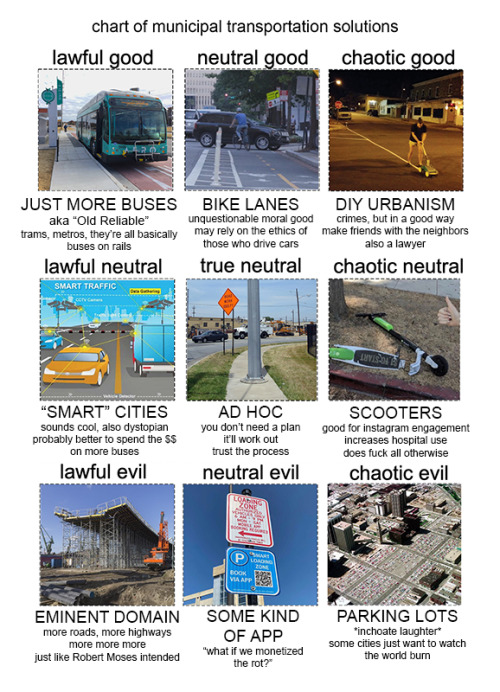
Insight can even come from general internet, for instance the Alignment Chart memes that have sprung up in the last couple years. Often humorous and subjective, they typically contain kernels of truth, and provide an easy way to compare and contrast technology, modes, applications, and justifications.
Municipal Transportation Alignment Chart. Solar Punks
Alignment Charts can be drawn up for individuals, as personality types, as well as for objects. The charts have their origins in the Dungeons & Dragons role playing game, of all places. But such simplistic charts can assist, if only subjectively and coarsely, in identifying and categorising technologies, modes, objects, and personalities.
A Young Person’s Guide to public transport advocacy
To be considered seriously by transport authorities and politicians, the following attributes are essential:
Pragmatism
Understanding the other side’s point of view
Adult and professional behaviour
Trust
Using case studies and data in context
These are all critical to advance up the Ladder of Public Participation:
Arnstein’s Ladder of Public Participation
Sherry Arnstein was a planner who in 1969 developed this ladder of public participation, which is useful to refer to as in relation to proposed public transport schemes.
Non participation
1 Manipulation The aim is to educate the participants as the proposed plan is best and the job of participation is to achieve public support by public relations.
2 Therapy The aim is to educate the participants as the proposed plan is best and the job of participation is to achieve public support by public relations.
Tokenism
3 Informing A most important first step to legitimate participation. But too frequently the emphasis is on a one-way flow of information. No channel for feedback.
4 Consultation Attitude surveys, neighbourhood meetings and public enquiries. But Arnstein still feels this is just a window dressing ritual.
5 Placation For example, hand-picked ‘worthies’ onto committees. It allows citizens to advise or plan ad infinitum but retains for power holders the right to judge the legitimacy or feasibility of the advice.
Citizen Control
6 Partnership Power is in fact redistributed through negotiation between citizens and power holders. Planning and decision-making responsibilities are shared eg through joint committees.
7 Delegated power Citizens holding a clear majority of seats on committees with delegated powers to make decisions. Public now has the power to assure accountability of the programme to them.
8 Citizen Control Have-nots handle the entire job of planning, policy making and managing a programme eg neighbourhood corporation with no intermediaries between it and the source of funds.
How to destroy trust
Binary black or white thinking (it is lazy, inaccurate, and ineffective)
Personal attacks on transport authority executives and staff, on politicians, and on other transport advocates
These traits only attract others with the same issues, which is not a basis for constructive dialog with authorities or conducive to positive change:
Bitterness
Anger
There is often a lot to be frustrated about with the lack of progress and funding for public transport. But deep anger needs to be channelled and retuned into positive actions, lest the anger and bitterness grow.
Transport authorities and politicians take the opinions of groups much higher than individuals in meetings, consultations, and submissions. In the UK, some bus and rail users groups, being focused on a single bus network or rail line, can look at the issues in detail.
There’s a lot in the world of campaign strategy and social change that looks at this sort of thing. Some groups attend public meetings and talk politely, whilst others take direct action to protest for or against:
GRAHAM’SHierarchy of Disagreements
Programmer, Harvard PhD, entrepreneur, VC capitalist, and writer Paul Graham elucidated this list. The force of a refutation depends on the method of addressing the argument. The disagreement hierarchy forms a pyramid, in the sense that the higher you go the fewer instances you find.:
Refutation – The most convincing form of disagreement, and the rarest as it’s the most work.
Counterargument – Contradiction with reasoning and/or evidence.
Responding to tone – responses to the writing, rather than the writer. The lowest form of these is to disagree with the author’s tone.
Ad Hominem – ‘Of course he would say that. He’s a politician.’ It doesn’t refute the argument, but it may be relevant.
Name-calling – The lowest form of disagreement, the easiest, and the most common unfortunately.
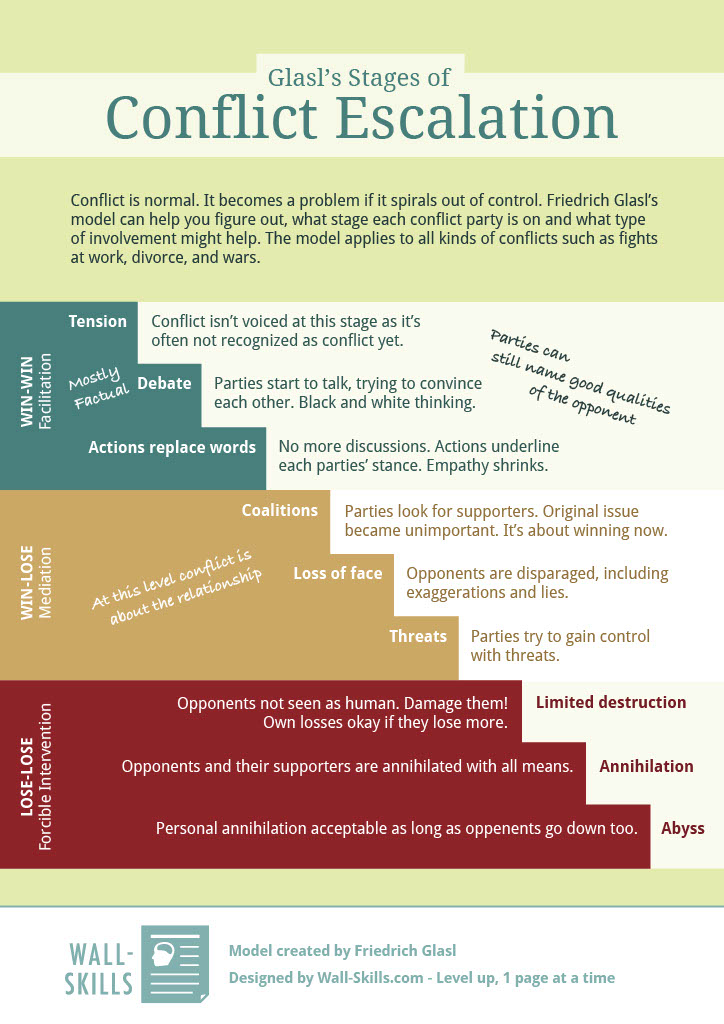
Glasl’s Model of Conflict Escalation
Dr Friedrich Glasl is an authority on conflict, and he developed this model to assist in the analysis and de-escalation of conflicts. The model has nine stages grouped into three levels, each containing three stages, which can be applied to any kind of conflict: in particular, it applies between and among transport authorities and advocates.
1st Level (Win – Win)
Stage 1 – Tension
Occasional clash of opinions but is not perceived as the start of a conflict.
Stage 2 – Debate
The parties consider strategies to convince the counterparty of their arguments which leads to dispute, and the parties try to put each other under pressure, and start thinking in terms of black or white.
Stage 3 – Actions instead of words
The parties increase the pressure on each other in order to assert their own opinion. Verbal discussions are broken off and sympathy for the other party disappears.
2nd Level (Win – Lose)
Stage 4 – Coalitions
Each party searches for sympathisers to their cause. Belief of right on one’s side, one can denounce the opponent. The issue is no longer important: one has to win the conflict so that the opponent loses.
Stage 5 – Loss of face
The opponent is denigrated by innuendo and similar actions. The loss of trust is complete. To lose face would mean a loss of moral credibility.
Stage 6 – Threat strategies
The parties try to gain control by issuing threats which demonstrate their power. The proportions decide the credibility of the threat.
3rd Level (Lose – Lose)
Stage 7 – Limited destruction
One tries to severely damage the opponent with all the tricks at one’s disposal. The opponent is no longer regarded as human. From this point onwards, limited personal loss is seen as a gain if the damage to the opponent is greater.
Stage 8 – Total annihilation
The opponent is to be annihilated by all means.
Stage 9 – Together into the abyss
At this point personal annihilation is acceptable if it means defeat of the opponent.
Slightly simplified Glasl Chart. Wall-Skills
Strategies for de-escalation and conflict solution
But there is hope, even though solutions for de-escalation are often not immediately apparent. Particularly when both parties don’t want to or believe be impossible to reverse the situation, or when one party selects escalation as a strategic ploy. To de-escalate, Glasl suggests the following:
Stages 1–3: Mediation
Stages 3–5: Process guidance
Stages 4–6: Socio-therapeutic process guidance
Stages 5–7: Intercession, intermediation
Stages 6–8: Arbitration, court action
Stages 7–9: Forcible intervention
The job is education
Education of others of the principles of public transport, its relation to land use, and the importance of service frequency is a major task for advocates. These are complex, inter-related issues:
Land use
Road use
Public transport options
Existing transport modes
Political choices
Simplistic reduction of them glosses over too many nuances and lead to misunderstandings and myths. Binary thinking is too easy, and poisons the well of intelligent discourse.
Silos of transport related disciplines
In the UK, transport management and planning is taught with little or no awareness or reference to urban and town planning. This is despite the close relation between urban structure and density with the need and demand for public transport.
In the real world, perfect public transport lines rarely exist. A flawed transport authority can still build a good line, and a good transport authority can build a line with deep flaws.
Why people resist change – Schuler’s Ten Reasons
The individual’s personal predisposition to change.
Surprise and fear of the unknown.
Climate of mistrust.
Fear of failure.
Loss of status and/or job security.
Peer pressure.
Disruption of cultural traditions and/or group relationships.
Personality conflicts.
Lack of tact and/or poor timing.
Not seeing the benefits.
Everyone gets frustrated with public transport authorities. The people inside of them get frustrated too. Getting angry at a public transport authority rarely has much effect. To influence someone, start by thinking about transport from their point of view.
Confusing direction from elected officials
Often without intending to, elected officials provide conflicting goals, like increased ridership at a lower overall budget. Many managers would not pressure officials to be clearer about which is the higher priority.
There is often a difference in attitudes between transport authority (who generally want to improve public transport) and the elected politicians which oversee it (who generally bow to the car driving voter). This is really important, but it is not clear in the minds of most of the public.
Operations Resist Change
The dominant task of most public transport operators is running the service to schedule every day, and most staff are focused on that. Disruption and change are generally avoided.
Most people and organisations are quite afraid of change. Change means that what staff did yesterday could be completely different going forward: new bosses, new evaluation criteria, retraining, moving divisions…
Hence having a pilot, or a nearby city demonstrating a mode, technology, or transport innovation is crucial to point to so that people can see for themselves how well it works.
Because operations is the dominant part of most authorities, they tend to define the authority’s culture.
Misdirected Blame
Many aspects of the success or failure of a public transport system are outside the public transport authority’s control. Like traffic, accidents, road and building construction, and their own budget.
Passengers typically blame the operator or transport authority for running late and slow buses, without often considering what priority measures (bus lanes, signal prioritisation) that the authority could prioritise buses. Or that it’s the city and its politicians who have decided this, directly or indirectly, by cutting transport funding and/or hiring malleable staff.
When a planning process seems bureaucratic and unresponsive, do you blame the Federal rules that they have to follow, or do you just blame the public transport authority?
When a public transport authority’s ridership falls, riders and the public don’t often consider external causes like low gas prices, Uber/Lyft proliferation, etc.
When a public transport authority proposes a new line, which usually results in sticker shock, riders and the public rarely consider the soft benefits of decreased pollution, improved network coverage, network resiliency, line-wide accessibility, and importance to following generations. These are all difficult to quantify in monetary terms.
When there is insufficient service, do riders and the public blame the public transport authority, or look at the elected leaders (and voters) who refuse to fund public transport properly?
Public transport authorities are constantly blamed for things they don’t control, which leads to:
Public Abuse
Yelling at authority staff or other advocates is not a good way to communicate. The reaction then is that they become more defensive and less open with ideas and information. The best people rise above this. But they also want understanding and support from advocates, who want the same goals – services provided, improvements implemented. Both the users and the transport authority need to educate the elected leaders on the importance of the public transport in question – the transport authority is rarely the villain. Typically it has been starved of funds, resources, and initiative. Those that control the purse strings are the ones ultimately responsible.
At best, the public transport authority service is unremarkable – people take transport vehicles, get to where they are going as expected, nothing unusual. Appreciation for providing stable, reliable service in normal conditions is rare. But as soon as service is disrupted, for whatever reason, the authority and its operators are the first point of contact. And blame.
It’s also important for advocates to be seen as reputable and trustworthy by the mainstream media, as a source of facts, rational thought, and a counter weight to NIMBYs, politicians, and stubborn transport authorities.
Most public transport authority staff also really want to improve their system, and often share advocates’ opinions and goals.
The Danger of the Technutopians
Autonomous vehicles, maglevs, Hyperloops, flying taxis, on demand transport – these are all unproven gadgetbahn technologies with at least a decade to widespread use. And they are always a decade away, ever shunting into the future. They are not mass transport solutions for cities, and will not be for the foreseeable future. Hence Reconnections does not waste time on them. ***
At best, they are a distraction. But the reality is that these shiny baubles are pulling in billions in investment funding and government support that will benefit millions fewer passengers than if the money were instead invested in proven public transport modes and services.
Summary
The goal of this piece is not to shame or put down advocates, but to provide a path on how to improve, whilst maintaining a positive, constructive attitude, if they so wish. ***
Without an informed public and an informed debate, public transport policy and development will forever be stuck in the trench warfare of advocates and critics, lobbing grenades at each other over a no man’s land of wilful ignorance of each other’s views and perceptions.
The standard of debate about transport planning in Britain is woeful, even amongst those who should know better. One real problem is that many people are obsessed with the mode they know the best, and are generally unwilling to accept that a range of transport problems will need a range of different modes to deal with them. It is often difficult for people to comprehend a scheme that doesn’t use their favourite mode and will actively denigrate other transport modes.
What is Light Rail Transit or more commonly known as LRT?
A modern light rail line in Bilbao, Spain.
According to the Light Rail Transit Association (www.lrta.org) Light rail is a mode that can deal economically with traffic flows of between 2,000 and 20,000 passengers per hour per direction, thus effectively bridging the gap between the maximum flow that can be dealt with using buses and the minimum that justifies a metro.
But there is more, by track-sharing with existing railways on their rights-of-ways, means that LRT can effectively and affordably service less populated areas, with public transport. Streetcars are also light rail, but operate on-street, in mixed traffic, with little or no signal priority at intersections. The main difference between LRT and a streetcar is the quality of rights-of-way, where a streetcar operates on-street, LRT operates on a reserved rights-of-way or a route that is reserved for the sole purpose of the light rail vehicle.
A reserved rights-of-way can be as simple as a HOV lane with rails, to a lawned park like route with trees, hedges and flowerbeds. LRT, in it’s various forms is used in over 600 cities around the world and is the first choice of transit planners for affordable, customer friendly public transport.
Classic lawned reserved or dedicated tram R-o-W.
The German city of Karlsruhe (City population 275,285) has taken light rail to a new standard, by track sharing with mainline railways and operating, what is called TramTrains. In Karlsruhe, one can board a tram, on-street, on the pavement and alight, on-street in Ohringen some 210km (130 mile) later, with the tram acting as a streetcar, light rail vehicle and a passenger train!
Karlsruhe’s light rail network now extends over 400 km. (250+ mile) of route, servicing scores of small towns and villages with high quality public transit at very little cost simply because the tram can use existing railway tracks.
The River Line In New Jersey, a classic TramTrain.
In British Columbia, tramtrain can be a useful tool for implementing a high quality ‘rail’ transit service, not only in Vancouver and the Fraser Valley, but in Victoria (E & N Railway) and the Kelowna/Vernon rail corridor as well.
The question is: Why does TransLink and the BC government reject modern LRT out of hand and continue to build with dated light metro?
And still, in 2021, the provincial, Ministry of Transportation, regional mayors and councils, including their bureaucracies and the mainstream media, still think that modern light rail is inferior to SkyTrain and is some sort of poor man’s SkyTrain. The reality is different, as only of the seven proprietary MALM have been built since it was first marketed over 40 years ago (which also had five previous brand names). No one has copied the Canada Line, which is a heavy rail metro built on the cheap and and has less capacity than a modern streetcar costing a fraction to build.
In 13 years, nothing has changed, except for more and more costly transit projects, built to suit politcal and bureaucratic whims, rather than to provide an affordable and user friendly alternative to the car.
As urban sprawl and strip development is now engulfing the lower mainland, with associated traffic congestion and pollution, Rail for the Valley’s concept of TramTrain makes sense.
We cannot afford to extend SkyTrain at over $200 million/km and certainly there is absolutely no real economic or business case for a subway under Broadway for a $500 million+/km subway. Transit planning in metro Vancouver has entered the world of Mad Max.
RftV’s TramTrain could provide an under two hour journey from Vancouver to Chilliwack for a cost of around $12 million/km!
Mad Max planning at TransLink and the Ministry of Transportation, approved by the Mad Max politicians who want massive metro projects to cut ribbons in front of at election time is turning what once was a paradise into a massive traffic jam, complete with instant slums, suffocating in overcrowding and pollution.
At 3 trains per hour per direction, a modern tramtrain service in the Fraser Valley could carry as many as four lanes of traffic.
From 2015.
An interesting read and quite pertinent to our transit situation in the lower mainland.
Both the BRT and SkyTrain Lobby’s have so perverted the concept of modern light rail, to support their own projects, that the concept of affordable LRT has all but disappeared from the TransLink lexicon.
The following quote; “……….while cities with rubber-wheeled public transport continue to be dominated by cars and urban sprawl“, is so true of Metro Vancouver, where congestion is on the rise, yet politicians and planners opt for remedies that will further exacerbate the situation.
How to build light rail in our cities without emptying the public purse
Light rail is good for cities, but it’s also expensive, which is why many Australian cities have opted for buses instead. But there is a way to get top-drawer public transport using private dollars.
The way forward? Light rail helps urban development far more than roads do – the challenge is how to pay for it. AAP Image/Dave Hunt
In cities all around Australia, light rail is being considered as a solution to a range of urban problems. Perth, Newcastle, Parramatta, Bendigo, Canberra, Cairns and Hobart have all considered trying to do what many European and American cities have done to create new development around light rail.
Often, though, the high costs of these projects mean that the debate can soon become a question of whether buses might do the job just as well. But what if private financing could allow the preferred option of light rail to stay on the table?
Advocates of the cheaper bus mass transit option might ask whether there is truly any fundamental difference between steel wheels and rubber ones. My answer is that is not just a question of trams versus buses: it’s really an issue of rail-based versus road-based urban development. The former can attract private financing, while the latter does not.
Driving development
Most of the world’s urban development over the past 50 years has been road-based. The assumption has been that most people will drive, with the odd bus laid on to pick up those who don’t.
Perth’s beleaguered MAX light rail project: now mothballed in favour of a bus rapid transit service, was designed to deliver precisely these benefits. But when the bus lobby sidles in and whispers “we can do exactly the same for half the price”, they get a sympathetic ear from transport planners who are trained to get people efficiently from A to B, without thinking about whether they are also delivering good urban development.
Rubber-wheeled public transport does not create dense, mixed-use urban centres. Having examined examples around the world, I have found none that can be claimed to have resulted in more focused urbanity apart from already dense third world cities where BRT’s have been successful in attracting patronage as they get people out of traffic. In the United States, the past 20 years of dramatic growth in public transport has seen light rail grow by 190% and heavy rail by 52%, while bus transport has contracted by 3%.
It is no surprise that developers, banks and governments in developed cities have returned to light and heavy rail to help regenerate urban centres, while cities with rubber-wheeled public transport continue to be dominated by cars and urban sprawl. On current trends, Perth itself could conceivably turn into a 240 km sprawl stretching from Myalup to Lancelin, most of it made of nothing but car-dependent housing; more Mad Max than MAX.
Perth’s planners know that they must redevelop and create activity centres, but they do not control the decisions on transport. Transport planners, meanwhile, do not seem to see that their choices have impacts that go beyond simple modes of transport.
Enter the private sector
Here is my possible solution, which Infrastructure Australia has previously tried to get state governments to adopt: get the private sector involved in the planning stage, as well as the delivery and operations, of any light rail project. Light rail lends itself to private-sector involvement, but only if the development outcomes being sought are built into the whole project, rather than being an afterthought.
The model for Infrastructure Australia’s approach was the A$1 billion Gold Coast Light Rail, which runs through areas that had lots of potential for redevelopment. Thus the funding was provided by a public-private partnership, with expressions of interest sought from private bidders to design, finance, build, own, operate and develop land as a basis for funding.
Government base funds and a general set of guidelines were delivered and bids were sought. Five consortia from around the world competed on this basis and included most of the world’s main consulting groups with expertise in light rail.
However, the group of transport experts (mostly main roads engineers) set up by the Queensland Government to deliver the light rail argued that they did not have the expertise to manage the land-development part of the exercise, and successfully appealed to avoid this approach. Instead, funding was delivered through an annual transport levy across the whole Gold Coast local government area.
The private sector consortia were well prepared for the land-development option but of course went ahead without it. Keolis won the tender and delivered a first-class light rail. As soon as the route was announced, developers from around the world bought up all the best sites and are now delivering them, albeit for their own interests rather than channelling back to the project.
This is the way to do it if you have tax funds to provide the capital and the operational expenses, and if you can find the initial public funding. But most politicians today say they do not have sufficient government funds for a light rail so they need to consider the cheaper bus option. Do we have to take second best?
The rubber-wheel option is never going to deliver the regeneration that many of Australia’s cities need. We need to be brave enough to go for the better option, the rail system, and that means embracing the public-private partnership financing model.
Bringing the private sector on board
To go for a full private-sector approach you must integrate redevelopment into every stage of the project. This is how you do it. Call for expressions of interest for private companies to design, build, finance, own and operate the light rail link and, crucially, make sure this includes land-development options (rather than letting in outside developers). This would help to create funds that can be used to finance and to operate the system.
Government needs to contribute a base grant and an operational fund that could be more specifically focused along the areas where the biggest benefits are felt in the corridor itself, where land values will go up most. Private expertise will ensure that the best sites are chosen for the light rail route. These land-value increases will flow through taxes into treasury and can be set aside in a dedicated light rail fund for ongoing operations and/or for raising finance (rather than instituting a city-wide levy as the Gold Coast did).
The approach, called tax increment financing, allows infrastructure to be built where it can be shown that the taxes would not have been generated without it. A bus instead of a light rail would not generate such land-value increases, and hence the extra tax dollars would not flow. For instance, Perth’s southern rail line raised land values around stations by 42% over 5 years and could have raised 60-80% of the capital cost if tax increment financing had been used.
Across Australia we should accept that there is a real choice over steel or rubber wheeled development. We can choose MAX over Mad Max. But are we brave enough to go one step further than the Gold Coast and involve private financing?
Some might object to our public transport being in private hands, but if we manage it well, this kind of partnership with private expertise can deliver beautiful cities as well as beautiful trains.
In 2021, TransLink with the approval of the provincial and federal governments are spending almost $3 billion to build a 5.8 km subway under Broadway in a transit route which (pre Covid) saw the Broadway 99B-Line bus achieve a maximum capacity of 2,000 pphpd, yet the North American standard for subway construction for a subway is a transit route with traffic flows in excess of 15,000 pphpd.
The City of Vancouver claims that LRT cannot carry more than 7,000 or 8,000 pphpd, yet the City of Toronto operated streetcar routes, offering a maximum capacity of 12,500 pphpd in the late 1940’s! In Europe, modern tram/LRT routes can carry in excess of 20,000 pphpd, which is over 5,000 pphpd more than what the Expo and Millennium line can legally carry.
This begs the question:
Is the region spending up to five times more for a subway instead of a much simpler modern tram, which would have a higher capacity?
It is time to have a national standard for public transit construction?
Recent angst and confusion in local and national blogs concerning bus, light rail, metro, and commuter train makes Zwei wonder if a Royal Commission on Urban Transportation is needed. There are no national standards that readily defines transit mode and one is needed, so the average Canadian (read Canadian taxpayer) can engage in honest debate on urban transportation. To date, most transit modes are defined by those promoting particular transit projects and the mode chosen for that project. There is no national definition for light rail, metro and bus and confusion is endemic in the mainstream media, the political arena, as well in academic circles.
A good example of this confusion is BRT or Bus Rapid Transit. Outside of BC, BRT is a an express bus system that is either guided by rail like the GLT (Guided Light Transit) bus systems; a bus system guided by a raised curb, like the German O-bahn; or a bus system that has the exclusive use of busways, such as used in Ottawa. In BC, BRT is merely a limited stop express bus service, such as the B-Line express buses, which is not BRT at all.
Light rail also needs a standard definition as there are many different definitions given to modern LRT. Example: in BC, TransLink claims that modern LRT can not carry more than 10,000 persons per hour per direction, yet in Europe many LRT type installations carry more than double this number in daily revenue service!
The North American variant of LRT, the streetcar also needs a standard definition. In Europe there is no distinction between a tram operated as a streetcar or a tram operated as LRT, the only difference between the two is that one operates in mixed traffic, while the other operates on a reserved rights-of-ways. One tram line in Europe can operate as a streetcar and LRT combined.
The newest variant of LRT, the TramTrain also needs a new definition and a completely new understanding of the application of light rail in alleviating traffic congestion and pollution. TramTrain has created a new dynamic to urban transportation planners in Europe, as TramTrain can operate as a streetcar, LRT and a passenger/commuter train. Operating TramTrains in Canada will require a overhaul of the Canadian Transportation Act, which governs how our railways operate.
What constitutes a metro also needs to be discussed as there are several variations including light metro and monorail. In BC, our automatic proprietary light-metro (SkyTrain) system is sometimes called advanced light rail and not a metro. As the SkyTrain system is driverless, it can’t operate in mixed traffic and definitely not of the light rail family. Also the terms rapid rail and rapid transit are used to describe transit projects, yet there is no official definition what rapid rail or rapid transit is.
“Why do we build public transit?” and “What do we wish to achieve with new transit installations”, are questions that are mostly ignored by the powers that be, as most politicians regard transit projects, mega-projects built to secure photo-ops for the next election.
Do we build public transit to shape growth, as the TOD transit philosophy dictates, or do we build transit to move people, with a customer comes first policy, as what is evolving in Europe?
Should a transit project achieve a minimum modal change from car to transit? If there is to be a modal shift, what numbers should we be aiming for? And what would be the consequences if a planned new transit line failed to achieve minimum standards of operation?
The lame statement that the Canada Line would take 200,000 car trips off the road each day, may never be achieved in the foreseeable future and the claim probably would not have been made if their were guidelines for transit mode and implementation.
The question should be asked, “Should metro or light-metro be built on routes with passenger loads that can be easily handled by LRT?” Presently the Vancouver Metro area is spending four or five or more times more money for a transit line that could have been built with a much cheaper, but just as effective alternative. TransLink has spent at least six times more for two SkyTrain metro lines, yet the two lines carry about the same ridership as Calgary’s three line LRT system. Another question that needs to be answered, “Is tunneling necessarily good for LRT projects or do they turn affordable LRT into unaffordable metro?”
What we are lacking in Canada is a national standard for building enhanced transit projects, with many being built strictly for political whim, like TransLink’s Canada Line. To rectify the the current situation a Royal Commission on urban transportation may just be the ticket for a more affordable and more customer friendly urban transportation for more urban and suburban customers.
After a flurry of TransLink sponsored advertisements on Facebook, has made it very clear, forty years of anti LRT rhetoric by BC Transit, TransLink, the mainstream media, the Ministry of Transportation and the associate claques and shills that parrot the above, the public hasn’t a clue about modern light rail transit.
What Zwei calls the “Goebbels Gambit” by…………….
“repeating SkyTrain lie so often that the public and politicians begin to bevel it”
……………….. the locals think LRT is an inferior transit mode and that what they call SkyTrain is indeed superior.
Sadly, the opposite is true and that light rail made light-metros like SkyTrain obsolete several decades ago and TransLink is very diligent ensuring that the public not know this.
The sheer simplicity and flexibility of LRT, when compared to light-metro, has made LRT the number one transit choice for urban and transportation planners around the world.
Classic reserved R-o-W in Australia
The above is a classic reserved or dedicated rights-of-way (R-o-W) located in the median of the road. Simple design, yet gives the tram the operational ability on par with a heavy-rail metro at a fraction of the cost.
Reserve R-o-W on the new tramway in Luxembourg.
The new tramway in Luxembourg with a classic lawned R-o-W, with added trees will make the tramway a linear “green space” or linear park, both giving a pleasing visual look to the transit line and making the tram organic, fitting in with local surroundings.
A lawned R-o-W in Paris
In Paris, France, careful siting of new tramways, complete with lawned R-o-W’s statuary and more make the tram line park like, fitting in with local surroundings. Only on careful inspection of the photo reveals that this is a tram-stop or station.
A German tram on a reserved R-o-w, including bike lanes.
In Germany, where transit operators have long known the benefits of reserved and lawned R-o-W’s, also plan tram routes as cycle paths. The above photo shows a modern tram on a dedicated, lawned R-o-W, with cyclists unconcerned with tram operation.
Modern light rail transit has transformed how public transit is perceived internationally, yet not so in Canada, where politcal intervention, corruption, and just plain hubris have relegated LRT as some sort of also ran.
In metro Vancouver, this is even more true, because of 40 years the politically inspired and politically supported SkyTrain light metro system, LRT is seen by politicians and many planners as nothing more than a poor man’s light metro.
The Covid-19 pandemic has transit planners worrying about future operations, especially in Vancouver.
Despite TransLink’s claims that……
“The agency is projecting ridership to be at 80 to 90 per cent of pre-pandemic capacity by next year”
………. privately, some insiders are predicting that transit may reach pre-covid levels in ridership in a decade!
Why so.
One big reason is that a lot of transit customers are finding out how bad transit is, compared to taking the car. Trips that now take 40 to 50 minutes by car, take 90 minutes by transit. TransLink provides a service that is stale and user unfriendly; as a product, transit is somewhat toxic.
Remote work and education has become more of a norm, reducing transit use and more bad news, a lot of businesses are relocating outside the hugely expensive downtown core.
The regional transit system has been designed to feed transit hubs, where offices and other businesses are located, but recent massive tax hikes , based on inflated property values in and near those hubs has caused businesses to close and or move away.
Added to this, many older people are finding Metro Vancouver too expensive to live and are moving out, as the Fraser Valley housing boom is well illustrating.
Thus, with a hugely expensive light metro system built to deal with 20th century ideas of commuting to work, the 21st century demands a far more flexible public transit product. Alas with the SkyTrain light-metro system, flexibility is impossible as the massive cement guideways have become anchors of inflexibility.
Should there be a complete rethink about the Broadway subway and the Expo Line extension to Fleetwood? Are the assumption made about SkyTrain expansion valid post Covid?
Is the current $4.6 billion investment to extend the Expo and Millennium Lines a mere 12.8 km is akin to a dinosaur flailing in a tar pit?
Prudent politicians should look 20 minutes into the future and adjust their 20th century concepts of public transit and plan for 21st century public transit, where flexibility and affordability in operation is number one reason for people taking transit!
Western Canada: Transit systems have taken a huge hit from the pandemic – and some of that impact could be permanent
Globe and Mail Western Canada Newsletter April 17, 2021
Good morning. It’s James Keller in Calgary.
The COVID-19 pandemic gutted ridership on Canada’s public-transit systems after the abrupt and widespread lockdowns of the first wave a year ago, and there has only been a slight recovery since. Empty buses and trains prompted layoffs and translated to significant cuts to fare revenue.
A combination of business closures, the massive shift to working from home, and public health advice about avoiding crowds have all changed the way many people use public transit. And now local governments are facing the prospect that some of that shift may be permanent – even when the pandemic is over.
That reality will require public-transit agencies and the governments that finance them to adapt to a new reality in which people travel less or at different times of the day. And the post-pandemic recovery could present an opportunity to reimagine those transit systems in a way that may leave them better off.
Last month, Moody’s Investor Services estimated transit ridership will drop permanently by 20 per cent.
The Moody’s report said the structural changes will particularly affect cities such as New York, Paris, London and Vancouver, where transit has been popular enough that fares have covered a big part of operations. Toronto wasn’t mentioned in the report, but it’s in the same class, with 67 per cent of its operating costs paid for by fares.
Canadian transit systems aren’t projecting anything that dire, but they are preparing for long-term changes.
In Vancouver, the regional transit authority, TransLink, has produced its own analysis, projecting things to improve this year as vaccines take hold and postsecondary institutions resume in-person classes in the fall. The agency is projecting ridership to be at 80 to 90 per cent of prepandemic capacity by next year.
Geoff Cross, TransLink’s vice-president of planning and policy, said changing travel patterns could mean the agency no longer needs to stretch to provide service for the peak-hour commuting, which has been the most expensive and demanding part of the system.
If more workers commute throughout the day, the system could improve service everywhere rather than focusing so much on the big two rush hours.
Edmonton and Calgary are also expecting things to rebound this year. Edmonton is currently at no more than 45 per cent of prepandemic capacity right now, while Calgary is at 30 per cent.
Sarah Feldman, Edmonton’s director of planning and scheduling, said the city has several scenarios about potential recovery. Best case, everything is back to where it was by the fall of 2022. Worst case, a year later. And the agency is also preparing for a reality that ridership may not recovery fully – or if it does, public transit may need to look different.
Calgary Transit spokesman Stephen Tauro agreed that the pandemic could spur long-term change. For example, an increase in the number of people working from home might cut commuter traffic, but might also prompt those people to rethink car ownership and use transit in different ways.
“We know, historically, that in any great, vibrant city, the backbone is a good transit system, and we don’t see that going away,” Mr. Tauro said.
London-based transit consultant Michael Schabas said many cities will no doubt experience a reduction in peak-time commuting; that trend has been under way for decades.
“The peak has been flattening for 30 years,” said Mr. Schabas, who has been a consultant for transit systems in Vancouver, Toronto, London and other places.
He said that will likely require transit systems, especially those that rely heavily on fare box revenue, to adjust their funding models. In Vancouver, TransLink was getting 57 per cent of its operating revenue from fares alone before the pandemic. The rest of the money came primarily from taxes on property and fuel.
This is the weekly Western Canada newsletter written by B.C. Editor Wendy Cox and Alberta Bureau Chief James Keller. If you’re reading this on the web, or it was forwarded to you from someone else, you can sign up for it and all Globe newsletters here.

















Recent Comments