Arbutus Corridor Resurrected?
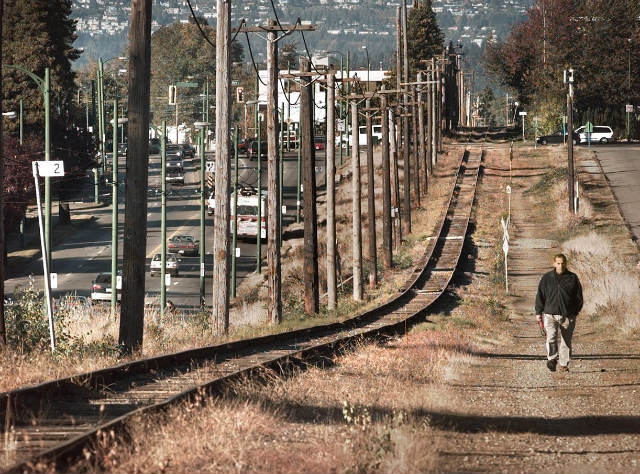 It seems the CPR is going to resurrect the Arbutus Line for freight and the wails of “shock and disbelief”, from Vancouver’s creme de la creme are echoing through the halls at city hall.
Get real folks, the CPR did not abandon the railway and the city failed to negotiate a transit solution for the route.
Maybe, the CPR has plans for a local passenger rail service along the line as American railways are finding commuter services workable and even profitable on lightly used freight lines and the Arbutus corridor would be a natural to experiment with. Just maybe the CPR can do, what the city of Vancouver; Metro Vancouver and Victoria could not do, and operate a local passenger line along the Arbutus corridor.
Trains may run again down Vancouver’s Arbutus corridor
Canadian Pacific Railway crews have been surveying and cutting brush on the line
By JEFF LEE, Vancouver Sun
VANCOUVER – More than a decade after the last Canadian Pacific Railway train made its way down the Arbutus line, the company is considering putting the spur railway back into service.
On Thursday, CP said it has crews out surveying and cutting brush on the overgrown line that runs 11 kilometres between Kitsilano and the Fraser River.
That activity has sparked concern among residents and gardeners along the line since the railway ai??i?? long considered abandoned ai??i?? has become a popular strip for walks and community gardens. City hall has been flooded with calls from people complaining about the renewed railway activity.
Mayor Gregor Robertson issued a statement Thursday saying his office is against the reactivation of the railway line.
ai???Recently, the Canadian Pacific Railway began preparations to reactivate the Arbutus corridor to run trains. However, the city has very little detail from CP about their plans, other than that they intend to run trains along the route.
ai???The city doesnai??i??t support the reactivation of cargo trains along the corridor and we have expressed this clearly to CP. The corridor is a unique, green route running from False Creek to the Fraser River, crossing several residential neighbourhoods, and our vision for it is to maintain it as greenway for residents of Vancouver until thereai??i??s a viable case for rail transit use,ai??? he stated.
Robertson noted the city has been trying to work with CP Rail for years to convince them of the need for the corridor to remain a community greenway until there is a viable case for passenger rail use. He noted the rail line is not suitable for large-scale development or cargo trains.
ai???I support the Arbutus corridor as a community greenway and future transit corridor, and ask CP to respect the neighbourhoodai??i??s wishes and the Arbutus corridor official development plan.ai???
CP spokesman Ed Greenberg issued a statement following the mayor’s comment:
ai???CP has attempted for many years to reach a deal on this line with the City of Vancouver. Unfortunately, we have failed to reach an agreement, so we are now reconsidering our operational options. In saying that though, CP remains open to continued dialogue and discussion.ai???
In an earlier interview Greenberg said the railway company is clearing out brush along the line as well as surveying its property lines.
ai???We are doing a new survey to ensure we have a current record of our property,ai??? he said. ai???We are continuing to explore operational options for the line, but no decisions have been made at this time.ai???
Greenberg said CP did not formally abandon the line as required under federal legislation, and it ai???remains an active rail line as defined by the Canadian Transportation Act.ai???
However, in a letter CP is issuing to residents along the line, Mike LoVecchio, western director of governmental affairs, said the company is considering putting the line back into operation because it hasnai??i??t been able to resolve long-standing community desires for non-railway use.
In 2006 the Supreme Court of Canada ruled the city had the right to designate the line for transportation and greenway uses. It affirmed the cityai??i??s right to enact its Arbutus corridor official development plan, effectively killing a proposal by CP to sell or develop the land for commercial or residential use. The line has not been used since 2001.
ai???For many years now, CP has been involved in conversations to convert the Arbutus corridor for a number of combined public uses, such as a greenway, public transportation, community gardens and eco-density development. Despite our efforts, the company and other parties have been unable to achieve a plan for the disposition of this valuable asset,ai??? LoVecchio wrote. ai???As a result, the company must look at optimizing the use of this corridor. This includes running CP trains.ai???
He said the track network and adjacent 66-foot-wide right of way is private land owned by CP and people entering the area without authorization are trespassing.
However, in recent years the city and its neighbourhoods have created a number of community gardens along the right of way, in some cases installing water lines. Along some of the commercial strips, people have taken to parking on or next to the tracks. Elsewhere, along the lineai??i??s Kerrisdale and Marpole regions, thick patches of Himalayan blackberry have grown, providing fertile crops for berry pies in summer.
Greenberg said CP is aware there are many community gardens along the right of way and if crews determine they are in conflict with the railwayai??i??s operations, residents will be consulted.
===
A history of the rails
1886 ai??i?? Arbutus corridor given to the Canadian Pacific Railway by the province, just a few months before the City of Vancouver was incorporated.
1902 ai??i?? Vancouver and Lulu Island Railway Company, a CP subsidiary, builds rail line from False Creek to Steveston.
1905-1950s ai??i?? Electric locomotives shuttle passengers and freight along the corridor.
Mid-1950s ai??i?? Passenger service ends.
1995 ai??i?? CP severs connection between Arbutus corridor and Science World by selling a single lot at 1500 W 2nd Ave., which becomes a Starbucks.
1999 ai??i?? CP discontinues the railway apart from service to Molson brewery and starts working on plans for residential and commercial development. Also offers to sell corridor.
2000 ai??i?? City passes an Official Development Plan that restricts development on the corridor. CP sues city for limiting its use of the property to unprofitable rail service. The company claims the bylaw amounted to taking the property without compensation. Also, some Kerrisdale residents oppose use of corridor for rapid transit.
2001 ai??i?? Last train runs.
2002 ai??i?? B.C. Supreme Court judge rules the bylaw was not within the city’s powers. Separately, the B.C. Court of Appeal reverts northernmost 10 acres of the unused corridor to the Squamish Nation.
2004 ai??i?? B.C. Court of Appeal overturns lower court decision, preserving the city’s bylaw.
2006 ai??i?? Supreme Court of Canada unanimously rules that the city is within its rights to make decisions about land use and it does not need to compensate CP for any loss of value, real or perceived.
2007-present ai??i?? Residents plant community gardens along the line and use the space for recreation and transportation.
With a files from Kim Pemberton and Matt Robinson

Who says LRT or streetcars can’t operate at close headways!
There is a reoccurring theme from the SkyTrain trolls at TransLink and the city of Vancouver that LRT can’t operate at close headway’s and one can hear the wailing and gnashing of teeth when they are corrected. “Lies”, they scream in unison, at every correction. It is extremely funny and extremely sad at the same time that the SkyTrain trolls firmly believe their fairytales to be true and those who support modern LRT are some sort of latter day Luddite.
How many SkyTrain systems have been built Daryl? Only seven you say. Pity.

So here we have a contemporary photo from San Fransisco with a tram, a bus and a tram traveling at 3 second headway’s. Hmmm, say it ain’t so!
Gregeor Telling Porkies – Again!
Vancouver wants a subway and its mayor will say anything to get the province to pay for one under Broadway.
There is an old Hungarian saying; “When the gypsies knock at the door, rush out and protect the chickens.” Updated, the saying should say, “When Gregor preaches a SkyTrain subway under Broadway, say no and keep your taxes and transit affordable.”
Vancouver mayor renews push for Broadway transit line
Vision Vancouver has started its re-election campaign by releasing a video with a heavy emphasis on its hoped $3-billion subway line for the Broadway corridor to the University of B.C.
The shows Mayor Gregor Robertson extolling Vision’s successes, which includes “cutting congestion with the new Broadway subway line” and providing more affordable housing.
Robertson said Tuesday he doesn’t believe the video makes it sound like the subway line is a done deal, noting it indicated Vision is simply advocating for the project.
“We’ve got to champion this. Eventually this will happen; I want it to happen soon,” he said, following a keynote address to the Urban Land Institute of B.C. “I’m going to keep battling hard for this.”
Robertson said the Broadway subway is crucial to the city’s future because it would address increasing congestion and bus pass-ups along the route.
He pointed to a city analysis that suggests the new subway would see 250,000 trips on its first day ai??i?? more than a new Massey Tunnel Bridge or the Port Mann Bridge ai??i?? and take 50,000 car trips off the road.
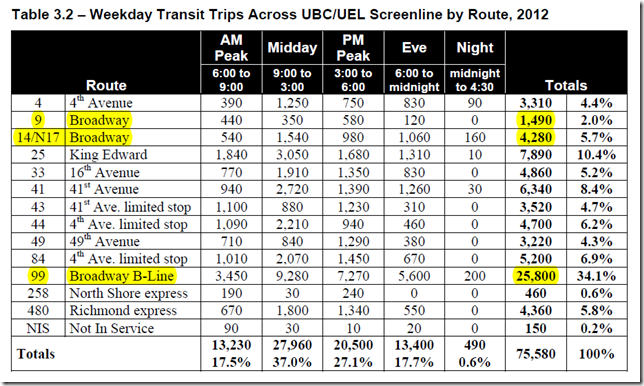
Here is a reality check for Mayor Gregor and the so called CoV experts, the total bus trips made by transit customers along Broadway amount to 31, 570 trips a day. Really, where does the City of Vancouver come up with 146,000 a day? Inhaling too much pixie-dust maybe?
Then there is this nonsense that subways will increase revenue and transit savings, which is a farce. The fact is, subways are hugely expensive to operate and maintain. Further, subways are very poor in attracting ridership; Robertson and the Vision Vancouver gang think the regional taxpayer, who will be taxed to the max to fund this extravagance, are rubes.
The city had predicted in 2012 that 146,000 people a day would be shuttled in a subway along the new route.
The new analysis, based on TransLink’s Broadway Corridor study and trip diary data released last year, also suggests new revenue from the subway and transit savings ai??i?? by increasing transit ridership and reducing the need for B-Line buses ai??i?? would total upwards of $200 million over 10 years.
The subway is among a list of TransLink priorities, which also includes a light-rail line in Surrey and a replacement for the aging Pattullo Bridge. Metro Vancouver mayors are in the midst of developing a 10-year plan and proposed funding options, such as using a vehicle levy or other forms of road pricing such as tolls on every bridge or tunnel, which will go to a public referendum.
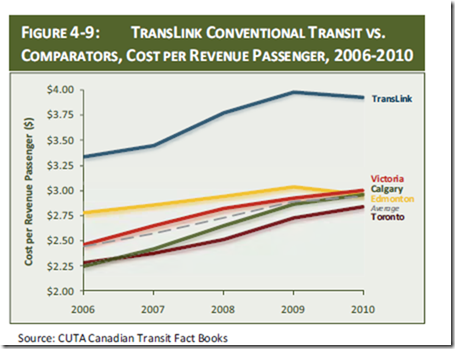
 Just as a reminder, Metro Vancouver, after spending over $9 billion on three mini-metro lines, also has much higher ‘cost per revenue passenger’ than Edmonton and Calgary, which operate with light rail. A Broadway subway would dramatically increase the costs per revenue passenger.
Who Killed Public Transportation in Los Angeles?
Why did the streetcars disappear, there many reasons and this news item may shed a little light from 50 to 60 years ago.

“Who Killed Public Transportation in Los Angeles?
Posted on 03 May 2014
by Craig FitzgeraldWith Elon Muskai??i??s Hyperloop making news in Israel, the story of how Los Angelesai??i??s trolley system disintegrated is once again rising in discussions. The demise of the Red Car trolleys in Los Angeles is the stuff of legend. Itai??i??s such a great narrative that it made its way into the plot of the movie Who Framed Roger Rabbit?, the Chinatown-esque movie that spearheaded the resurgence in American animated films. But, like the story of Preston Tuckerai??i??s quest to outdo the American automotive industry at its own game, thereai??i??s a lot more to the story of the demise of Pacific Electric ai??i?? also known as the Red Car System ai??i?? than meets the eye.
The Conspiracy
Thereai??i??s no doubt that General Motors and many other automotive-centric companies bought up trolley services all over America. According to United States Court of Appeals for the Seventh Circuit in 1951, ai???Pacific City Lines was organized for the purpose of acquiring local transit companies on the Pacific Coast and commenced doing business in January 1938,ai??? with the backing of investors like Firestone, Standard Oil of California, Phillips Petroleum, General Motors, Mack Trucks and the Federal Engineering Corporation.
National City Lines ai??i?? the parent company of Pacific City Lines ai??i?? bought the Yellow Cars of the Los Angeles Railway, converting most of those lines to bus routes. National City Lines, Pacific City Lines and American City Lines made similar purchases and conversions in over 100 American cities like Oakland, Baltimore and San Diego, and eliminated streetcar service en masse.
In 1949, Firestone Tire, Standard Oil of California, Phillips Petroleum, GM and Mack Trucks were convicted of conspiring to monopolize the sale of buses and related products to local transit companies controlled by NCL and other companies. However, they were acquitted of conspiring to monopolize the ownership of these companies. The verdicts were upheld on appeal in 1951.
The Whistleblowers
In 1946, Edwin J. Quinby had recently retired from the US Navy as a Lieutenant Commander. As a result of the conversion of the Key System trolleys in Oakland, California, Quinby penned a 24-page expose on the owners and investors of the National City Lines. ai???This is an urgent warning to each and every one of you that there is a careful, deliberately planned campaign to swindle you out of your most important and valuable public utilitiesai??i??your Electric Railway System,ai??? Quinby wrote.
Quinby had previously worked for the North Jersey Rapid Transit, which operated in New York and had established the Electric Railroadersai??i?? Association in 1934, which had lobbied on behalf of rail users and the services they used.
Thirty years later, Bradford Snell, a the Senate antitrust attorney, former scholar with the Brookings Institution and attorney with Pillsbury, Madison and Sutro testified before the United States Senate, and provided what would become the document of record that conspiracy theorists would refer back to time and time again when discussing the ai???Great American Streetcar Scandal.ai???
Snell testified: ai???My findings, contained in a study entitled American Ground Transport, are briefly this: the Big Three car companies used their vast economic power to restructure America into a land of big ca=rs and diesel trucksai??i??General Motorsai??i?? destruction of electric transit systems across the county left millions of urban residents without an attractive alternative to automotive travel.ai???
Snell took particular issue with the leniency of the fines levied in the conspiracy cases: ai???The court imposed a sanction of $5,000 on GM. In addition, the jury convicted H.C. Grossman, who was then treasurer of GM. Grossman had played a key role in the motorization campaigns and had served as a director of Pacific City Lines when that company undertook the dismantlement of the $100 million Pacific Electric system. The court fined Grossman the magnanimous sum of $1.ai???
The Mitigating Factors
Whether or not GM, Firestone and Standard Oil were buying up trolley companies and converting them to buses, the fact was that many of those lines were in dire financial shape when they were purchased, due in part to the trust-busting that followed the stock market crash of 1929.
The Public Utility Holding Company Act of 1935 ai??i?? also known as the Wheeler-Rayburn Act ai??i?? put the kibosh on trolley company profitability. Prior to the Act, streetcar companies like Pacific Electric could provide a public transportation service, as well as producing electricity for sale to other parties. By 1932, eight utility holding companies controlled 73 percent of the private electric industry. Complex legal structures made it very hard for individual states to regulate.
Companies like Pacific Electric were private companies, not public services. They were owned by electric utility holding companies. The electric utility company could sell electricity to the streetcar affiliate company and artificially mark up the price, allowing the utility company to effectively subsidize the streetcars, and then jack up electric rates for other customers.
The Wheeler-Rayburn Act resulted in the divestiture of utility-owned electric streetcar companies, and seriously impinged their ability to run profitably.
The DebunkerAi??
In 1997, in an issue of Transportation Quarterly, Cliff Slater essentially exploded the myth that the demise of trolley cars in America was due solely to the fact that GM and its cohorts were buying them. Slater essentially said that the trolley car systems around the country were able to be purchased because they were going broke.Ai?? As far back as 1920, ridership on streetcars was on the decline. By the time of the stock market crash, 20 percent of cities across the country were already relying solely upon bus service.
In 1915, streetcars were cheaper than buses to operate, according to Slater, but just a few short years later, as soldiers returned home from World War I, that wasnai??i??t necessarily the case. The capital cost of maintaining railways exploded, versus the road maintenance for buses, which was essentially subsidized by road construction specifically for automobiles that were becoming vastly more popular in the 1920s.
Streetcar ridership increased heavily during World War II, which made it a lot easier for conspiracy theorists to point to increased ridership as a suggestion that all was well with the trolley systems. But it was a time of great austerity and gas rationing, artificially inflating ridership during the war years. Immediately following the war, ridership plummeted and never recovered.
ai???GM simply took advantage of an economic trend that was already well along in the process ai??i?? one that was going to continue with or without GMai??i??s help,ai??? concluded Slater.
Films like Who Framed Roger Rabbit? and documentaries like Who Killed the Electric Car? have continued to utilize Snellai??i??s testimony and his writing as the basis for the theory that GM was at fault for cities in the United States not having adequate public transportation. But in an article entitled The Transformation of the Pacific Electric Railway: Bradford Snell, Roger Rabbit, and the Politics of Transportation in Los Angeles,Ai??scholar Sy Adler flatly states that everything Snell suggested about transit in Los Angeles ai???was wrong.ai???
Like the story of Preston Tucker, when you start to look at the actual facts of what happened, it turns out he was just a guy who wasnai??i??t particularly good at paying his bills.
From the Georgia Straight ~ Light rail and B-Line combo better than Broadway SkyTrain?
Zwei doesn’t quite agree, but then in BC everyone seems to to be at least 40 years behind when talking about public transit.
Transit should operate on the surface, to give the transit customer the best options. It is not speed of the transit service,Ai?? rather it is the ambiance and ease of use that attracts customers to transit. The speed issue is dishonest as it is not the speed of transit that is important, but the speed of the overall journey, doorstep to doorstep that is.
One should seriously consider the following, despite over $9 billion spent on three mini-metro lines, the mode share of autos in the region has remained at 57% for the past 20 years! During the same period, the region saw 700,000 new drivers and transit ridership has only grown with the population.
The shrill anti-LRT rhetoric, so often repeated, omits the the singular fact, no one buys SkyTrain anymore, very few cities use light-metro and no one has copied BC Transit and TransLink’s transit planning since the first SkyTrain was forced onto the region in 1980. Yet we continue to follow the dead end transit so loved by politicians.
The problem is simple; the Fraser Valley taxpayer has subsidized Vancouver’s expensive transit regimen and when the Fraser Valley needs good transit to help alleviate growing congestion, Vancouver wants more to build a needless and extremely expensive subway that will not, as it has not in the past, offer an attractive alternative to the car.

Light rail and B-Line combo better than Broadway SkyTrain?
by Stephen Hui on Apr 30, 2014
As Vancouver hurtles toward a civic election in November, Mayor Gregor Robertson is on record as supporting a proposed $3-billion subway line in the Broadway corridor.
ai???Heai??i??s wrong on probably four or five fronts,ai??? Adam Fitch, a planning technician for the Thompson-Nicola Regional District, told the Straight by phone from Kamloops.
Fitch, a former Vancouver resident, has a cheaper, off-Broadway solution to the overcrowding on the 99 B-Line buses. First of all, he suggests extending the Millennium SkyTrain line to the Great Northern Way Campus. From there, a new light-rail line would carry passengers to the University of British Columbia, using existing rail corridors and road medians for 80 percent of the way and tunnels for the rest.
On Saturday and Sunday (May 3 and 4), Fitch will give free bike tours of the proposed route as part of Janeai??i??s Walk, an annual event inspired by the legacy of urbanist Jane Jacobs. He envisions the light-rail line meeting up with the Canada Line at Olympic Village Station, using the Olympic streetcar route and Canadian Pacific Railway corridor, and taking West 16th Avenue to the Point Grey campus.
According to Fitch, compared to a tunneled SkyTrain line, light rail would involve one-quarter the cost and half the construction time, while also not taking away any traffic lanes. With double-decker trains and gated crossings, he believes this solution could offer the same capacity and speed as SkyTrain.
Zwei’s note; No one builds doubledecker trams, nor to road intersections needs gated crossings, which goes to show that Mr. Finch is somewhat out of date. As for capacity, LRT trumps SkyTrain, always had and always will.
ai???I think the reason that the B-Line is so congested is because of people going out to UBC,ai??? Fitch said. ai???They just want to get to UBC as fast and efficiently and pleasantly as possible. They donai??i??t care whether theyai??i??re on Broadway or on 16th. And, if you did what Iai??i??m talking about, then you could keep the B-Line on Broadwayai??i??maybe even improve it.ai???
Vision Vancouver Councillor Geoff Meggs told the Straight the B-Line is at capacity, as predicted by a 1999 study of the Broadway corridor.
ai???This proposal doesnai??i??t offer any benefit to the second-largest business district in the province,ai??? Meggs said by phone from City Hall.
http://www.straight.com/news/636586/light-rail-and-b-line-combo-better-broadway-skytrain?comment_mode=1#add-new-comment
Jane’s Walk Vancouver Series – An Alternative to the Broadway Subway

Dear Rail for the Valley people, I will be leading bike tours on Saturday May 3 and Sunday May 4 as part of the Jane’s Walk Vancouver series – An Alternative to the Broadway Subway.
You are all welcome to come along, if you wish. I would also really appreciate if you would publicize this as widely as possible through RailfortheValley.
Here is a link to the webpage: http://www.janeswalk.org/
Sincerely, Adam Fitch
Adam Fitch
Planning Technician
Thompson Nicola Regional District
300 – 465 Victoria Street | Kamloops, BC |V2C 2A9 | Office 250 377-8673
Ai??
Urban rail news in brief – April 2014

From the “Railway Gazette”, urban news for April 2014
Tokyo Metro has signed a technical assistance memorandum of understanding with Hanoi Metropolitan Railway Management Board.
Brazilian President Dilma Rousseff has announced R$3Ai??8bn of public transport investment. The projects include tramways in the city of Natal and state of ParaAi??ba.
China Railway Group has been awarded a 20bn yuan build-transfer contract for Phase 1 of Chongqing metro Line 5. This will run 39Ai??7Ai??km from Yuanbo Yuan to Tiaodeng, serving five elevated and 20 underground stations.
On March 4 EIB signed a ai??i??150 low-interest loan for Dublinai??i??s ai??i??368m Luas Cross City tram project. The 5Ai??6Ai??km route from St Stephenai??i??s Green to Broombridge will have 13 stops, and the project includes the acquisition of 10 more trams.
A 1Ai??9Ai??km southern extension of Milano metro Line M5 from Zara to Isola and Garibaldi opened on March 1. Garibaldi provides an interchange with Line M2 and suburban rail routes.
Capital Metro Agency has appointed a consortium including Arup and Parsons Brinckerhoff as technical adviser for the planned light rail line in Canberra. The technical advisory work is to be completed in the second half of this year, with construction starting in 2016.
An eastern extension of Eskisehir tram Line 3 to AAi??elya opened on March 18. The seven-stop extension branches off Line 1 near Yunusken.
Construction of Phase 1 of Line 1 of the Xuzhou metro started on February 13. Opening is planned for 2017.
The District of Columbia, Maryland and Virginia have agreed in principle to provide $25m each for the 2015 budget of the Washington metro. The Silver Line is set to receive a federal loan of $1Ai??9bn.
The last two stations on Dubai metroai??i??s Green Line – Al Jadaf and Creek – opened on February 28.
Gaziantep is taking delivery of 28 second-hand TSF2 trams from Rouen.
A groundbreaking ceremony took place on February 26 for the extension of Strasbourg tram Line D to Kehl in Germany. Opening is planned for mid-2016.
LRTA – How other countries see light rail and appraise light rail investments?
From from 2009

Article from the March 1999 edition of Tramways & Urban Transit
As anyone involved in a British light rail scheme knows, the appraisal system is rigorous and, many feel, fatally flawed, oriented as it is to short term and financial criteria rather than a properly broad social cost-benefit analysis. It is now also heavily influenced to favouring projects which are attractive to private companies under the Private Finance Initiative (PFI) and public-private partnership requirements which though they may well be the Nineties version of the Emperor’s new clothes, are certainly the the flavour of the decade in the U.K.
Tramways & Urban Transit is pleased to publish a summary of the report prepared by Prof. Carmen Hass-Klau and Dr. Graham Crampton of consultants ETP (Environmental and Transport Planning). This article is a for a DETR Project on the examination of the appraisal methods and financial support mechanism used for light rail outside Britain. The full report studied the appraisal methods in France, Germany, Netherlands, Sweden and the United States.
Advantages and disadvantages of Light Rail
Among the aspects discussed were the advantages and disadvantages of light rail in comparison to other public transport modes. The main disadvantage of light rail is that investment in light rail is more expensive than running buses along the same corridor because for buses the basic infrastructure ai??i?? the roads ai??i?? are already there. However there is quite a wide variation in the cost per km of light rail.
One of the advantages of light rail versus buses is that a typical light rail vehicle carries between 144-188 people (units with two or three carriages could carry 288-465 people) whereas an articulated or double-decker bus is only able to carry 80-160 people.
An update – as this article was written almost 15 years ago, most trams today are much longer and there fore have even higher capacities. A coupled set of modern trams has the capacity of over 500 persons.
On the Continent, public transport experts believe that modern trams are perceived by the public to be a superior transport mode to buses. This appears to be in contrast to Britain where the run down trams of the 1950s and 60s left negative memories in the minds of many people.
Buses may have to use bus bays and make other sharp manoeuvres, as well as suffering engine vibration and road surface unevenness. Modern trams in contrast normally have a smoother and more comfortable ride.
As many trams have their own right of way, often established a long time ago, they are more protected from congestion and are normally faster than buses. Furthermore the same tram corridor can often also be used by buses. Even if bus lanes are available buses have problems with parked cars, which is not the case for trams as tram corridors are mostly in the middle of the carriageway. However at junctions delays can occur if cars are allowed to use the same right of way as trams.
Normally trams blend in better with the built environment of a city centre and other historic parts of the urban area. In practice the construction of a tram line can be used to redesign large parts of the city centre into a more pedestrian-friendly environment. With modern on-street running, there is no separation between the tram track and the rest of the carriageway. Pedestrians and trams mingle especially well together. Streets with trams can be designed much more attractively than streets with bus lanes. In Britain, the ugliness of overhead cabling is often an issue, whereas on the Continent, firstly people are used to it, and secondly it is normally designed to a high standard. Some tram routes have trees on both sides and/or lawn track beds. In the city centre similar pavement as in pedestrianized streets is used. Increasingly the traditional design of having tram beds looking like railway tracks has been abandoned.
Whereas underground rail is not visible to the public, surface trams have a strong marketing effect in favour of public transport. Zurich or Strasbourg trams have become a tourist attraction and are featured on public relations material for the cities, like the red buses in London. In contrast, elevated systems such as the VAL or the Docklands Light Rail are difficult to integrate into the urban environment; they are mostly too intrusive.
Environmentally, trams are much cleaner than normal diesel buses but increasingly local authorities are switching to earth-gas buses which have very low emission values. Trams are quieter than buses but this is not always the case.
Trams can be attractively designed, representing a futuristic image of a public transport mode as in Strasbourg. Buses have so far not been able to change their design significantly.
Conditions for successful running of light rail
The success of light rail is dependent on many factors, of which population and the employment density of the light rail corridors and the frequency of service seem to be the most important aspects. Trams which run at low headways (high frequency) can gain a significant number of passengers. The higher the frequency of a public transport mode the more passengers will use it (or the more additional passengers can be won). However, the operators have to weigh the higher operational cost against the advantages of a high frequency. In many cases there is not even a choice, because the capacity to increase the frequency is not available.
In the past transport experts believed that the speed of the public transport mode was one of the major features to attract passengers. Again, there is little established evidence of this. Today we know from surveys carried out that speed itself is not the crucial factor. Passengers prefer ai???seamlessai??i?? journeys or short interchange times with immediate connections.
Even so, speed is still important. Many light rail lines in Europe have priority at traffic lights which can increase average speed and therefore give trams an advantage over cars.
We know little about how other factors like design and the comfort of the vehicle generate passenger growth.
The success of light rail is also dependent on the administrative and operational structure of which light rail forms a part. Competition between public transport modes is not particularly helpful in creating a successful public transport infrastructure.
An overview of the operational structure of public transport in some of the European countries shows great differences in the ways in which public transport is organised, with the Netherlands having the most centralized approach and Britain having in most cases no transport authority at all.
The financing of light rail
Light rail investments have been funded by German governments since 1971. A specified percentage from national petrol tax revenues is awarded to urban public transport systems.
In previous years, up to 60% of the cost of urban rail investment has been paid by the Federal Government, up to 25% by the Lander and the rest by the local authorities. Since 1992, the Federal Government maximum funding percentage has been increased to 75% in West Germany and up to 90% in East Germany.
With the constitutional changes which introduced a new regional rail transport law in 1994 an amendment permits the Lander to receive even more petrol tax for those parts of the railway network which are defined as `regionalai??i?? rail transport (in practice the local rail network). This will also affect those light rail modes which run on traditional rail track like the ones in Saarbrucken and Karlsruhe.
Since 1992 all French transport regions with more than 20,000 inhabitants have the right to demand a public transport tax which can only be used for public transport investment but also helps to pay operational costs. Every employer with more than 9 employees who is located inside a transport authority may be asked to pay between 0.55 ai??i?? 1.05% of its total payroll as Versement Transport to the authority.
The local transport authority can decide, following agreement within the Communes, how they want to spend the money, as long it is on public transport. However the upper limit can be increased if new public transport investment is built, and since 1990 this upper limit in provincial France can be 1.75%. In the Paris region the variation lies between 1.3 ai??i?? 2.2%. However, there the employers also pay half of the cost of travel cards for their employees. This is in addition to the Versement Transport.
At the beginning of 1995, of 190 transport regions about 90%, which had the right to collect this tax, actually used this opportunity.
The Federal Government of the United States spent about $18.5 billion over 1980-95 on discretionary grants for new rail starts and extensions, contributing between 50-80% of the construction costs for these projects. This funding made it easier to initiate projects, and often made up funding shortfalls when projects ran over budget. Critics have argued that the whole capital grants program is discredited and the Federal Government has no business in funding new rail public transit systems at the local level at all. Others conclude that the main focus of any reform of the process should be to remove discretionary control of the funding, which has proved to be an easy target of misuse. The 1991 Intermodal Surface Transportation Efficiency Act (ISTEA) launched the first major re-structuring of the USai??i??s surface transportation programs since Interstate Highway construction began in 1956. It embodied a Surface Transportation Fund, which includes roads amounting to $120.8 billion over 6 years. Within this was included a Mass Transportation Fund amounting to a $31.5 billion mass transit program over 6 years, with its 80% Federal share for capital programs and 50% for operating expenses.
The evaluation of light rail investments
When studying the financing and evaluation methods in the various European countries and the United States, the political dimension of any method to justify light rail investment becomes apparent. Generally speaking, investing in light rail is seen by most politicians as being a good cause.
In Germany a traditional cost benefit analysis is used to justify the funds which come from the Federal Government. (This method is also applied in Switzerland, Austria and parts of Italy). One of the most important factors is the time savings to the public transport customer if a new line is installed. It is normally assumed that with each 1% time saving, additional demand of 0.75% for light rail service is created. It is further assumed that the transfer is made by the car users and not from any other mode. In reality, there is little evidence on how many people actually switch from car to public transport. Neither the public transport operators nor the Federal Government seemed to be interested in this question.
Although comprehensive traffic studies are normally carried out by the French transport authorities, no cost benefit analysis is demanded by the Central State. The British reader may find this surprising but this was also the case in Germany until 1982. Most major investment decisions regarding German light rail and underground were all made before this date. One of the reasons why the French may not require such an evaluation method may lie in the relatively low financial participation of the State in providing funds for light rail (only a maximum of 30% is funded). Funding of the rolling stock is not included in France but is in Germany. But the Versement Transport provides a significant proportion of the funds needed for light rail investment.
A very different approach is carried out in the Netherlands. Here the integration between land use and transport appears to be a very important factor. A traditional cost benefit analysis is combined with a multi-criteria approach, consisting of 20 different criteria. They include hard and soft measures and each of them is valued and weighted. This creates a balance sheet where the cost side is financial and the benefit side non-monetary. The results are provided as a benefit-cost ratio. Yet, independent of these calculations a high quality factor seemed to be decisive.
The Swedish studies allowed relatively little insight into their procedures but in the past a more traditional cost benefit analysis has been applied. This approach is questioned and new methods are being discussed that are similar to the Dutch appraisals.
The Federal U.S. Government does not seem to work with a cost benefit analysis as a decision device for the funding of light rail projects. But this does not imply that for an individual State that wants to obtain funding, cost benefit analysis is not carried out. In the past the decision making was highly political and more based on an equal distribution between the States than on a strict evaluation method. This may have been a deliberate choice because if such a method had been used the eastern States with their higher population and employment densities might have got most of the funding.
Complementary measures
Apart from the operational and technical aspects and the location of the lines the role of complementary measures may be decisive for the degree of success of light rail investment. Whether a system is characterized as successful or not depends on the indicators used. If the success of light rail is measured in passenger growth since the start of operations then most newly built light rail lines are thriving. There are only very few exceptions known among experts, though unfortunately Sheffieldai??i??s tram is one of them. However, if success is measured by the extent to which car drivers are lured out of their cars, then most light rail lines are not as successful as they could be, possibly because there is a lack of policy measures that could be used to strengthen the role of light rail.
Complementary measures are defined as all those measures which are not connected directly to the operation of light rail for instance restraint policies (pedestrianisation, closure of town centres to through traffic), ticketing and marketing. Complementary measures can be divided into hard and soft. Measures which support light rail in order to ai???forceai??i?? a transfer from car to tram are called hard measures. Some authors prefer the word ai???stickai??i?? instead of hard. In contrast, all those methods which primarily try to persuade car drivers to use light rail are soft measures such as marketing or comfort improvements. Ideally a combination of soft and hard measures should be used. Hard measures have to be sold well politically, otherwise people may not be willing to accept them.
The full report can be purchased from ETP, 9 South Road, Brighton BN1 6SB, Tel. 1273-540955, Fax 1273-508791, E-mail: etp@mistral.co.uk
Mini-biographies:
Prof. Carmen Hass-Klau has a Professorship in Engineering and European Public Transport at the University of Wuppertal, Germany, and has also set up and directed Environmental and Transport Planning, a consultancy based in Brighton, England. She was also a member of the DETR Expert Committee advising on the preparation of the 1998 Transport White Paper.
Dr. Graham Crampton is a Lecturer in Economics at Reading University, England, and works for Environmental and Transport Planning on transport policy research projects.
A Letter to NDP MLA David Eby
A letter by D. M. Johnston that is circulating around town.
Light Rail – SkyTrain – subways – myth and fact
Mr. Eby;On Wednesday night I was a guest speaker at the West Broadway Business Improvement Association meeting, giving a talk about modern light rail on Broadway. Those attending the meeting were quite savvy on the subject of transportation issues on Broadway and I was shocked to learn from them that you and the other Vancouver NDP MLA’s support a SkyTrain subway under Broadway.
If one talks to ‘real’ transit experts and not the career bureaucrats working a both the City of Vancouver and TransLink, one would very soon discover that there isn’t the ridership to justify a subway at all. Present peak hour traffic flows along Broadway are well under 4,000 persons per hour per direction which is barely the ridership to justify building with much cheaper LRT. Peak hour congestion and pass-ups on the 99 B-Line has more to do with bad management, with TransLink failing to provide the buses to deal with present passenger flows and I am convinced this is being done deliberately by TransLink to force the impression onto transit customers for the need of a subway.
The claim that LRT would take away all parking and that trees would be cut down is another juvenile scare tactic by the CoV and Translink, to make local residents and merchants fear modern LRT. Real transit experts know that parking is very important to local merchants and would design a LRT in such a way to keep the all important merchant’s parking on Broadway. The tree issue is all the more bizarre when one considers the supports and span wires for the proposed LRT are already in place, holdovers from when streetcars operated along Broadway in the early 1950’s. In fact, the foundation for modern LRT is already in place along Broadway from the streetcar days and building LRT would be far cheaper than Translink and the CoV would have us think.
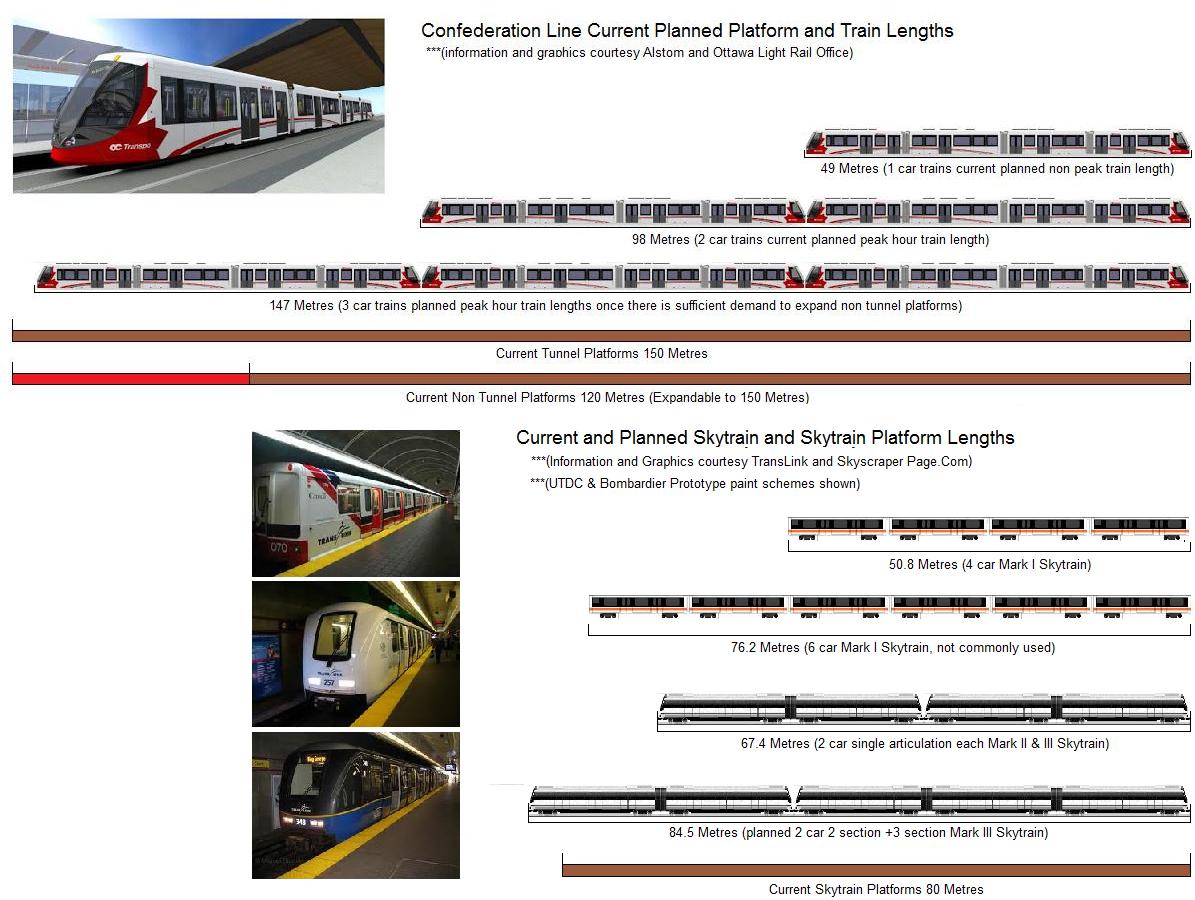
The LRT/SkyTrain capacity debate is more ludicrous as in revenue service, modern LRT has proven to obtain higher capacities than SkyTrain. The City of Ottawa rejected SkyTrain, in favour of modern LRT, due to its lack of capacity. The notion that SkyTrain has a higher capacity than LRT is based on 1970’s studies in Toronto, comparing ICTS (early version of what we call SkyTrain) with 40 year old PCC streetcars and not modern articulated light rail vehicles. For comparison, a modern tram has the same capacity of four car train of MK.1 stock. Modern trams, operating in coupled sets, would give a higher capacity than a six car train of SkyTrain MK. 1 stock or a four car train of MK. 2 stock.
SkyTrain’s capacity is also constrained because of its small 80m station platforms, which limits SkyTrain’s practical capacity to its contracted 15,000 persons per hour per direction. Most modern LRT station platforms are now 120m in length and the City of Ottawa is designing its stations with 150m station platforms to accommodate even longer trains. A SkyTrain subway would be limited to 15,000 pphpd unless all SkyTrain station platforms were extended by at least 40m, which would increase the cost of a Broadway SkyTrain subway by $1billion to $1.5 billion!
Modern LRT is both a ‘Green’ and economic. Green because is leaves a small carbon footprint and its proven ability to attract the motorist from the car. Economic because LRT greatly reduces operating cost of the transit route. One modern tram or streetcar (1 driver) is as efficient as six buses (6 bus drivers) and with wages accounting for about 80% of a transit systems operating costs, the economy of LRT replacing buses is easy to see. Even though SkyTrain is driverless, it still has more employees than comparable LRT operations making it about 40% more expensive to operate and SkyTrain needs buses to shuttle passengers between widely spaced stations. Operating SkyTrain only drives up operating costs of a transit route, not reducing operating costs as does modern LRT.
Subways are notorious for their high energy use as the cost of electricity to power lights, elevators, escalators, and ventilation is about the same as the electricity consumed by the subway trains themselves.
Doorstep to doorstep journey times on subways, with widely spaced stations, are only faster than LRT (with stops every 500m to 600m) if the journey greater than 7 km. The Hass-Klau International Study “Bus or Light Rail – Making the right Choice” found that transit speed was not as important as many would like us to think, as the study found that the ambiance and ease of use of a transit system far outweigh speed in customer importance. Subways are notorious in not attracting new customers and in fact, in some cases, forced transit customers back into their cars! Modern LRT has an opposite effect as it actual attracts new customers to transit. In South Delta, the forced transfer from bus to the Canada Line has deterred ridership to such an extent that suburban bus services have been reduced to post Expo 86 days.
The Canada Line, despite the hype and hoopla, has only 40m to 50m long station platforms, which can only accommodate two car trains, which means the Canada Line was at capacity the day it was built! Internationally, the Canada Line is seen as a “White Elephant”, as it is the only heavy-rail metro in the world, built as a light-metro, which has less capacity than a streetcar costing about one tenth to build!
SkyTrain was first conceived to mitigate the high cost of subway construction in Toronto, at a time when the heritage streetcar system was facing expensive major renewals or abandonment. In 1978, as SkyTrain’s development proceeded, the world’s first new-build LRT system opened in Edmonton. Today, only seven Skytrain systems have been built (only three used seriously for urban transit), has been marketed under five names; ICTS, ALRT (two versions) ALM, and now ART. During the same period, over 150 new LRT systems have been built and scores more are either under construction or in the final stages of planning. Not one SkyTrain type system has ever been allowed to compete against modern LRT. There are now over 500 LRT/tram systems in operation around the world, with one the newest LRT systems being built in Beijing.
I see SkyTrain and subway planning as pure Lysenkoism (Lysenkoism is used metaphorically to describe the manipulation or distortion of the scientific process as a way to reach a predetermined conclusion as dictated by an ideological bias, often related to social or political objectives.) to subsidize land speculators and land developers who have assemble properties at potential subway stations. SkyTrain subway planning is not about building a sustainable transit system for the future and in fact the massive construction costs of a subway, coupled with equally massive maintenance costs will make it impossible to fund future transit investment in Metro Vancouver, especially in Surrey, Langley, and North Delta.
If no other transit authority is building with SkyTrain, why are we? When subways are not considered until ridership is at least three times what Broadway is currently carrying in the peak hour, why are we planning for a subway?Sincerely
D. M. Johnston
Complaints Up and Service Down At TransLink

Nothing new here as TransLink fumbles along trying to operate the Transit system.
The important question is: “Should we pay more taxes for more of the same?”
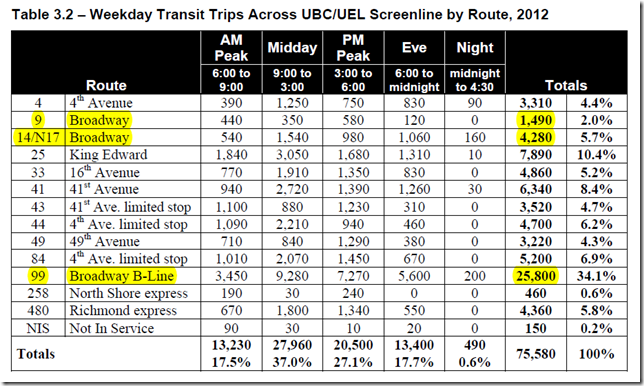
The problem with Translink is that transit operation is not provided on a sound economic model, rather the hocus-pocus model of SkyTrain and densification. Vancouver is unique in not providing adequate transit on high demand routes and operates scores of buses on politically inspired routes, which cater to the very, very few. Broadway is a good example; if ridership is down, why is there overcrowding and daily pass-ups on the 99-B Line route, while the 609 (Wally-Wagon) in South Delta, operates a daily hourly service that carries less than 20 passengers a day? This is example is compounded by the fact there are two other bus services in South Delta that carry less then 20 passengers a day!
TransLink’s real problem is management, or the lack of and throwing more money at this grandiose bureaucracy is just like flushing money down a toilet.
TransLink got 31,595 complaints about transit service in 2013
Last year, Metro Vancouver’s transportation authority received a total of 36,390 complaints, up from 32,617 in 2012.
The number of transit-related complaints went up about 10 percent, to 31,595 in 2013 from 28,408 in the previous year.
TransLink released today (April 3) its 2013 statutory annual report, which contains a complaints summary.
The report notes that the ratio of complaints per 1,000,000 boarded passengers rose to 88.9 from 78.2.
Why? “Some of the key reasons for this increase include: changes to the Fare Tariff policy that saw elimination of longstanding fare programs (WCE monthly and weekly passes, Employer Pass Program), a technical issue for SkyTrain in October that caused significant delays for customers, service optimization changes and a controversial advertising campaign that ran on the TransLink system,” the report states.
Transit service and ridership both decreased in 2013. Service hours were tightened to 6.792 million from 6.927 million. Boarded passengers declined to 355.2 million from 363.2 million.
By the way, of the transit-related complaints, 28,494 pertained to the Coast Mountain Bus Company, 1,526 to HandyDART, 599 to the West Coast Express, 551 to the Expo and Millenium lines, and 425 to the Canada Line. (CMBCAi??operates the SeaBus.)
Regarding the Coast Mountain Bus Company, a little more than half of complaints related to staff and a third to service.
As for TransLink’s customer service performance ratings, this is what the report says about the transit system: “In 2013, six out of ten transit riders, or 60 per cent, gave the system good-to-excellent scores of 8, 9 or 10 out of 10 for overall service. This is down from 2012 (63 per cent) suggesting that overall perceptions of service quality have declined.
“Similar to 2012, the transit system service attributes that customers are most critical of include: the amount of transit information available at stops and stations and on-board buses; as well as the number of bus shelters available throughout the region. Less than half of customers consistently rate these aspects of transit service as being good to excellent (8 or higher out of 10). In addition, less than half (44 per cent) of TransLinkai??i??s customers feel they are getting good-to-excellent value for the money they spend on transit, this also is down slightly from 2012 (48 per cent).”
TransLink can look forward to more complaints in 2014 with the delayed rollout of the Compass card system.



Recent Comments